
I’ve been writing about House of the Dragon longer than the show itself has existed. Maybe that’s why my relationship with Westeros feels a little different from being part of the online fandom. Watching the changes the adaptation made compared to Fire & Blood, I didn’t always agree with them, but I was never the kind of reader who demanded a literal recreation of every scene. Honestly, I think I was lucky to watch Game of Thrones before reading George R. R. Martin’s books. I experienced many of those major narrative shocks as genuine surprises. Today, that feels almost impossible.
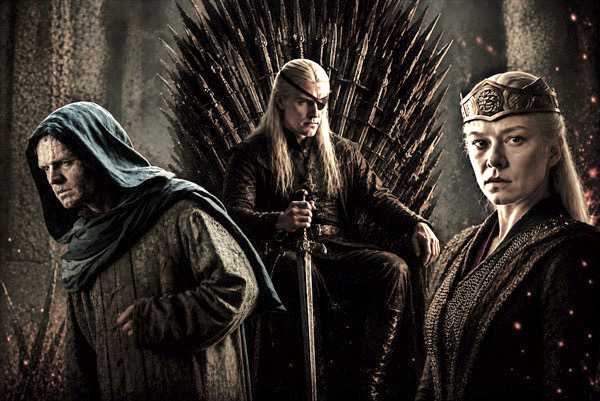
Even people who have never opened Fire & Blood probably already know how this story ends — tragically, especially for Rhaenyra. And yet, for years now, we’ve watched the debate become dominated by demands for specific scenes, specific battles, specific characters, as if adapting Westeros were simply a matter of completing a fandom checklist.
Maybe that’s why I feel a certain exhaustion whenever HBO and the showrunners repeat the same promotional speech every new season. Once again, we’re being told that season 3 will feature battles “like nothing we’ve ever seen,” that the war has finally begun, that everything has grown in scale. Entertainment Weekly’s traditional coverage practically functions as an official extension of the campaign, describing the Battle of the Gullet as an event comparable to Helm’s Deep in The Lord of the Rings: ships mounted on giant gimbals to simulate ocean currents, thousands of liters of water dumped onto actors, flamethrowers recreating soldiers burning alive, dragons cutting through skies consumed by smoke and fire.
It may all be visually spectacular. And it probably will be, but House of the Dragon never really had a scale problem. Its problem was always something else: understanding its characters, and that’s exactly where season 3 suddenly becomes far more interesting.
The most important statement in the entire EW feature may have come from Emma D’Arcy, who described Rhaenyra as moving “towards tyranny.” That idea doesn’t bother me at all. Quite the opposite. I’ve never been among those disappointed by Daenerys Targaryen’s fate in Game of Thrones or those who insist her “personality suddenly changed.”
To me, Daenerys was always exactly that person. Her liberator rhetoric absolutely functioned as social transformation, but it was also the construction of personal power. Dany was always deeply ambitious, populist, seductive, and progressively in love with her own myth. That was present from the very beginning. What made the character fascinating was watching someone who started as an absolute victim slowly begin to believe that destiny, morality, and personal desire were all the same thing.
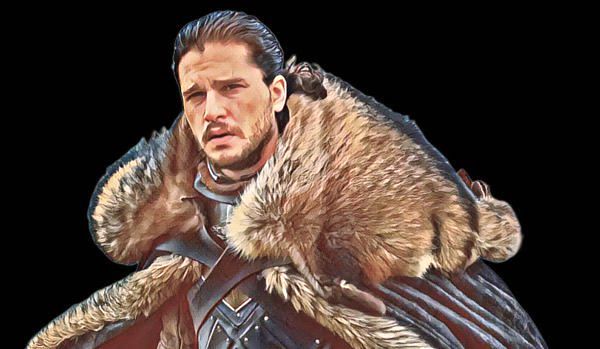
It would have been far stranger to see Jon Snow — a character who repeatedly rejected crowns, titles, and power — suddenly become obsessed with fighting for what was “rightfully his.” Daenerys’s trajectory made sense. The problem was probably the speed of its execution. And that shadow now hangs directly over House of the Dragon.
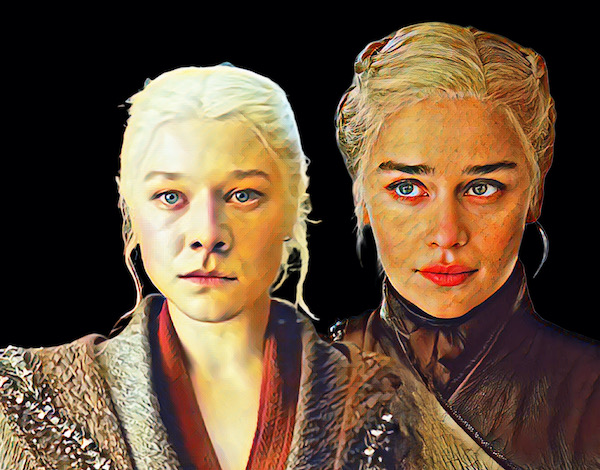
I’ve already written here on Miscelana about how deeply the series altered Rhaenyra’s historical image compared to what exists in Fire & Blood. In Martin’s text, she is often described as paranoid, cruel, resentful, and increasingly politically isolated. The show chose instead to initially portray her as a woman cornered by patriarchal structures, constantly forced to survive within a system that never intended to accept her in power.
Dramatically, that makes sense. Especially because, in the end, Rhaenyra will be the losing side of Westerosi history. And history is rarely kind to the defeated, but there’s one specific change I still consider misguided: the adaptation’s almost compulsive need to transform Rhaenyra into a more physically “active” protagonist.
Emma D’Arcy makes this clear when they explain wanting to see the character stop “apologizing” and become more directly involved in the war. I completely understand the actor’s desire. And apparently, they successfully influenced that interpretation of the character.
The problem is that Rhaenyra was never a battlefield commander. In the books, that is precisely one of the criticisms directed at her. Because she understood her role as sovereign. Others fought for her. There was a monarchical logic to her position. Rhaenyra did not need to wield swords or personally command armies to exercise power. By placing her more directly at the center of physical action and military strategy, House of the Dragon reshapes her into a far more contemporary kind of television heroine: active, operational, cinematic. That, fundamentally, alters her political nature. Still, honestly? I’ve already accepted that this is the direction the show intends to take.
And maybe that’s why I’ve become more interested in the characters the adaptation initially seemed willing to flatten into simpler villains.
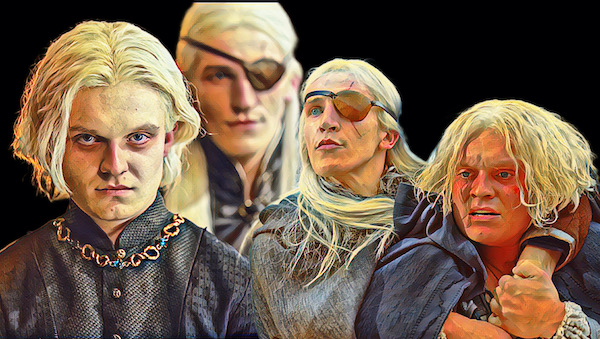
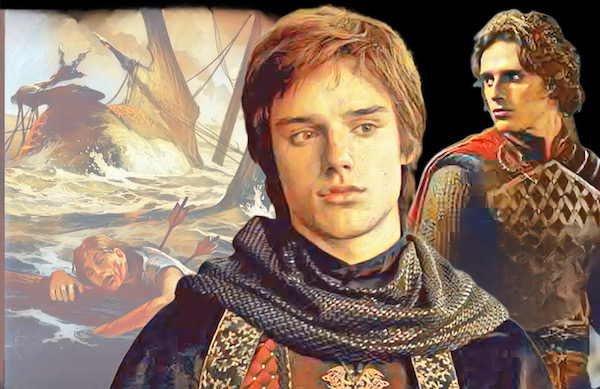
Because both Tom Glynn-Carney and Ewan Mitchell have achieved something genuinely difficult: transforming figures who could easily have become shallow antagonists into deeply tragic characters.
Tom understands Aegon as almost a permanent victim of an emotionally deformed family system. That comes through not only in the performance itself, but even in the physical stories from production: endless prosthetic sessions, unbearable heat, a body literally decaying in front of the audience. Aegon doesn’t emerge as some triumphant tyrant. He emerges as someone already destroyed before he fully understands the power he inherited.
Ewan Mitchell found something even more unsettling in Aemond. The character could easily have become the fandom’s standard “cool villain.” Instead, Mitchell plays him almost like a psychological horror figure. There’s something profoundly disturbing about Aemond because he seems permanently dissociated from his own humanity. When the actor says that House of the Dragon is “a horror TV show where the monsters are the human beings, not the dragons,” he understands Westeros better than many people discussing it online.
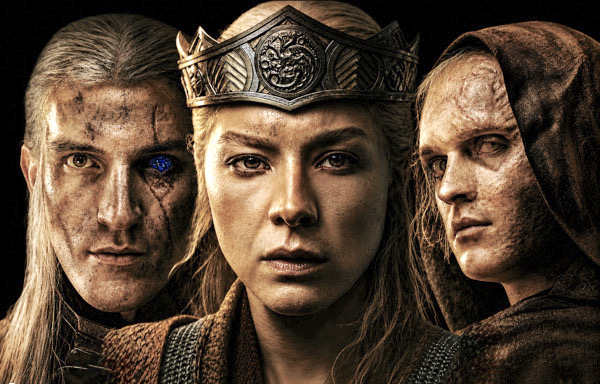
And maybe that’s ultimately what I expect from season 3. Not simply larger battles or more impressive dragons. But finally seeing House of the Dragon fully embrace what George R. R. Martin has always written best: the moment when people convinced of their own moral legitimacy slowly begin justifying atrocities in the name of supposed historical destiny.
Descubra mais sobre
Assine para receber nossas notícias mais recentes por e-mail.


1 comentário Adicione o seu