
For decades, Matt Damon probably thought he was playing soldiers, astronauts, geniuses, spies, and adventurers. Then the internet decided to look at his filmography from a different angle and reached an unexpected conclusion: Matt Damon doesn’t play heroes. Matt Damon plays men who go missing and force other people to cross wars, oceans, galaxies, and entire planets to bring them back.
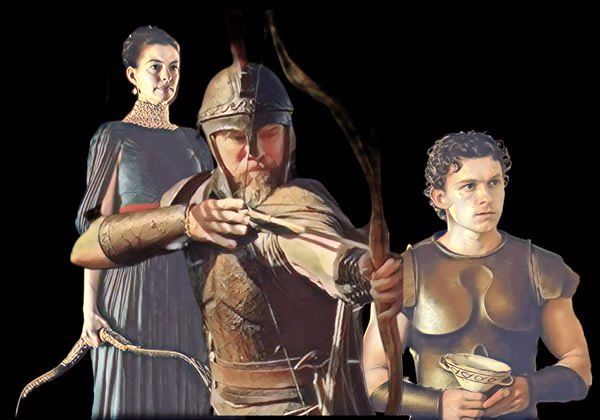
The joke resurfaced after the first images from Christopher Nolan’s The Odyssey were released. Fans quickly noticed a curious pattern. In Saving Private Ryan, the U.S. Army spends millions trying to find Private James Ryan. In Interstellar, a space mission crosses the universe to rescue Dr. Mann. In The Martian, NASA mobilizes international resources to recover Mark Watney. Now, in The Odyssey, a production with a reported budget of around $250 million follows Odysseus’s long journey home.
The viral image making the rounds online adds up the budgets of those films and concludes that Hollywood has spent nearly $600 million trying to bring Matt Damon back. The caption is even better: “Have they considered maybe he just doesn’t want to come home?”
It’s a funny observation. But it also reveals something fascinating about Hollywood.
When we think about typecasting, we usually imagine actors becoming trapped by a specific character. Christopher Reeve spent much of his career associated with Superman. Mark Hamill never entirely escaped the shadow of Luke Skywalker. Daniel Radcliffe is still first remembered as Harry Potter.
But there is a subtler version of the phenomenon. Some actors are not trapped by a role. They become trapped by an idea.
Jimmy Stewart spent decades playing an idealized version of the American everyman. Honest, loyal, kind, and morally upright. Even when Alfred Hitchcock began exploring darker shades of that image in films like Rear Window and Vertigo, the impact came precisely because audiences trusted him.
Tom Cruise built a different archetype. For more than forty years, he has played extraordinarily competent men. Pilots, lawyers, secret agents, military officers. Whatever the profession, audiences walk into the theater knowing that sooner or later Tom Cruise will run toward danger and save the day.
Matt Damon occupies a different space.
His career was never built around invulnerability. Since Good Will Hunting, there has been something approachable about his screen presence. Damon projects intelligence without arrogance, competence without perfection, and heroism without grandeur. Audiences believe his characters can solve complex problems, but they also believe those characters might get lost along the way.
That may be why the joke works so well.
Nobody would make the same meme about Arnold Schwarzenegger. Nobody would look at Dwayne Johnson’s filmography and conclude that the world is constantly trying to find him. Those stars built their personas around strength and certainty. Matt Damon, by contrast, feels human. When he gets stranded on Mars, we believe it. When he disappears during a war, we believe it. When he gets lost in a distant galaxy, we believe that too.
And Hollywood keeps finding new ways to put him in those situations.
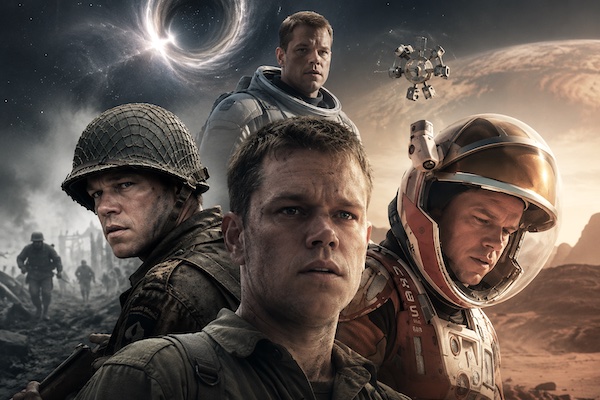
What’s particularly interesting is that the films featured in the meme don’t even belong to the same genre. Saving Private Ryan is a war drama. Interstellar is philosophical science fiction. The Martian is a survival adventure with a comic edge. The Odyssey will be a mythological epic. Yet all of them share a remarkably similar structure: the story exists because someone needs to find Matt Damon.
In a way, he has become the inverse of the traditional hero.
The classic hero embarks on a journey to save someone else. A Matt Damon character is often the reason the journey happens in the first place. Tom Hanks crosses war-torn Europe to find him. Matthew McConaughey travels across space to find him. Jessica Chastain leads a mission to bring him home. Now Christopher Nolan is preparing yet another odyssey centered on his return.
No studio planned this. No agent sat down and decided that Matt Damon should become the most frequently rescued man in movie history. The pattern emerged organically over decades until the internet finally noticed it.
And perhaps that’s the best part of the story.
Hollywood spent years selling Matt Damon as one of the defining heroes of his generation. Audiences looked at the exact same filmography and reached a different conclusion.
He’s not exactly the hero.
He’s the mission.
Descubra mais sobre
Assine para receber nossas notícias mais recentes por e-mail.

