
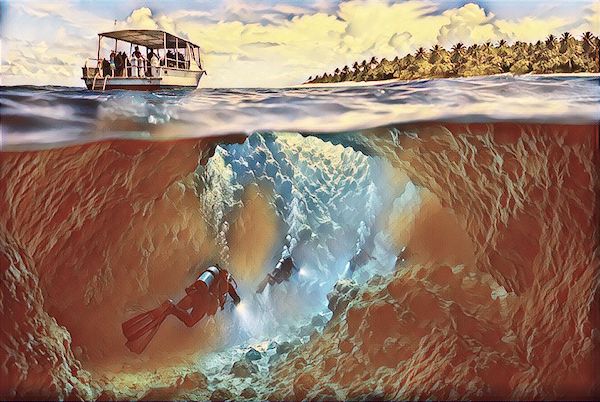
In recent weeks, very different tragedies have sparked similar waves of shock and collective grief. In Brazil, the brutal death of the young girl thrown from a bridge prompted millions to search for answers to a crime as violent as it was difficult to comprehend. Also in Brazil, just a few miles from where I live, the collision between two helicopters that killed American singer Oliver Tree triggered a similar sense of disbelief. In the Maldives, the deaths of five Italian divers during an expedition into underwater caves in Vaavu Atoll also attracted enormous international attention. And in recent years, stories such as that of the Brazilian student who fell into a volcano during a hike, the billionaires who disappeared aboard the Titan submersible, and climbers stranded on Mount Everest have all produced something in common. Millions of people followed the updates, searched for explanations, debated theories, and tried to understand how such terrifying stories could unfold.
Despite their completely different circumstances, all of these cases shared something in common: the collective feeling that they simply should not have happened.
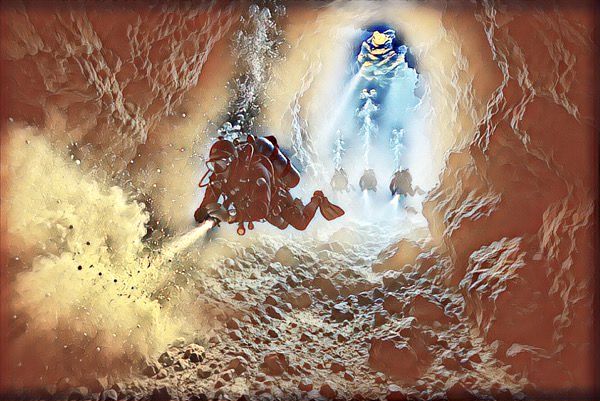
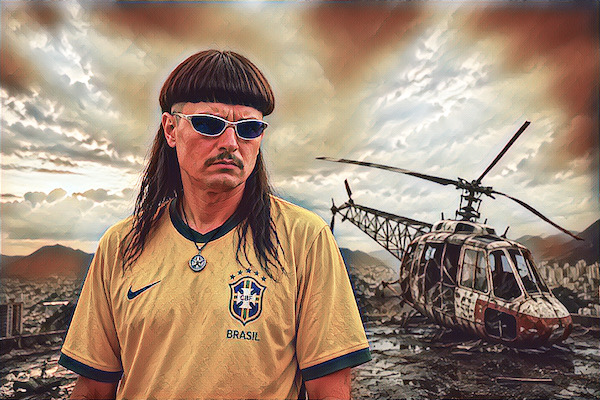
While we never witnessed the final moments of the Italian divers — whose cameras were recovered but whose footage was never released — the death of Maria Eduarda Rodrigues de Freitas, the 21-year-old physical education student who was participating in a rope jump activity in Limeira, Brazil, was captured by witnesses and shared across countless social media accounts and platforms. In an age in which nearly all of us carry cameras in our pockets, horror has ceased to be merely a news story and has become a shared experience unfolding in real time. Those who are present record events, others repost them, commentators analyze them, and millions follow along simultaneously. In one way or another, everyone becomes a reporter, a detective, and a commentator.
Faced with this, an inevitable question emerges. Why do we keep watching? Why do we read every update, search for new details, and debate theories, even when these stories are painful and often unbearable?
The simplest answer would be to attribute this fascination to morbidity. Psychoanalysis, however, might ask a different question. What if what we call morbid curiosity is, in fact, a form of identification?
At first glance, the idea sounds absurd. After all, no one wishes to become the victim of an accident or a tragedy. But perhaps it is not death itself that we recognize in these stories. Perhaps it is the desire that came before it.
The Italian divers did not embark on their expedition in search of death. They were seeking beauty, adventure, and discovery. The passengers aboard the Titan did not want to disappear at the bottom of the ocean. They wanted to witness the most famous shipwreck in history. The Brazilian woman who fell into a volcano was not seeking her own end, but the experience of an extraordinary landscape. Maria Eduarda Rodrigues de Freitas wanted to experience a moment of adrenaline. Even the climbers who challenge Everest and the astronauts who venture into space are driven by something deeply familiar to us all: the desire to go farther.
Perhaps that is precisely what fascinates us. Not death, but life pushed to its limits.

Freud believed that human beings are not motivated solely by the pursuit of pleasure and safety. There is within us a paradoxical relationship with risk and with boundaries. Not because we wish to die, but because there is something profoundly human in the desire to explore, discover, challenge, and transcend limits.
Lacan would argue that human desire is never completely satisfied. There is always something beyond. A higher mountain, a more distant journey, a more intense experience, a mystery yet to be solved. Perhaps that is why we explore oceans, cross deserts, climb mountains, and dream of reaching Mars. Not because we are suicidal, but because we refuse to live entirely within boundaries.
This is why certain tragedies affect us so deeply. They represent the collapse of a fantasy we all share: the fantasy that it is possible to go deeper, higher, or farther and still return to tell the story.
Ernest Becker, author of The Denial of Death, believed that much of human experience is built around the attempt to forget our own mortality. We live as though accidents happen to other people. As though we are the exception. As though the rope will hold, the helicopter will land safely, the submersible will return, and the mountain will allow us to come back down.
Perhaps that is why we search so obsessively for explanations. We want to believe there was a specific mistake, an identifiable error, or a bad decision. Because the alternative is far more frightening: accepting that life contains far more chance, vulnerability, and unpredictability than we would like to admit.
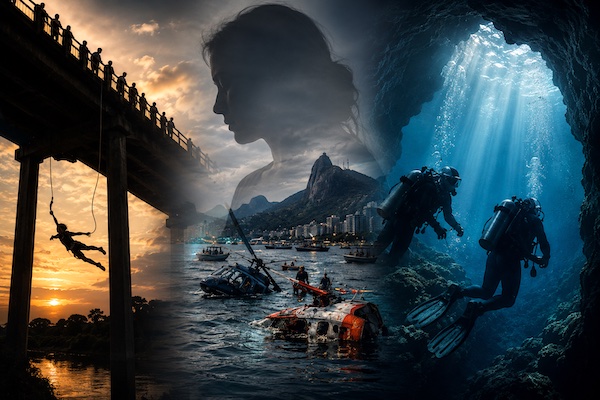
In the end, perhaps we do not follow these stories simply because we are morbid. Or at least, perhaps morbidity is not the opposite of identification. Perhaps it is one of its forms.
From Icarus to polar explorers, from astronauts to mountaineers and modern adventurers, humanity seems to tell the same story over and over again: the story of men and women who insist on approaching the impossible.
And perhaps that is why certain tragedies continue to haunt us. Because they do not merely show us how people die. They remind us how all of us choose to live: silently believing that it will be possible to challenge limits and return safely.
Perhaps what we call morbid curiosity is simply the name we give to something far more uncomfortable. In these stories, we do not see only victims. We see an amplified version of our own desires. And it is precisely this identification that makes horror so difficult to look away from.
Descubra mais sobre
Assine para receber nossas notícias mais recentes por e-mail.

