
As published on Blog do Amaury Jr./Splash UOL
Long before streaming platforms transformed the way we watch movies and series, Brazil had already embraced the invention that would change 20th-century culture. The country’s first film screenings took place in 1896, just months after the Lumière brothers’ historic presentations in Paris. Yet June 19 became established as Brazilian Cinema Day. The date refers to the images Afonso Segreto is believed to have filmed of Guanabara Bay in 1898, traditionally considered the first motion pictures shot on Brazilian soil.
More than a century later, the occasion arrives at a particularly symbolic moment. One year after the Brazilian film industry earned its first Academy Award, the national cinema is experiencing a period of renewal and greater international visibility. More than an isolated achievement, the Oscar helped increase public interest in Brazilian productions and reinforced the prominence of a film industry that, for decades, alternated between periods of prestige, financial difficulties, revivals, and recurring debates about its own future.
The truth is that this recognition did not emerge overnight. In recent years, Brazilian productions have become regular presences at festivals such as Cannes, Venice, and Berlin, while films and series from the country have found new audiences thanks to streaming platforms. Globoplay, Netflix, Prime Video, Disney, Max, Mubi, and Looke have expanded access to a national cinema that, for many years, depended almost exclusively on theatrical releases. At the same time, services such as Telecine and Canal Brasil continue to play an important role in preserving and showcasing classics and independent productions.

This momentum is also reflected in the diversity of projects currently in development. The second half of 2026 promises a mix of nostalgia, biographical stories, and crowd-pleasing productions. Among the most anticipated releases is If I Were You 3, which marks the return of the beloved franchise starring Tony Ramos and Glória Pires nearly two decades after the previous installment. The new story follows Cláudio and Helena in a different stage of life, now alongside their daughter Bia, who has grown up and married, until an unexpected event once again forces the entire family to literally put themselves in someone else’s shoes.
Another highlight is 100 Days, directed by Carlos Saldanha and inspired by Amyr Klink’s historic crossing of the South Atlantic. Written by Elena Soarez and Thais Tavares, the film transforms the maritime adventure into an intimate journey through fear, solitude, and memory. Looking ahead, the calendar already includes Our Home 3 – Eternal Life, scheduled for January 2027, as well as In the Ogre’s Garden, starring Alice Braga.
If there is one characteristic that defines Brazilian cinema in 2026, it is diversity. Popular films coexist with arthouse productions, documentaries, animation, dramas, comedies, independent features, and projects designed for streaming platforms. There is no longer a single portrait capable of representing Brazilian filmmaking, and that plurality may be one of the clearest signs of its maturity.
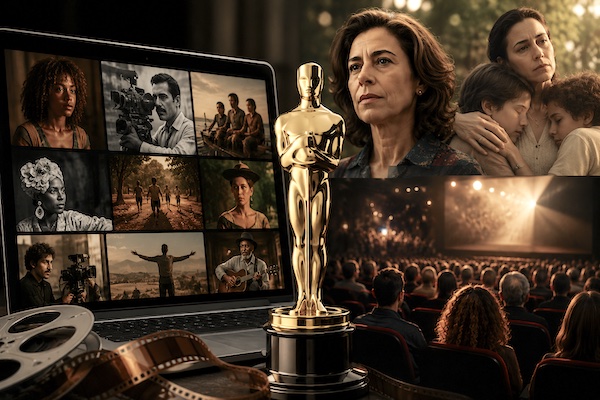
More than 125 years after the first images were recorded in the country, Brazilian Cinema Day in 2026 is not merely a celebration of the past. It is also an opportunity to observe how an industry accustomed to surviving crises and reinventions continues to find new ways of telling stories. Following the historic Oscar won in 2025, those stories seem to be receiving a level of attention and enthusiasm not seen in a very long time.
In the end, the best way to celebrate the date remains the simplest one: watching a Brazilian film. Whether in a movie theater, at home, or on a streaming platform, every new viewer helps ensure that the tradition that began in the 19th century keeps moving forward.
Descubra mais sobre
Assine para receber nossas notícias mais recentes por e-mail.

