
There is something extraordinary about Mel Brooks turning 100 while still talking about his next project. In an industry obsessed with youth, novelty, and the constant replacement of its own icons, Brooks reaches his centenary occupying a remarkably rare position: that of a legend who refuses to become merely a memory. While Hollywood devotes itself to celebrating his legacy, he continues to work.

The timing could not be more fitting. Earlier this year, HBO anticipated the milestone with the documentary Mel Brooks: The 99-Year-Old Man!, directed by Judd Apatow and Michael Bonfiglio. What could have been a conventional tribute ultimately became something far more interesting: the portrait of an artist who, at 99 years old, had absolutely no intention of bringing his story to an end. Across more than three hours, Brooks revisits a career that has become almost inseparable from the history of modern American comedy itself. It is essential viewing.
Born Melvin Kaminsky in Brooklyn in 1926, Brooks has lived through virtually every transformation in the entertainment industry. He served during World War II, became a writer on Sid Caesar’s legendary Your Show of Shows alongside figures such as Carl Reiner, Neil Simon, and Woody Allen, helped invent the language of modern television, and then went on to redefine film comedy.
His body of work remains one of the most impressive in the history of humor. The Producers turned Nazism into an object of ridicule when few would have dared. Blazing Saddles used the Western genre to dismantle American racism. Young Frankenstein reinvented the classic Universal horror films with a visual elegance rarely seen in comedy. Spaceballs proved that no cultural franchise was too large to escape its satire. Brooks never simply made parodies. He demonstrated a profound affection for the genres he was dismantling.
The documentary also devotes considerable attention to the more melancholy aspect of his longevity: the people left behind. The loss of Anne Bancroft, his partner of more than four decades, remains what his family describes as the greatest blow of his life. His son, Max Brooks, has said that after the actress died in 2005, “all the light went out” for his father. And yet, once again, humor became a mechanism for survival.
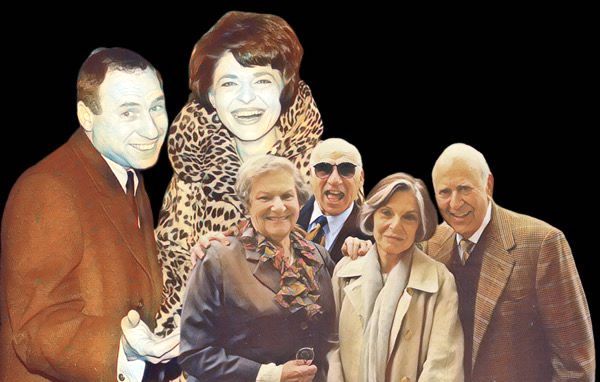
In recent years, Brooks has also witnessed the passing of some of the friends who helped shape his extraordinary career. The HBO documentary ultimately captured the final interviews given by David Lynch and Rob Reiner before their deaths, transforming what began as a celebration of Brooks’s career into an unexpected meditation on aging, friendship, and endurance.
And perhaps that is the most remarkable part of this story. At 100 years old, Mel Brooks is not merely being honored. He is still creating. In 2026, he became executive producer of Very Young Frankenstein, a series derived from one of the most beloved films of his career, by Stefani Robinson and Taika Waititi, which is currently in development. The idea that, a century after his birth, Brooks is still overseeing a new generation of jokes about Frankenstein sounds absurd. It is also entirely appropriate.
Perhaps that is because Mel Brooks has never believed that aging means giving up curiosity, irreverence, or the ability to laugh at the absurdity of existence. Few artists survive long enough to become institutions. Fewer still manage to remain fully human afterward.
At 100 years old, Mel Brooks continues to do exactly what he has always done: transform fear, loss, and the passage of time into one enormous and irresistible joke.
Descubra mais sobre
Assine para receber nossas notícias mais recentes por e-mail.

