
As published on Caderno B+
In 2016, Moana felt like something rare for Disney: a film that was both traditional and revolutionary. Traditional because it embraced the studio’s classic formula — a young heroine, unforgettable songs, a journey of self-discovery, and a breathtaking visual world. Revolutionary because it did so through an unprecedented level of collaboration with Polynesian cultures, introducing Disney’s first Polynesian protagonist and telling a story that completely dispensed with romance. The result was a box office success approaching $700 million, multiple award nominations, and, perhaps most importantly, an extraordinary second life on streaming platforms, turning Moana into one of the most-watched titles in Disney+ history.
Ten years later, Disney returns to the same story in live action. And perhaps the first question is inevitable: why?

The easiest answer would be to point to the studio’s ongoing fascination with revisiting its own catalog. After all, Disney has always operated in cycles: animation, live action, a return to animation, and then another wave of live-action remakes. But Moana may reveal something more interesting about contemporary filmmaking. We have reached a point where the very thing that once justified animation — the impossibility of bringing certain fantasies to life with human actors — no longer exists.
Heihei is still cross-eyed. The ocean is still alive. Maui still performs impossible feats. And almost none of that now requires animation to work. If we once animated because we could not film these worlds, we now film because we can recreate virtually anything.
There is another historical factor at play. Since Robin Williams’ iconic performance as the Genie in Aladdin, Hollywood has understood the commercial value of celebrity voice casting. However, the temptation to eventually pair those famous faces with the voices has always remained. A few examples make that transition feel as inevitable as Dwayne Johnson.
I tend to be quite traditional when it comes to adaptations. I am usually deeply skeptical of remaking films that already worked perfectly well. But Moana does something that many of its recent predecessors avoided: it respects its source material.
The framing is there. The camera movements are there. The visual effects are there. The songs are there. At times, the experience feels less like watching a new adaptation and more like witnessing an almost archaeological reconstruction of the 2016 animated film.
And honestly, if it worked so well before, why shouldn’t it work just as well now?
Ten years is not exactly a long time. But perhaps it is enough time to realize how much the world has changed. An entire generation grew up watching Moana repeatedly on streaming platforms. Children who discovered it on tablets are now teenagers. Parents who introduced it to their children have turned it into a family tradition. Revisiting it in live action feels less like an exercise in nostalgia and more like a confirmation of permanence.
That is because Moana still carries some of the most beautiful messages Disney has produced in this century: the search for identity, responsibility toward one’s community, reconnection with ancestry, and the courage to embrace who we truly are. None of those ideas required updating or correction.
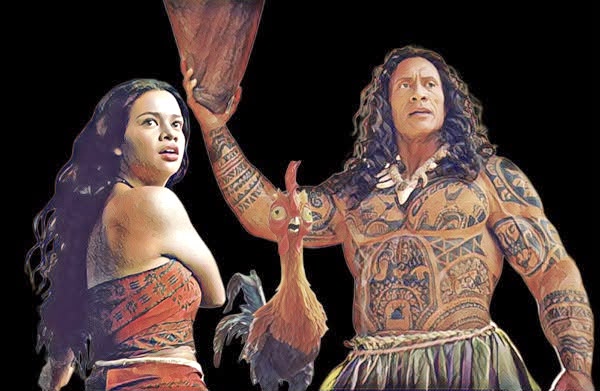
For those who have already seen the animated film, the experience is surprisingly comforting. It feels as rewarding as revisiting a film you never really stopped watching. And honestly, I don’t know many people who have only watched Moana once.
There is, admittedly, one small discomfort that animation managed to disguise more effectively: the age difference between Maui and Moana becomes more noticeable when drawings are replaced by real actors. But even that concern fades in the face of Dwayne Johnson’s almost overwhelming charisma.
And perhaps nobody else could have played this role.
For Johnson, Maui was never just another character. The demigod was conceived in part as a tribute to his grandfather, the legendary Samoan chief Peter Maivia. Throughout the film’s promotion, Johnson has repeatedly described Maui as perhaps the most personal role of his career. And that sincerity shows. There is something genuinely affectionate about his performance — an almost childlike joy in finally physically embodying a character he helped turn into a global icon.
In the end, Moana may represent the strongest argument Disney has yet made in defense of its own live-action remakes: not every adaptation needs to justify its existence by reinventing what already worked. Some exist simply to remind us why we fell in love with a story in the first place.
The film arrives in theaters on July 8, once again boosting interest in the original animated feature on streaming platforms and appearing poised to dominate the global box office. And this time, that feels less like a Disney strategy and more like an inevitability.
Descubra mais sobre
Assine para receber nossas notícias mais recentes por e-mail.

