
“Is it safe?”
Few questions have caused as much fear in the history of cinema. Removed from its context, it sounds almost ordinary. Is it safe? Is everything all right? Can we proceed? Repeated by Laurence Olivier as Dustin Hoffman sits trapped in a dentist’s chair, it became a threat capable of haunting generations.
Fifty years later, it may still be the perfect summary of Marathon Man: a film about people who believed they had survived the past, only to discover that the past had not disappeared. It was simply waiting for an opportunity to return.
Released in 1976, the thriller directed by John Schlesinger and written by William Goldman from his own novel belongs to one of the most extraordinary years in American film history. It was also the year of Taxi Driver, Network, Rocky, and All the President’s Men, films that, in different ways, attempted to understand a violent, exhausted country that had become profoundly suspicious of its own institutions.
Even among such an impressive group, Marathon Man occupies a place of its own. None of the others turned political paranoia into such an intimate, physical, and painful experience. It is not enough to discover that the government lies, that intelligence agents conceal information, or that the people closest to us may not be what they seem. In Marathon Man, History enters the home, crosses the family, and reaches the body.
The film does not merely ask whether we can trust governments, intelligence services, lovers, or our own siblings. It asks whether any place can truly be safe while buried crimes continue to produce money, power, and silence.
A man running from the past
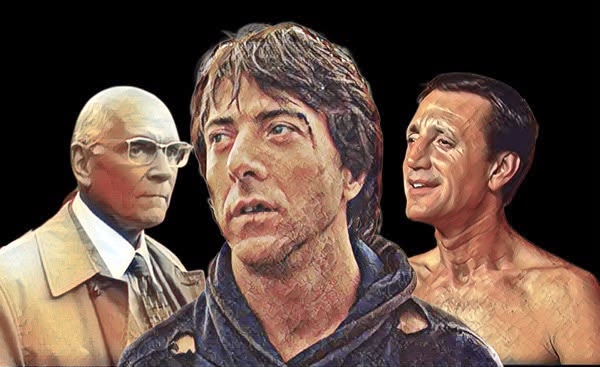
Dustin Hoffman plays Thomas “Babe” Levy, a Columbia University History doctoral student researching the presence of tyranny in American political life. His subject is not merely an academic choice. His father’s career and reputation were destroyed during the McCarthy era, eventually leading him to take his own life. Babe is trying to clear his name, as though understanding that persecution might finally bring order to his family’s history.
His older brother, Henry “Doc” Levy, played by Roy Scheider, wants him to leave the past behind. For Doc, continuing to investigate their father means remaining trapped by a man he prefers to describe as weak, alcoholic, and suicidal. For Babe, abandoning the subject would mean accepting the version created by the people who destroyed him.
The brothers have chosen opposite ways of confronting the same wound. Babe looks for answers in books. Doc chooses action, secrecy, and power.
Babe also runs. He is training for a marathon, but running is more than a convenient preparation for the chases that will follow. It reveals something essential about him. Babe runs because he believes he can control his own body when everything else feels beyond his control. He runs to organize his anxiety, test his limits, and perhaps escape a family legacy he does not yet know how to carry.
The title, therefore, acquires a much greater meaning. Babe is not simply preparing to finish a race. His entire journey is an extended endurance exercise.
The film uses footage of Abebe Bikila, the Ethiopian athlete who won the 1960 Olympic marathon in Rome running barefoot, and Babe keeps photographs of legendary distance runners in his room. His ideal is not simply speed, but resilience, discipline, and the capacity to continue through pain.
The camera runs with him. Marathon Man was among the first feature films to use Garrett Brown’s newly developed Steadicam. The equipment allowed Schlesinger to follow Hoffman through the streets without sacrificing the stability of the image. We do not watch Babe run from a distance. We are forced to move beside him, as though New York itself were a living labyrinth breathing down his neck.
The technology is not there merely to display an innovation. It places the character’s anxiety inside the movement of the film.
The past returns on Yom Kippur
It hardly seems accidental that Marathon Man begins on Yom Kippur, the Jewish day of atonement, repentance, and repair.
While Babe runs in Central Park, Klaus Szell retrieves from a bank vault a container connected to the diamonds belonging to his brother, Christian Szell. Soon afterward, Klaus is killed in a car collision, forcing Christian to leave his hiding place in Uruguay and travel to New York.
The choice of Yom Kippur creates an extraordinary irony. The film begins on a day associated with acknowledging guilt, just as a criminal who has never shown remorse returns to collect the profits of his crimes.
Christian Szell does not return to confess, repair the damage, or ask for forgiveness. He returns for his diamonds.
The character played by Laurence Olivier is a Nazi war criminal who accumulated wealth from the suffering of Jewish people during the Holocaust. The regime collapsed, the war ended, and decades passed, but the diamonds remain protected inside an American bank.
The victims died. The money survived.
This is one of the most disturbing elements of Marathon Man. Szell does not come to the United States to rebuild Nazism or lead a political movement. Evil reappears as property. Historical horror has been converted into private wealth, protected by vaults, institutions, and silent arrangements.
The film understands that the past does not disappear simply because survivors have grown old, documents have been archived, or criminals have found new addresses. It remains alive in accumulated wealth, false identities, and networks of protection that allow the guilty to be treated as useful collaborators.
The government did not lose Szell. It negotiated with him
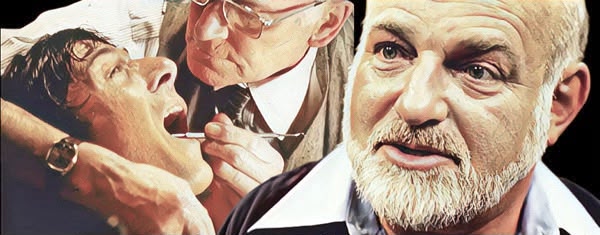
Babe believes that Doc works in the oil business. After his brother is murdered, he discovers that Doc was employed by a secret government agency known as the Division.
The most troubling revelation, however, is not Doc’s real profession. It is the nature of his work.
Doc served as an intermediary in an arrangement with Szell. He transported the criminal’s diamonds to Paris while Szell provided information to the Division. The American government had not failed to locate him. It knew where he was and had decided to use him.
This completely changes the film’s political dimension. The state does not ignore evil. It negotiates with it.
Szell remains protected not because no one knows his identity, but because he is still considered useful. Justice is replaced by pragmatism. His crimes matter less than the information he may still provide.
Marathon Man emerged in the years after Watergate, at a moment when American cinema was deeply interested in the secret structures of power. Yet its criticism goes beyond a generalized mistrust of government. The film depicts an institution willing to allow a Nazi criminal to retain his freedom and move a stolen fortune as long as the arrangement produces some strategic benefit.
Impunity is not presented as an accident. It is presented as policy.
Doc is not simply a heroic older brother trying to protect Babe. He is part of that system. Even if he had begun to question the arrangement or attempted to alter its terms, he participated in the operation that kept Szell safe.
Both brothers live beneath the weight of History, but they have chosen very different ways of relating to it. Babe tries to expose an injustice. Doc has learned to live with the dark compromises of power.
Neither choice protects them.
When even love is part of the conspiracy
While working on his dissertation, Babe meets Elsa Opel, played by Marthe Keller. She seems to offer a life that does not depend on his father, Doc or his research. His academic work came from the family. So did the pain. Elsa, by contrast, appears to be something Babe chose for himself.
That is precisely why her betrayal is so cruel.
The couple is mugged in Central Park by men wearing suits, an odd detail that immediately draws Doc’s attention. The attackers work for Szell. Babe later discovers that Elsa lied about her origins and was also serving as a courier within the conspiracy.
Elsa invades the only part of Babe’s life he believed belonged entirely to him. The danger came through his brother. The trauma came from his father. Love, however, seemed to be his own decision.
When Babe discovers that even this relationship had been planned and observed by other people, he loses more than a girlfriend. He loses the certainty that any part of his life was ever truly his.
Everyone around Babe knows more about his life than he does.
That is the central mechanism of paranoia in Marathon Man. Babe does not possess the information, understand the codes, or recognize the meaning of the questions he is being asked. He is haunted by a history he knows nothing about, despite having devoted his life to studying History.
“Is it safe?”
When Doc is mortally wounded by Szell, he manages to reach Babe’s apartment but dies before explaining what is happening. To Szell, the fact that Doc sought out his brother can mean only one thing: he must have told him something about the diamonds.
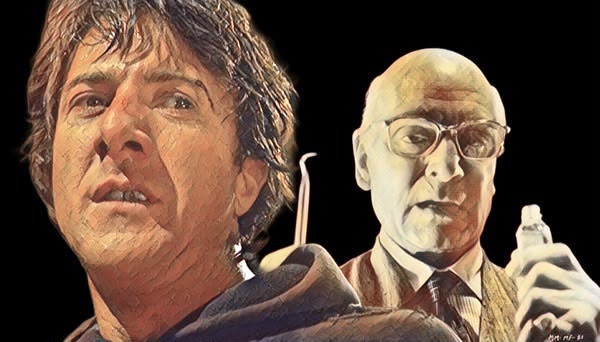
Babe is abducted and tied to a chair. Szell approaches him with dental instruments and repeats the same question:
“Is it safe?”
Babe has no idea what he wants to know.
Szell is asking whether it is safe to retrieve the diamonds from the bank. Babe understands “safe” in the most elementary sense: protected from danger, allowed to live, spared further pain. One man is asking about money. The other is trying to answer a question about survival.
The entire film is almost contained inside that misunderstanding.
Babe tries every possible answer. Yes, it is safe. No, it is not safe. Neither works because he does not know the real question.
The more he speaks, the less he understands. The less he understands, the more he suffers.
The line became one of the most famous in film history. The American Film Institute included “Is it safe?” among its most memorable movie quotations, while placing Szell among cinema’s most terrifying villains and recognizing Marathon Man as one of its most suspenseful thrillers.
Yet the scene remains almost unbearable for reasons that extend beyond the phrase. Its brilliance lies in turning a place associated with care into an instrument of violence. The chair, the light, the drill, and the metallic tools belong to an experience almost everyone recognizes. The dentist’s office should be a place of relief. It becomes a torture chamber.
The doctor, whose purpose should be to prevent pain, controls every movement to produce it.
Schlesinger does not need to recreate concentration camps or stage large scenes of war. Historical violence is condensed into an open mouth, an exposed nerve, and a man who does not understand why he is being tortured.
The sequence released in theaters had already been reduced after its violence caused a strong reaction during preview screenings. Even in its shortened form, it became one of the most difficult scenes to watch in 1970s American cinema.
Laurence Olivier and the delicacy of evil
Laurence Olivier builds Szell without relying on the easiest excesses of a great screen villain. He does not shout constantly, deliver long speeches, or display flamboyant pleasure in torture. He is precise, economical, and almost gentle.
That calm is exactly what makes him terrifying.
Szell does not regard himself as a monster. He behaves like a man accustomed to exercising authority over other people’s bodies. Violence is not an impulse. It is a method.
Olivier told Hoffman that he found the key to the scene while watching a gardener carefully trim roses. He realized that Szell should approach torture as a craftsman approaches his tools: not with rage, but with attention, technique, and a kind of perverse tenderness.
It is an extraordinary choice. Szell never appears to lose control because he has never needed to lose control to destroy someone.
Olivier’s performance earned him an Academy Award nomination for Best Supporting Actor and a Golden Globe victory in the category.
The performance becomes even more remarkable when we remember that the actor was facing severe health problems during production. Olivier was undergoing cancer treatment, depended on powerful medication, and, according to production accounts, sometimes struggled to remember more than a few lines at a time. His condition created difficulties in securing insurance for his participation. Even so, he delivered a performance built entirely on concentration, voice, rhythm, and absolute technical control.
Hoffman later remembered Olivier as a general on a battlefield. He was ill, but if he was going to die while working, he would die acting.
“Why don’t you just try acting?”
The meeting between Laurence Olivier and Dustin Hoffman also produced one of the most famous behind-the-scenes stories in film history.
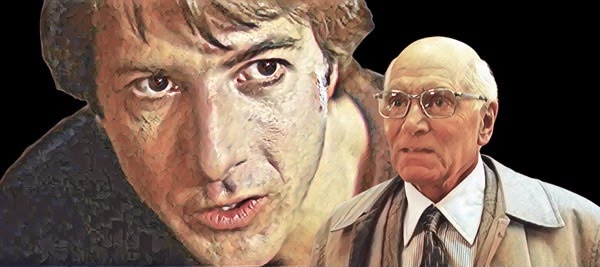
For decades, it was told as the definitive clash between two schools of performance. Hoffman, identified with the American Method, had supposedly remained awake for several nights to arrive on set genuinely exhausted. Seeing him in that condition, Olivier, the supreme representative of the British classical tradition, allegedly asked:
“My dear boy, why don’t you just try acting? It’s much easier.”
The line is too perfect not to survive. In a few words, it summarizes the public image of both men. Hoffman searches for the character’s truth through his own body. Olivier relies on technique, voice, imagination, and control.
Olivier never concealed his suspicion of an excessively literal application of Method acting. In On Acting, he essentially argued that Stanislavski could accompany the performer through study and preparation, but should not be carried onto the set as a permanent requirement for real suffering.
The story, however, is more complicated and more human than the legend.
Hoffman later explained that he had not remained awake solely in preparation for Babe’s exhaustion. He was going through a difficult period in his private life and spending his nights out. Olivier knew this. The question was an affectionate joke rather than an attempt to humiliate his colleague or destroy the American Method. The anecdote was gradually simplified until it became an almost ideological dispute.
Correcting the story does not weaken it. It makes it better.
Their encounter still represents different ways of reaching the same place. Hoffman lost weight, began running, and arrived at some scenes genuinely short of breath. Olivier selected gestures, rhythms, and images that produced the desired effect without requiring him to reproduce the character’s experience literally.
One needs to feel to act. The other acts with such precision that he forces us to feel.
Their relationship was also far removed from the rivalry suggested by the legend. After filming ended, Olivier visited Hoffman’s home, gave him a collection of Shakespeare’s works, and spent hours reading passages from the plays. Hoffman kept the memory as an example of generosity, endurance, and devotion to the craft.
Perhaps that is why they work so extraordinarily well together. Hoffman brings exhaustion into the body. Olivier transforms control of the body into a threat.
One sweats, runs, screams, and bleeds. The other watches.
The victims still recognize his face
Near the end of Marathon Man, a scene expands the film’s entire meditation on memory.
As Szell moves through Manhattan’s jewelry district, trying to determine the value of his diamonds, he is recognized by Holocaust survivors. An appraiser identifies his face. Soon afterward, an elderly woman recognizes him in the street and begins shouting for someone to stop him.
Institutions accepted his new identity. Agents negotiated his freedom. The financial system protected his fortune.
The victims did not.
They still know who he is.
It is one of the film’s great ironies. Babe studies History because he fears it will be forgotten. Szell discovers that History also has eyes — and that some of them can still recognize him in the middle of a crowd.
The criminal believed that he only needed to wait. Time would erase faces, weaken witnesses, and transform his crimes into a distant past. But memory survived alongside him.
Justice is not the first to find him. The survivors are.
What Babe throws into the lake
The final confrontation does not offer a clean victory. Babe takes Szell to the Central Park water facilities and attempts to force him to swallow the diamonds. Szell refuses. When Babe throws the case down a flight of stairs, the criminal lunges after the fortune and is wounded by his own blade. He dies trying to reach the wealth created from the deaths of others.
There is no trial. No confession. No institutional reparation.
Szell is destroyed by the same combination of greed and violence that defined his life.
Outside, Babe throws his father’s gun into the lake.
That gesture matters as much as Szell’s death. Throughout the film, Babe attempts to honor his father by reconstructing his history. In the end, he understands that preserving his memory does not require remaining imprisoned by his death.
He does not erase the trauma. He refuses to continue carrying the instrument.
Survival is not the same as healing, just as the criminal’s death cannot return the victims, restore Doc, or undo the betrayals. Babe is alive, but he is no longer the man who ran through Central Park believing that discipline, study, and distance would be enough to keep him safe.
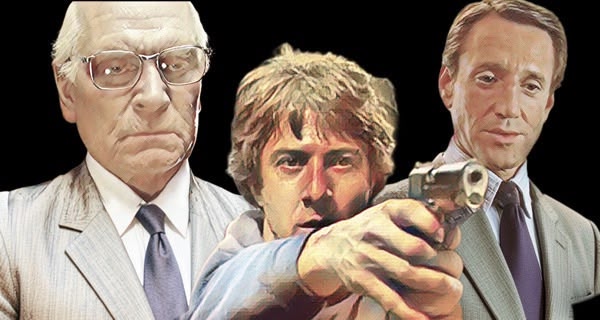
Fifty years later, is it safe?
Marathon Man is still remembered for the dentist’s chair, Laurence Olivier’s performance, and a question repeated until it becomes a threat. But its power extends far beyond that sequence.
The film is about how easily the world declares an unresolved history to be over. It is about criminals who cross borders, change identities, and preserve fortunes. It is about governments willing to coexist with evil when that coexistence appears convenient. And it is about children forced to carry what their parents could never overcome.
It is also about the illusion that knowing History is enough to protect us from it.
Babe devoted his life to studying the past and still failed to recognize that he was living inside it. Doc knew the secrets of power, but that knowledge could not save him. Elsa believed she could serve the conspiracy without being destroyed by it. Janeway thought he controlled every part of the arrangement. Szell trusted that money, silence, and time would be enough to erase his crimes.
They were all wrong.
Above all, Marathon Man understands that the past rarely returns in a grand gesture. It does not need to march through the streets again or announce its arrival. Sometimes it returns quietly, crosses an airport, enters a bank, opens a vault, and asks whether it is safe.
Fifty years later, we still do not know exactly how to answer.
Descubra mais sobre
Assine para receber nossas notícias mais recentes por e-mail.

