
In football, substitutions usually happen on the pitch. At the 2026 FIFA World Cup, however, the substitution that changed history took place far from the players, inside a stadium sound booth. It is one of those rare moments when chance is embraced by thousands of people, forever changing the meaning of both an occasion and a song.
The song planned for England’s victory was another one
When England defeated Croatia 4-2 in their opening match of the tournament on June 17, 2026, in Dallas, millions of viewers watched the players celebrating in front of their fans. What no one saw was that, at that very moment, another decision was being made behind the scenes.
The song originally scheduled to accompany England’s victory was Neil Diamond‘s Sweet Caroline. Instead, a different track took the field. Within seconds, an Oasis classic released in 1995 stopped being just another song on FIFA’s official playlist and became the unofficial anthem of the England national team: Wonderwall.
As the final whistle blew and the music echoed around the stadium, Harry Kane, Jude Bellingham, Declan Rice, and the rest of the squad joined thousands of supporters singing the now-famous chorus: “Because maybe, you’re gonna be the one that saves me… And after all, you’re my wonderwall.”
Phones were lifted into the air. Videos flooded social media. Without any official announcement, a new ritual had begun.
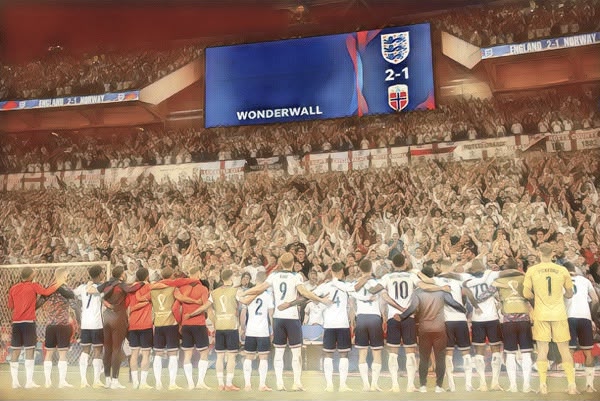
From that moment on, the scene repeated itself after every England victory. Against DR Congo. Against Mexico. And now against Norway. Rather than heading straight down the tunnel, the players stayed in front of the stands to sing with their supporters.
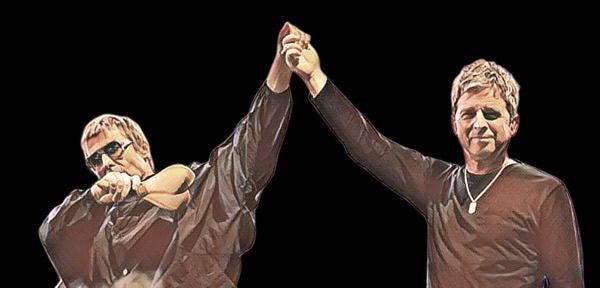
Harry Kane even joked that he finished some celebrations more hoarse than after the matches themselves. Liam Gallagher has already promised that if England wins the World Cup, he’ll personally sing for the team. After the massive success of Oasis’ reunion tour, having the band perform after a World Cup triumph would instantly become football folklore.
FIFA’s playlists and the last-minute decision
The original scene looked spontaneous because, in many ways, it was. Yet it also reveals a quiet transformation in the way modern football is produced. Today, a World Cup is no longer shaped only by what happens on the pitch. It also has a musical director.
Few people realize that FIFA spends months designing the tournament’s soundscape. National teams submit songs that represent their identity. There are dedicated playlists for player entrances, warm-ups, goals, celebrations, halftime, and post-match ceremonies. At the same time, an entertainment team coordinates everything heard by tens of thousands of fans inside the stadium. Altogether, the World Cup’s music library comprises hundreds of carefully curated tracks, designed to cater to every stage of the matchday experience.
It was within that structure that the story of Wonderwall began.
That night in Dallas, the post-match sequence had already been planned. First came Three Lions, the timeless “Football’s Coming Home.” It would then be followed by Sweet Caroline, the song that became the emotional soundtrack of England’s remarkable run to the Euro 2020 final and one of the defining anthems of Gareth Southgate’s era.
Then the script changed.
While Three Lions was still playing over the stadium speakers, Ryland Baptist, FIFA’s stadium music director, decided to alter the planned sequence. According to reports published after the match, he felt Sweet Caroline had become too closely associated with England’s previous generation and wanted something that better reflected this new squad. Hey Jude by The Beatles was briefly considered before being dismissed because it seemed too closely tied to Jude Bellingham. The choice eventually fell on Wonderwall, helped by the enormous worldwide attention surrounding Oasis’ reunion tour.
The person who executed the switch was Jesus “DJ Chuy” Salazar, the DJ assigned to the Dallas matches. Like many DJs working major American sporting events, he was not simply pressing play. His role was to manage FIFA’s music program throughout the match, adapt it to the atmosphere inside the stadium, and implement changes requested by the tournament’s entertainment team.
The substitution looked minor.
It wasn’t.
As soon as the opening chords of Wonderwall echoed across the stadium, something unexpected happened: Harry Kane started singing. Jude Bellingham joined in. Within seconds, more than sixty thousand people were singing together. A thirty-year-old song had found a completely new life.
No one had planned that.
Fans choose the anthem
The impact became obvious almost immediately.
After every England victory, Wonderwall returned. Players stayed on the pitch. Supporters sang. A tradition born almost by accident during the opening match quickly became one of the defining images of England’s World Cup campaign. Following the win over Mexico, the song’s streams surged by more than 300% in the United Kingdom in just one hour. Within days, the Oasis classic had returned to streaming charts nearly three decades after its original release.
In an era increasingly shaped by algorithms and artificial intelligence, emotion remains impossible to manufacture.
Modern football can choreograph light shows, giant screens, playlists, and special effects. It can hire music directors, DJs, and entertainment specialists to design every second of the fan experience. But anthems cannot be programmed; they are adopted.
That’s what happened with You’ll Never Walk Alone, which began life on Broadway before becoming Liverpool’s anthem. It happened with Seven Nation Army, whose iconic riff was transformed into a football chant by Italian supporters. It happened with Sweet Caroline, which became synonymous with England during Euro 2020. Now, it has happened with Wonderwall.
Curiously, the song did not simply replace another track in that night’s playlist; it replaced an entire symbol.
For five years, it was almost impossible to think about England’s national team without hearing Sweet Caroline. It took only four World Cup matches for that emotional soundtrack to be rewritten.
In the end, perhaps that’s the best way to describe what happened in Dallas: the DJ made a substitution, but it was the fans who changed the game.
Descubra mais sobre
Assine para receber nossas notícias mais recentes por e-mail.

