
Perhaps the most interesting question raised by The Hawk, Will Ferrell’s new Netflix series, is not whether it is funny. It is whether Will Ferrell is still funny in the same way he was twenty years ago. Watching the show means encountering, almost perfectly preserved, the kind of character that helped turn him into one of the biggest comedy stars of the 2000s: the childish, arrogant, loud, sexually inappropriate man who is absolutely convinced of his own brilliance.
It was an extraordinarily effective formula. Ron Burgundy in Anchorman, Ricky Bobby in Talladega Nights, and several other Ferrell characters were essentially built around the same idea: men who occupied the center of the world without ever realizing how ridiculous they were. We laughed at them precisely because they never suspected they were the joke.
The problem with The Hawk is that twenty years have passed.
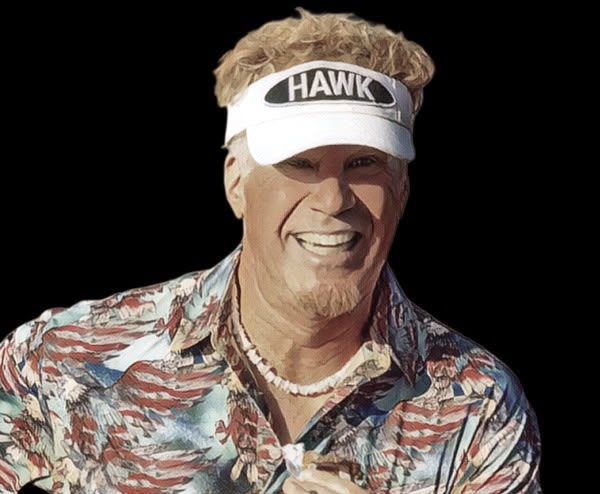
Ferrell plays Lonnie “The Hawk” Hawkins, a former golf star whose career collapsed after he failed just as he was on the verge of completing a Grand Slam. Now older, while his own son begins to rise in the sport, he desperately tries to return to the PGA Tour and reclaim his lost glory. Across ten episodes, the series follows a man who refuses to accept that his time may have passed — a premise that, ironically, begins to feel like an unintended metaphor for the show’s own comedy.
Because Lonnie could have been a fascinating character precisely for that reason. An aging man trying to survive the disappearance of the very thing that once defined him. Someone forced to deal not only with professional decline, but with a son stepping into the place he once occupied, an ex-wife who knows all his weaknesses, and a world that has learned to function perfectly well without him.
Instead, The Hawk often seems far more interested in putting Will Ferrell back into an absurd costume and letting him do what he has always done.
And that is exactly where much of the criticism begins.
The reception has been harsh, with critics on Rotten Tomatoes hovering around 30 percent approval, while audiences have been considerably more forgiving. The Guardian described the series as an unsuccessful attempt to revive the “Frat Pack” comedy of the 2000s, pointing to overextended jokes, bodily humor, dated stereotypes, and the persistent feeling that we are watching a comic mechanism that once worked much better.
But it would be too easy to conclude that the problem is simply that “you can’t make these kinds of jokes anymore.” You can. Comedy remains vulgar, offensive, politically incorrect, and perfectly willing to cross boundaries when it has a reason to.
What has changed is something else: a man behaving badly is no longer automatically funny simply because he is behaving badly.
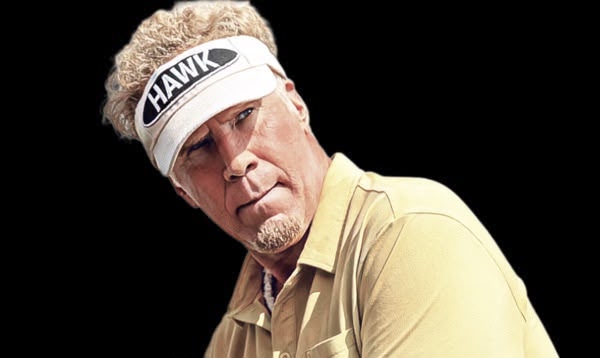
In Ferrell’s best films, there was always something smarter happening underneath the stupidity.
Ron Burgundy was not simply an absurd sexist. Anchorman mocked a male world terrified by the arrival of a woman threatening its position. Ricky Bobby was not just an idiot obsessed with speed. Talladega Nights offered a surprisingly effective satire of American masculinity, the worship of winners, and the idea that finishing second is the same as failing.
The characters were ridiculous, but the world around them was being ridiculed, too. That is what The Hawk often lacks: a clear sense of what, exactly, it is laughing at.
The series seems aware that Lonnie is a dinosaur, but it is not always interested in exploring what it means to be that dinosaur in 2026. Instead, it repeatedly returns to the old formula: Ferrell walks into a scene overly tanned, dressed absurdly, says something inappropriate with absolute confidence, and waits for the character’s conviction to do half the work.
For a long time, it did. Maybe now it does less.
Curiously, The Hawk improves whenever it stops relying entirely on him. Molly Shannon, as Stacy, his ex-wife, and Fortune Feimster, as his new caddie, are frequently singled out as two of the show’s strongest elements. Shannon, especially, works because she does not exist merely to react to Ferrell’s character. She knows Lonnie, understands his tricks, and can confront him on the same comic wavelength. Even negative reviews have noted how the supporting cast manages to find moments that the writing does not always provide for its lead.
Some critics have embraced precisely what others rejected. The Los Angeles Times, for instance, accepted the show’s juvenile and exaggerated humor as part of the premise, essentially arguing that this is, after all, a Will Ferrell golf comedy — and expecting something fundamentally different may simply mean walking into the wrong room. Ferrell’s own knowledge of and affection for the sport also give the setting enough familiarity to keep the whole thing from becoming nothing more than a collection of jokes about clubs and holes.
And perhaps that is exactly where the divide lies.
Anyone nostalgic for that version of Will Ferrell will probably find plenty that feels familiar in The Hawk. The problem is that familiarity and nostalgia are not necessarily the same thing as being funny.
There is also an especially good irony at the center of the premise. Lonnie Hawkins is a man who believes he can return to the place he occupied twenty years ago. The world only needs to see him again to realize he is still extraordinary.
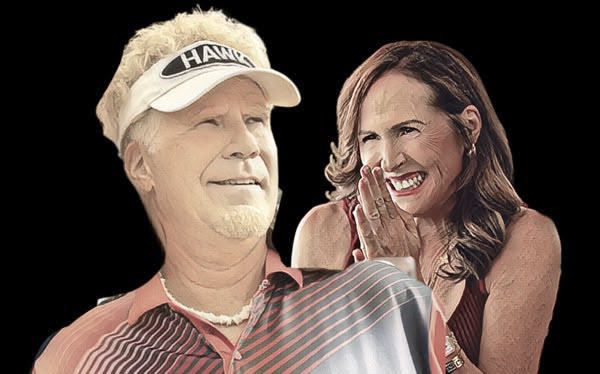
Will Ferrell may be doing something similar.
The difference is that Ferrell has already shown that he is far more interesting than the man-children who made him famous. There is a vulnerable, strange, and melancholy actor hidden behind that gift for absurdity, and some of his best performances have come when someone recognized it. For that reason, a series about aging, failure, fatherhood, and the difficulty of letting go of one’s own image could have been the perfect vehicle for confronting his old comic persona with the man he has become.
The Hawk occasionally gets close to that idea. And then another genital joke arrives.
Perhaps it is unfair to expect every comedy to age alongside us. Some simply belong to the moment in which they were made, and there is nothing wrong with still laughing at them. What is more curious is when someone tries to rebuild that exact moment and discovers that the formula has remained almost perfectly intact, but we have not.
That may ultimately be the most interesting problem with The Hawk. We do not know whether Will Ferrell stopped being funny.
Maybe we simply learned to laugh at different things.
Descubra mais sobre
Assine para receber nossas notícias mais recentes por e-mail.

