
When Ted Lasso premiered in August 2020, perhaps no marketing team could have planned a more perfect match between a television series and its historical moment. The world had been indoors for months, frightened, exhausted, separated, and trying to believe that somehow, eventually, all of it would end. Then along came an American coach who knew almost nothing about football, crossed the Atlantic to take charge of an English team, and insisted that kindness was not naivety, vulnerability was not weakness, and believing in people could be a form of leadership.
The yellow “Believe” sign became almost a symbol of that period. Ted Lasso was not merely an Apple TV success. It became a kind of collective comfort during the pandemic, which is particularly curious because the series had never been conceived to carry such enormous emotional weight. It arrived at exactly the right moment and found an audience that perhaps needed exactly that character.
But reducing Ted Lasso to positivity has always meant oversimplifying what made the series so special.
Its sensitivity came precisely from its ability to address deep, often painful subjects beneath a surface of joy and lightness. It dealt with abandonment, suicide, anxiety, panic attacks, divorce, emotional dependence, masculinity, aging, failure, and the fear of not being loved without ever ceasing to be funny. At its best, it could make a joke seconds before touching a very real wound without allowing one to diminish the other.
Six years later, Ted is coming back. The question is: to what kind of world?

The fourth season arrives in August after Jason Sudeikis spent years resisting the idea of continuing a story he believed had already ended. From the beginning, he had imagined Ted Lasso as a three-season arc. When Ted left AFC Richmond and returned to the United States at the end of season three, Sudeikis saw no narrative reason to undo that decision simply because the series had become an enormous success.
He has even said that he was not going to uproot Ted’s life again just to justify “the money truck.” It is an important remark because, at least in principle, it separates this return from those continuations that exist simply because nobody is willing to walk away from a profitable franchise. But something changed.
In 2024, Sudeikis brought the writers together again. There had been ideas for spinoffs involving Roy Kent and Keeley, along with other possibilities for characters within that universe, but Sudeikis himself began noticing that he was still writing down ideas about Ted. Gradually, the question stopped being how to continue Ted Lasso without Ted and became whether his story was truly finished.
There is something especially interesting in the explanation Sudeikis has now given for that change of heart. Playing a man who tries to see the best in people, he said, was good for him personally. Ultimately, he summed up his decision by saying that he needed Ted as much as other people might need him.
That is precisely where this return becomes interesting. Because the world welcoming Ted Lasso in 2026 is very different from the one that turned him into a phenomenon in 2020.
The pandemic is already beginning to feel like a past that grows more distant by the day, even though its effects are far from gone. Political division has deepened, public discourse has become even more aggressive, and the idea that empathy can overcome antagonism sometimes feels harder to defend now than it did six years ago.
At the same time, many of the things that once made Ted Lasso feel so modern are no longer new. Talking about mental health is no longer revolutionary in itself. Therapy, anxiety, panic attacks, and vulnerable masculinity have become recurring themes on television. The challenge now is different: whether Ted Lasso still has something new to say about them. Because Ted himself had already begun to change.
The man who smiled, made jokes, handed out biscuits, and compulsively cared for everyone else was hiding an enormous inability to deal with his own suffering. Gradually came the panic attacks, the trauma of his father’s suicide, the end of his marriage, and the fear of failing the person who mattered most to him: his son.
That is why his ending was never as simple as “Ted went home.”
The series did not show Ted romantically rebuilding his life with his ex-wife, as though restoring the traditional family unit was the reward for everything he had learned. He returned, above all, for Henry. His final move was paternal, not romantic. That matters.

Ted spent three seasons trying to be emotionally available to everyone while living thousands of miles away from his son. Once we learn the story of his own father, that distance acquires a different weight. His decision to return can be read less as a retreat and more as an attempt not to repeat, in another form, the kind of absence that profoundly shaped his own life.
That refusal to take the most obvious path appeared repeatedly throughout Ted Lasso. Ted and Rebecca may be the best example.
From the beginning, there was chemistry between them, and for three seasons, there was enormous pressure to turn that intimacy into romance. It would have been the most conventional solution: the male and female leads discover that they were destined for one another all along. Ted Lasso never did that.
Rebecca and Ted loved each other deeply without needing to become a couple. They were partners, friends, confidants, and perhaps two of the most important people in each other’s lives. In a television tradition that spent decades treating intimacy between men and women as merely a stage before romance, keeping that relationship platonic was a modern and surprisingly meaningful choice.
Rebecca, ironically, did receive a romantic ending. Just not with Ted.
She was reunited with the Dutch stranger with whom she had spent a few unexpectedly happy hours in Amsterdam. It was almost a fairy-tale ending, but it worked only because her real romantic journey had never simply been about finding a better man than Rupert. It was about no longer allowing Rupert to organize her life, even through hatred and the need for revenge. Only then was there room for something else.
Keeley also escaped, albeit imperfectly, from a conventional ending. The series stumbled at times by allowing too much of her journey to seem defined by her relationships with Jamie and Roy. But when it finally could have resolved the triangle by making her choose one of them, Keeley chose neither. She chose herself.
She did not get the romantic happy ending with Roy that many viewers expected, although that did not necessarily mean the two could never find their way back to each other. The point was something else: her ending did not have to be determined by which man stood beside her.

Choices like these help explain why Ted Lasso always had more depth than its reputation as a “feel-good” series sometimes suggested.
It did not always get everything right. Season three became too sprawling, some characters lost focus, and certain storylines seemed to exist simply because nobody wanted to leave that universe behind. Episodes grew longer, production became more complicated, and some of the simplicity that had made the first season so effective was lost along the way.
Perhaps that is why season four now has to prove two things at once: first, that Ted Lasso still knows how to be Ted Lasso. And then, that Ted Lasso still makes sense in 2026.
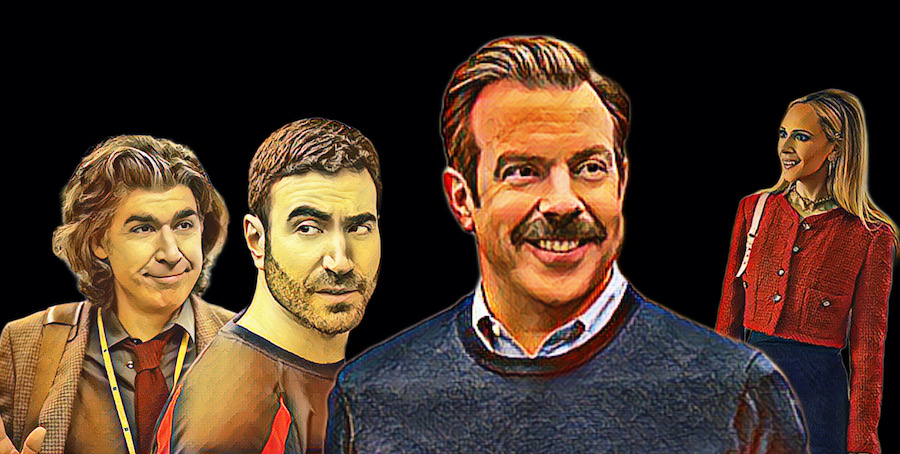
The change in setting may help. Ted is now taking charge of a second-division women’s football team, while Rebecca, Roy, Keeley, Coach Beard, and Higgins remain connected to the story. This is more than replacing one group of players with another. It is an opportunity to test Ted’s philosophy against different experiences, power dynamics, and conflicts from those that shaped the first three seasons.
There are also signs of an attempt to correct course. The new episodes have returned to shorter running times, Jason Sudeikis is sharing production responsibilities more effectively, and people involved with the series say the new season recaptures some of the magic of the first.

Naturally, it is too early to know whether that is true. But perhaps the smartest decision would be not to try to recreate 2020 at all. Back then, millions of people were literally isolated from one another when Ted offered a very specific fantasy: the possibility of building a community based on trust, care, and affection. AFC Richmond began as a place divided among players, coaches, executives, and supporters, and gradually became an improvised family.
In 2026, the question is harder.
What does it mean to defend kindness in an even more aggressive world? What does it mean to choose curiosity over judgment when everyone seems expected to decide immediately which side they are on? How healthy can positivity remain when Ted himself has already taught us that optimism can also be used to hide pain? Perhaps that is exactly where a real reason for bringing him back can be found.
Jason Sudeikis, who for years was the main obstacle to continuing the series, is now once again thinking in terms of a three-season arc. That means season four is not being treated merely as a nostalgic reunion designed to show us where the characters we learned to love have ended up.
It could be the beginning of a second life for Ted Lasso, and that second life will have to justify its existence. In 2020, Ted did not need to convince anyone that the world was tired of cynicism. He only had to show up. Perhaps his greatest challenge in season four will not be taking over a women’s team, learning new names, or once again trying to understand how football works. It will be proving that what felt almost revolutionary during the pandemic can still carry weight six years later, and that may be exactly why Ted Lasso decided to come back.
Descubra mais sobre
Assine para receber nossas notícias mais recentes por e-mail.

