
In the final episode of Ted Lasso’s third season, amid so many farewells that seemed definitive, one relatively small scene left a door open. Keeley presents Rebecca with a proposal for AFC Richmond to invest in a women’s team. Rebecca looks at the project, smiles, and the idea remains there, like one of those possibilities for the future that a finished series would not necessarily need to develop. Three years later, we know that moment was far more important than it seemed.
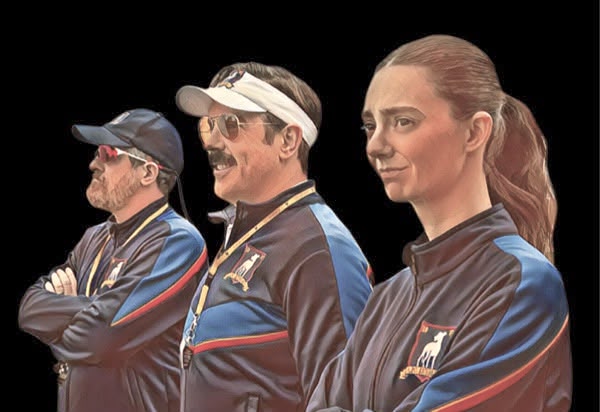
Ted Lasso is returning for a fourth season and, this time, Ted will take charge of a second-division women’s team. It is not merely a practical way to refresh the cast without erasing the ending given to Richmond’s male players. The choice places one of recent television’s most popular series inside a cultural transformation that football is still trying to understand.
Women’s football has never had more visibility, larger audiences, or greater investment, but that is still far from meaning it has defeated prejudice. In England, the difference compared with Brazil is enormous. The Lionesses won back-to-back European Championships in 2022 and 2025, filled Wembley, and helped turn players into national celebrities. The women’s game became more professional, attracted larger audiences, and brought in new sponsors. Even the second division, precisely the world Ted Lasso has now chosen to enter, has been recording significant growth in attendance.
That growth, however, still exists alongside very concrete inequalities. Reports of sexism and misogyny connected to football continue to rise in the country, especially online. Women have gained significantly more space as presenters, pundits, and analysts on major British broadcasts, but leading commentary on men’s matches remains a far more resistant territory. There are more women inside football, therefore, but that does not mean their presence has been fully accepted.
Brazil knows this contradiction very well. We have produced some of the greatest players in the history of the game, we have an internationally respected women’s national team, and in 2027, we will host the first Women’s World Cup ever staged in South America. And yet all it takes is for a woman to comment on an important men’s match for the same complaints to return, questioning her voice, her knowledge, her presence, and, often, her right to be there at all.
It is the old argument disguised as personal preference. They do not like “that voice,” “that style,e” or “that commentator,” as if the resistance were always tied exclusively to one specific professional. Curiously, the same standards were rarely applied over decades to the countless mediocre men who commentated, analyzed, coached, and ran football without ever having to justify the collective presence of their gender.
That is precisely why Ted Lasso’s choice has far greater potential than simply replacing a men’s team with a women’s one. The series has always been especially effective when dealing with difficult subjects without explicitly addressing them, instead trusting the characters’ experiences over explanatory speeches.
Ted Lasso never needed to stop a scene to explain what a panic attack was. It showed Ted struggling to breathe while the world around him kept moving. Nor did it need long explanations about masculinity to talk about Jamie, Roy, or Nate. It put in front of us men who could not admit they were afraid, ashamed, or in need of help, and allowed their stories to reveal all of that.
Mental health entered the series in the same way. When it premiered in 2020, Ted initially seemed simply to be the absurdly positive man who believed kindness could transform a hostile environment. Gradually, we discovered that this positivity was also hiding suffering, abandonment, trauma, panic attacks, and an enormous difficulty in caring for himself while compulsively caring for everyone else.
It was this ability to place depth beneath a surface of joy and lightness that made Ted Lasso work so well. Women’s football now offers similar territory, because it allows the series to enter a structural discussion without necessarily turning every episode into a lecture about pay inequality, misogyny, lack of investment, or insufficient coverage.
In fact, it would be better if it did not. It only needs to show these women living inside a structure that still does not offer them the same conditions given to men, and allow the differences to emerge naturally. Training schedules, access to stadiums, sponsorship, press attention, motherhood, sexuality, aging, harassment, and scrutiny of the body are all issues that can arise through the characters’ experiences without anyone needing to stop and explain the problem directly.
There is also a particularly interesting question in the fact that, even within women’s football, many positions of power are still occupied by men. Coaches, executives, and decision-makers remain predominantly male, creating a contradiction the series is perfectly positioned to explore: women gain more and more space on the pitch while the structures that determine their futures are still often controlled by men.
That creates a very interesting challenge for Ted himself. He enters women’s football carrying everything he learned over the first three seasons. He listens better, understands his own vulnerabilities more clearly, and is no longer merely the confused American asking what offside means. Even so, he remains a man entering a space whose experience he cannot fully know.
That is exactly where an important narrative risk appears. The series cannot turn Ted into the enlightened man who arrives to save women, because that would contradict everything it has built so far. The more interesting possibility would be to do precisely the opposite and allow Ted once again to discover what it means not to know.
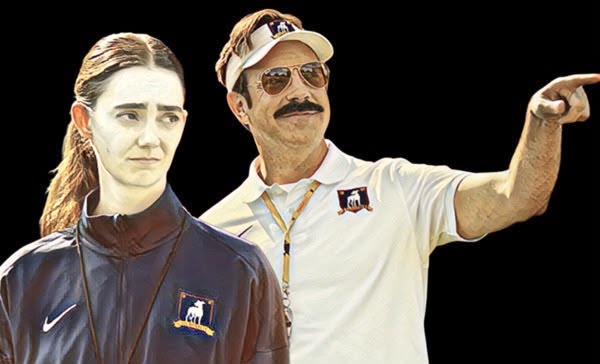
In the first season, he entered English football without understanding the sport and realized that his ignorance could also be a strength because it forced him to observe people differently. Now he may discover that understanding human beings does not automatically mean understanding what it is like to be a woman inside a structure historically built by men.
Perhaps some of his formulas will not work in quite the same way. Telling someone to believe in herself is beautiful, but believing in yourself does not solve underinvestment, change salaries, guarantee stadium access, prevent harassment, or transform structures that continue to offer men and women different opportunities.
This could, in fact, become a fascinating evolution of the very idea of “Believe.” In the first seasons, Ted believed deeply in the possibility of transforming individuals and relationships through trust, empathy, and listening. Now, the series may lead him toward something more complex: not every problem can be solved individually, because some are structural.
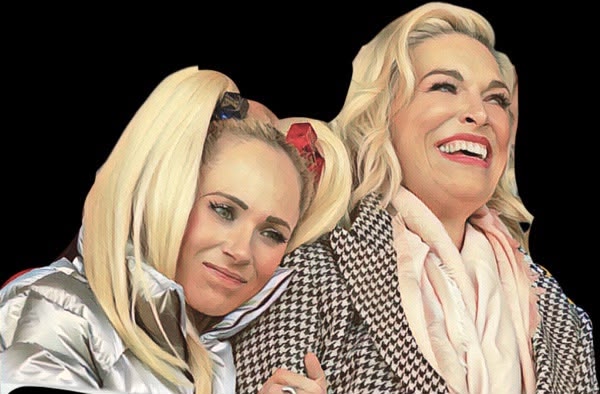
There is also something especially meaningful about the fact that this new story began with Keeley and Rebecca. Neither of them entered Ted Lasso as someone the football world instinctively believed belonged there.
Rebecca received AFC Richmond in her divorce and spent much of the first season being treated as the resentful woman who had inherited her ex-husband’s toy. Rupert, in the eyes of many, was still the real owner, the real supporter, and the man who truly understood football. Over three seasons, she stopped merely occupying that space and came to belong to it, eventually reaching a position where she could decide who else might be allowed to belong.
Keeley followed an equally symbolic path. She was introduced as a footballer’s girlfriend and later became involved with another player. The series stumbled at times by allowing too much of her identity to revolve around her relationships with Jamie and Roy, but it ended her journey with her occupying a professional space of her own and bringing Rebecca the proposal to create a women’s team.
There is something deeply significant about two women who spent much of the series trying to exist inside male-dominated environments, ending by creating space for other women. It does not feel accidental that the continuation of the story grew directly from that idea.
That also does not mean, obviously, that Ted Lasso will transform women’s football on its own. A television series cannot correct decades of inequality, and it would be naive to give pop culture a power that institutions, federations, clubs, sponsors, and broadcasters need to exercise in concrete ways. But culture has an enormous ability to normalize what is still treated as an exception.
Perhaps that is the most important point of all. Many people who would never choose to watch a series advertised as “a story about women’s football” will watch because it is Ted Lasso. They will not need to be persuaded by an institutional campaign that women deserve space in the sport, because for ten weeks, they will simply follow a women’s team in much the same way they once followed Jamie, Roy, Sam, Dani Rojas, and the rest of Richmond.
These players will have stories, conflicts, flaws, ambitions, and relationships of their own. Audiences will have favorites, they will root for them, get angry when they lose, argue about team selections, and want them to win. That is how some cultural shifts happen, when something that once needed to be explained no longer requires explanation because it simply exists at the center of the story.
Women’s football has already proved that there is an audience. Packed stadiums at World Cups and European Championships have demonstrated that repeatedly. The challenge now is making that interest survive beyond the major event, the decisive match, and the national team, because equality is not measured only when Wembley is full for a final. It is also measured during an ordinary second-division match, when there is no trophy at stake and no wave of national patriotism driving the audience.
That is precisely why Ted Lasso’s new choice may be so interesting. In 2020, the series found an unexpected way to talk about mental health, anxiety, and masculinity with millions of people who had turned on the television simply to watch a comedy about an American coach lost in English football.
In 2026, it may be able to do something similar with women in sport, but not by teaching audiences that women can play football too, because we should have moved beyond that discussion a long time ago. The challenge now is to show why, even after proving so many times that they belong in the game, women still have to fight so hard for the same opportunities, the same investment, and the same legitimacy.
Perhaps Ted’s new challenge, then, is not teaching women to believe in themselves. It may be discovering why they still have to fight so hard for the rest of the world to finally believe in them.
Descubra mais sobre
Assine para receber nossas notícias mais recentes por e-mail.

