
Among the ballets that have survived through the centuries as dramatic masterpieces, some endure because of their music, their tradition, or because certain roles have become dreams for any great dancer. Don Quijote achieved something rarer: 156 years after its premiere, it still feels like a party, a competition, and a trial by fire all happening at once.
This week, we will have a perfect opportunity to see why in Rio. The Ballet and Symphony Orchestra of Theatro Municipal return with Don Quijote beginning August 20, for a season running through August 30. The conception, restaging, and adaptation are by Hélio Bejani and Jorge Texeira, with Tobias Volkmann conducting the orchestra. And there is one detail that may say more about the ballet’s longevity than any historical explanation could: tickets are already sold out.

A classic that is already 156 years old
The Don Quijote we recognize today was born in Moscow in 1869, choreographed by Marius Petipa to music by Ludwig Minkus. It premiered that December at the Bolshoi Theatre, on December 14 according to the calendar then used in Russia, equivalent to December 26 in the Gregorian calendar. So, in December 2026, it turns 157.
That does not mean it has remained frozen in time. Quite the opposite. Petipa returned to the work in St. Petersburg in 1871, and Alexander Gorsky transformed it again in 1900. It is from this Petipa-Gorsky lineage, repeatedly altered by choreographers and dancers themselves, that virtually all the versions we see today descend. The Mariinsky itself acknowledges something delightful about that history: so many performers added tricks and ideas to the role of Basilio that some of them could, in a way, be considered his co-choreographers.
There were Don Quijotes before Petipa — Cervantes’ character had already reached the ballet stage in the 18th century — but it was the Minkus-Petipa version that became one of the pillars of the classical repertoire. And there is an immediate curiosity for anyone who has never seen the ballet: despite the title, Don Quixote is hardly the protagonist of Don Quijote.
The ballet uses only a small part of Miguel de Cervantes’ monumental novel. Its true love story is that of Kitri, the daughter of an innkeeper, and Basilio, the poor barber her father does not consider a suitable husband. Don Quijote works instead as a kind of poetic and comic catalyst for the adventure, mistaking Kitri for his idealized Dulcinea and, in his own particular way, helping the young lovers.

Why is Don Quijote still so popular?
Because it is almost the opposite of contemplative ballet. Giselle demands atmosphere. Swan Lake requires a very particular dramatic and stylistic construction. La Bayadère creates its own spiritual universe. Don Quijote practically opens the curtain and says: let’s dance.
There is humor, romance, fans, capes, bullfighters, gypsies, fandango, taverns, windmills, a dream scene, and Minkus’ irresistibly rhythmic music. Kitri defies her father to stay with the man she loves, Basilio turns even a fake suicide attempt into comedy, and Gorsky’s Spanish square was conceived precisely to feel like a living crowd rather than a geometrically organized corps de ballet.
It is also an extraordinarily accessible ballet for anyone who has never walked into a theater to watch classical dance. The story is simple, the characters are instantly understandable, and, most importantly, you do not need to know anything about technique to realize that someone has just done something incredibly difficult. The audience understands the risk.
And Don Quijote spreads the opportunities to shine around. Kitri and Basilio dominate the spectacle, but there are Espada, Mercedes, Cupid, the Queen of the Dryads, Kitri’s friends, bullfighters, gypsies, and a corps de ballet constantly involved in the action. It is not merely a test of the leading dancers. It is one of those ballets capable of revealing the technical and artistic condition of an entire company.

Balanchine: the Don Quijote that broke with Petipa
Before Nureyev and Baryshnikov helped turn Don Quijote into one of the great showcases of 20th-century virtuosity, George Balanchine did something completely different with the character.
And here it is important not to confuse the lineages. The Don Quijote Balanchine created for New York City Ballet in 1965 was not a revival of Petipa, did not use Minkus’ music, and deliberately did not follow the 19th-century Russian version. It was an entirely new full-length ballet, with music by Nicolas Nabokov, commissioned by New York City Ballet, and a much darker, more philosophical, and more personal interpretation of Cervantes’ novel.
The official premiere took place on May 28, 1965, at the New York State Theater, but there is one extraordinary detail: at the benefit preview the night before, Balanchine himself danced Don Quijote. He would return to the role several more times. Suzanne Farrell, then just becoming one of the great muses of his work, danced the central female figure. That same year, she was promoted to principal dancer at New York City Ballet.
What Balanchine did with Dulcinea also says a great deal about his interpretation. Instead of simply reproducing the idealized young woman we know from the Petipa tradition, he made the woman desired by Don Quijote appear in different forms, a servant, a shepherdess, the Virgin Mary, and other incarnations, as though the knight were forever trying to find in the real world a perfection that exists only in his imagination. It is almost the photographic negative of Minkus’ Don Quijote.

In the ballet that dominates the international repertoire today, Don Quijote lends his name to the work but allows Kitri and Basilio to take over the party. In Balanchine, the knight returns to the center. The question is no longer merely whether the young lovers will end up together, but the distance between ideal and reality, desire and impossibility.
That is why Balanchine deserves a particular place in this history. He did not add new fouettés for Kitri or new technical difficulties for Basilio. He proved that Cervantes could inspire a completely different ballet from Petipa’s.
And perhaps that comparison helps explain why the Petipa-Gorsky-Minkus version won the battle for popularity. Balanchine’s Don Quijote was an auteur work, intellectual and deeply connected to his own aesthetic. The other Don Quijote offers something irresistible to companies, dancers, and audiences: exuberant characters, music that propels movement, and a structure almost designed to allow great performers to be great performers.
It is this second lineage that Rudolf Nureyev, and later Mikhail Baryshnikov, would push even further toward the technical spectacle we know today.

Nureyev and the transformation of the male dancer into a star
If today we expect Basilio to enter the stage almost defying gravity, part of that expectation inevitably comes from Rudolf Nureyev.
Nureyev knew the role intimately. He danced Basilio while still with the Kirov and took Don Quijote with him after moving to the West. In 1966, he created his own version of the ballet for the Vienna State Opera, based on Petipa. The production remains connected to the company’s history and would later be adopted by other major companies. For it, Nureyev asked conductor and arranger John Lanchbery to create a new orchestration and adaptation of Minkus’ score.
But Nureyev’s contribution goes far beyond a revival. His arrival in the West helped change the very place of the male dancer in classical ballet. Male virtuosity no longer meant simply being an excellent partner to the ballerina. Jumps, pirouettes, speed, batterie, and stage presence began to be expected as spectacle in their own right. Critic Joan Acocella observed that Nureyev’s influence dramatically raised the technical standard for male dancers in the West and even changed the way audiences watched their variations.

Few ballets could have benefited more from that change than Don Quijote. In Nureyev’s version, the steps are notoriously fast, dense, and relentless. There is very little room to breathe: one technical sequence seems to propel the dancer immediately into the next. A recent review of the Australian production neatly summarized this Nureyev trademark by noting his tendency to add another rond de jambe, another difficulty, another something within the musical phrase. Basilio thus definitively stops being merely Kitri’s amusing boyfriend and becomes a major bravura role for a male dancer.
In 1970, Nureyev staged his version for The Australian Ballet. Two years later, he co-directed a film adaptation with Robert Helpmann, released in 1973, in which Nureyev himself danced Basilio opposite Lucette Aldous as Kitri and Helpmann as Don Quijote. The film helped project both the production and the Australian company internationally and remains a visual reference for the ballet.
And then came Baryshnikov
If Nureyev helped redefine what audiences expected from a male dancer, Mikhail Baryshnikov took the combination of precision, speed, elevation, and apparent effortlessness to another level.
Baryshnikov also came to the role through the Russian tradition and, in 1978, created his own production of Don Quijote for American Ballet Theatre, conceived and directed by him, with choreography based on Petipa and Gorsky. Gelsey Kirkland was his first Kitri. It was not a break with Petipa. Almost the opposite: Baryshnikov understood perfectly that the nature of Don Quijote allowed that tradition to be taken to its limits.
Those who saw the original production would later remember its virtually uninterrupted energy. And anyone who has seen Baryshnikov as Basilio immediately understands why. The character has speed, insolence, comedy, charm, and such clean technique that the danger seems to disappear. Even the famous tavern variation, demanding as it is, becomes a scene of seduction in his hands. The production would also be immortalized in ABT recordings from the 1980s, particularly those with Baryshnikov and Cynthia Harvey.

Nureyev and Baryshnikov did not create the modern Don Quijote on their own, nor did every step we now associate with the ballet originate with them. But the two helped crystallize an expectation that remains: Basilio has to be a star every bit as spectacular as Kitri.
And this is where the trouble begins for whoever has to dance it.
Why do dancers love Don Quijote?
Because Don Quijote allows personality. There are ballets in which the performer has to disappear into an extremely specific aesthetic. In Don Quijote, particularly as Kitri and Basilio, the dancer can practically walk onstage saying: “Look at me.” It is part of the tradition.
One Kitri may hold a balance a little longer. Another may turn her fouettés into doubles. Another bets on speed. Basilios play with pirouettes, jumps, tours, and different ways of finishing their diagonals. That does not mean anything goes. It means there is a tradition of surpassing oneself embedded in the very DNA of the work.
That is why the wedding Grand Pas de Deux took on a life of its own. Even people who have never seen the complete ballet have probably watched its variations in galas, competitions, festivals, or videos of great stars.
It is almost like the Olympics of ballet, except that the athlete still has to act, flirt, interpret, and convince the audience that he or she is having fun.


And why is it so feared?
Kitri is particularly cruel because she demands several different ballerinas inside the same ballerina.
In the first act, she needs attack, speed, jumps, fast pointework, confidence, flirtatiousness, and absolute command of the stage. Kitri cannot look cautious. Even while calculating every step, she must give the impression that she could do all of it for fun. Then comes the dream scene. And everything changes. The same woman who was setting the square on fire has to transform into Dulcinea: classical line, adagio, balance, purity, control. Suddenly the big Spanish gestures disappear, and the ballerina is exposed in sustained movements that leave almost nowhere to hide.

Then she still has to make it to the wedding. And here lies one of the great cruelties of Don Quijote: the part everyone is waiting for happens when the leading dancers have already danced a great deal.
Kitri arrives at the Grand Pas de Deux with her famous fouettés — the sequence traditionally associated with 32 turns, today often embellished with doubles and other combinations — as well as the balances that great ballerinas have turned almost into silent competitions with the audience.
For Basilio, the physical toll can be even more brutal: huge jumps, turns, tours, speed, partnering, and lifts. All while maintaining the appearance of a man utterly sure of himself, a poor barber who knows he is going to win the girl, the father-in-law, and the audience. It is technique fueled by adrenaline.
And there is a curious risk in Don Quijote: precisely because the work encourages technical exhibitionism, it invites dancers to try just a little more. Jump higher. Turn more. Hold longer. The audience’s energy feeds the performer, and the performer responds.


In Brazil, Don Quijote also became a tradition
In Brazil, and particularly in Rio, this relationship has a history of its own.
Don Quijote came to occupy a special place in the repertoire of the Ballet of the Teatro Municipal with the historic production created by Dalal Achcar in 1982. It was a large-scale staging, with sets by José Varona and a cast that brought together international artists including Fernando Bujones, Yoko Morishita, Zhandra Rodríguez, and Jean-Yves Lormeau. Among the Brazilian dancers were Ana Botafogo and Sílvia Barroso.
For me, there is also a personal memory attached to that history. It was at a matinee during that season, watching Ana Botafogo alongside Graham Bart, that I had my first encounter with this Don Quijote. Their partnership would extend beyond the stage: they married shortly afterward, and Bart joined the Ballet of the Municipal, where he remained until he died in 1988.
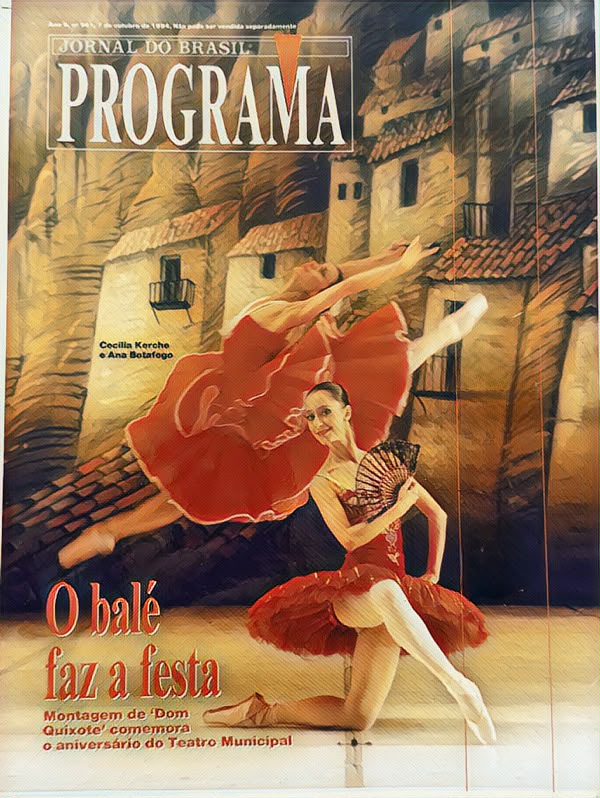
The work returned many times. In 1994, it was chosen for the celebrations marking the 85th anniversary of Theatro Municipal, with Ana Botafogo and Cecília Kerche among the Kitris and guest artists including Igor Zelensky, then a principal dancer with the Kirov. In 2010, Dalal’s production returned after a 16-year absence, bringing together Dorothée Gilbert, Marcelo Gomes, Sascha Radetsky, Márcia Jaqueline, Cícero Gomes, and others.
That is precisely what makes Don Quijote so interesting within the history of Brazilian dance. It is not simply an imported classic that periodically returns to the stage. For generations of dancers, it has also become a measure of arrival: dancing Kitri or Basilio means taking on one of those roles that immediately puts technique, personality, and stamina under examination.


And now, back at the Municipal
The version returning to Theatro Municipal this week was created in 2022, with conception, restaging, and adaptation by Hélio Bejani and Jorge Texeira. It is an interpretation that preserves Petipa while placing particular emphasis on theatricality, humor, and the performers’ individual personalities — especially appropriate for a ballet in which technique without presence is never enough.
Márcia Jaqueline and Cícero Gomes return to a work they know intimately. Cícero, in fact, considers Basilio his favorite character and remembers dancing his first Don Quijote with Márcia in 2005. She also captures the ballet’s paradox perfectly: technically and physically extremely difficult, yet light and fun to perform.
There is another interesting encounter in this season. Brazilian dancer Gabriel Lopes, trained at the Bolshoi Theatre School in Brazil and with a career built in Russia, returns to the country to dance Basilio opposite Juliana Valadão. Earlier in 2026, he had already appeared on the Municipal stage as Natalia Osipova’s partner at the Prix Osipova; now he returns as part of the company for one of the roles that best serves as a calling card for a male dancer. He performs with Juliana on August 21, 23, and 25.
And there could hardly be a better moment to see the ballet again.
The real secret of Don Quijote
Because, ultimately, there is something about Don Quijote that goes beyond the 32 fouettés, Basilio’s jumps, Kitri’s balances, or the different versions left by Petipa, Gorsky, Nureyev, and Baryshnikov.
Don Quijote is one of the rare ballets in which technique must not look noble: it must look pleasurable. That changes everything. You can see Albrecht’s effort in Giselle and absorb it into the tragedy. Siegfried can look exhausted and still remain Siegfried. Kitri cannot look tired. Basilio cannot look worried. They have to do absurdly difficult things while still conveying: “I’m having more fun than you are.”
Perhaps that is exactly why dancers love and fear it in equal measure. And perhaps it explains why, 156 years after its premiere, a ballet that practically turned virtuosity into dramatic argument can still do something many much younger works cannot. Sell out a theater before the curtain even rises.

Descubra mais sobre
Assine para receber nossas notícias mais recentes por e-mail.

