
Alice and Catherine had to finally come face to face for Furious to reveal what truly exists between them. Until now, one was the FBI agent obsessed with capturing the serial killer who murders men accused of violence against women. The other was the woman who had given up on justice and started personally executing those who always managed to escape it. In Episode 6, however, that opposition begins to crumble.
Alice is not pursuing Catherine simply because she wants to solve the case. She recognizes herself in her. And the final revelation suggests that this identification runs much deeper than we imagined: they may both have been victims of the same man. Their encounter takes place at a shelter for women experiencing violence, one of the few places where Catherine still believes she is protected. Alice is not officially authorized to lead the operation and, to remain close to her, assumes a false identity. She claims to be a sex worker fleeing an abusive boyfriend and ends up sharing a room with the woman she has been searching for over the past few weeks.
Catherine, however, has spent her life learning how to detect lies. Alice may have experience with interrogations, disguises, and manipulation, but she is facing someone who survived precisely because she learned to sense danger before it fully revealed itself. That is why the disguise only begins to work when Alice stops acting.

When she speaks about Marshall, she tells the truth. She reveals how the man who claimed to love her tried to kill her in the shower and how she thought she would die with shampoo still in her hair. The detail is horrifying precisely because it is so ordinary. It does not belong to the prepared vocabulary of an agent trying to win over a suspect, but to the memory of a woman who found herself facing her own death.
When the women at the shelter are told it is time to shower, Alice freezes. Catherine immediately realizes what is happening and begins talking to her, trying to keep her present. It is a brilliant reversal: Alice entered that place to manipulate Catherine, but it is the killer who recognizes her vulnerability and protects her.
For the first time, they stop being investigator and criminal. They are simply two women recognizing in each other the signs of a violence they both know intimately. Catherine also reveals part of her story. She has been coming to that shelter since she was 16 and met Isabel within the same world of abuse and exploitation. Isabel was not merely her friend. She was the person who remained by her side while they were both trapped in a hell no one seemed particularly interested in seeing.
Catherine’s memories of Jay Easton are fragmented. She remembers going to the billionaire’s house with Isabel. Afterward, Isabel was dead, her face destroyed, and the investigation was conveniently closed. Catherine began killing because she learned that men like Jay do not escape the system: they are protected by it.
We also discover that Elena is not Isabel’s sister, as Catherine had claimed, but her daughter. Catherine tried to care for the girl, but her trauma continued to prevent her from maintaining a home, a job, or any kind of stability. Before fleeing, she asks Alice to remove Elena from the control of Big Man, another violent man.
Alice insists that there is another way. She wants Catherine to hand over the evidence she possesses and testify against Jay. She still believes — or desperately needs to believe — that the FBI will be able to protect her and hold a rich and powerful man accountable. Catherine knows that promise is a fantasy. The episode itself makes a point of proving her right.
Nora finally understands why Ed sabotaged the investigation into Isabel’s death in 2012. Jay had supplied the information behind the major case that launched his career. In return, Ed became his protector inside the FBI, helping to erase the victim, the evidence, and any possibility of an investigation.
Nora believes she can corner him, but reveals what she knows before ensuring she has enough power to bring him down. Ed reacts immediately: he uses her alcoholism to sideline her, removes her team from the operation, and leaves Alice without backup. Catherine was right. The system did not fail Isabel through incompetence. It worked exactly as it was supposed to work to protect Jay Easton.
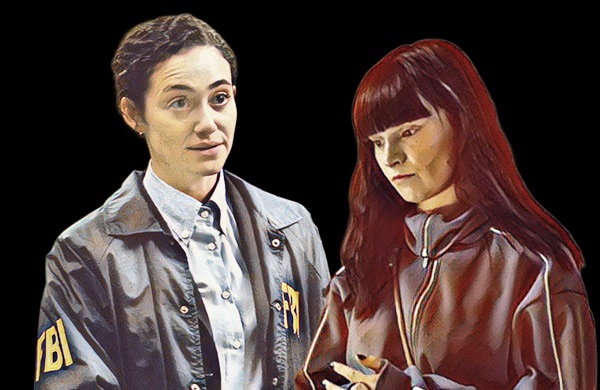
When Catherine realizes that Alice lied, she drugs the agent and takes her gun. Finally, there are no more disguises. Alice admits who she is and tries to persuade her to testify. Catherine refuses. The two women agree about the men, the violence, and even the impunity. The only difference lies in what they still expect from justice. Alice believes she can use her. Catherine believes she has already been used enough.
The situation becomes even more violent when Marshall appears at the shelter. He has followed Alice using police resources, gotten drunk, ignored every consequence, and returned to attack her. Like so many men in Furious, he also managed to explain away his behavior and remain free. The series makes it clear that we are not looking at a few monstrous exceptions, but at a structure that finds excuses for men while demanding endless proof from women.
Catherine saves Alice and asks whether she wants Marshall dead. Drugged, injured, and emotionally devastated, Alice cannot answer. Catherine shoots him and flees, leaving the agent to face what she most fears admitting: perhaps a part of her understands perfectly well the logic of the woman she is trying to arrest.
The final revelation transforms that identification into something even more disturbing. Alden gives Danny the device containing the files taken from Jay’s computer. There are folders bearing the names and dates of countless girls. Among them is one marked “Alice,” dated March 2004. Danny opens its contents, recoils in horror, and immediately closes the computer.
We still do not see what is inside, but the implication is clear. Alice’s connection to Jay began long before the investigation. She is not simply pursuing a killer whose crimes awaken her own trauma. Everything suggests that Alice was also in the hands of the same man who destroyed Catherine and Isabel.
The revelation also casts a shadow over the baby Alice gave up for adoption. Could that pregnancy be connected to Jay and whatever happened in 2004? The series has yet to confirm it, but it would hardly place those two pieces of information so close together without expecting us to make the connection.

It is precisely here that Alice’s obsession with Catherine takes on another meaning. Perhaps she does not remember everything. Perhaps she has turned the investigation into an unconscious way of approaching her own story. Catherine is not merely the target Alice needs to capture: she is the woman who may lead her back to the darkest trauma of her own life.
Furious began by asking whether a killer can be considered just when she targets men the justice system has chosen to protect. Now it poses an even more uncomfortable question: what happens when the woman assigned to arrest her discovers that she was also a victim of the same predator?
Alice believed she was hunting Catherine. By the end of this violent, tense, and twist-filled episode, we discover that they have always been searching for the same thing: some way to survive Jay Easton.
Descubra mais sobre
Assine para receber nossas notícias mais recentes por e-mail.

