
Maybe Ted Lasso needed to take football off the pitch for its fourth season to finally start finding its game. In “Greyhounds’ Day Off,” the fourth episode of the season, that deceptively simple structure the show handled so well at its best returns: identify a sporting problem, have Ted come up with a solution that seems absurd, and before we know it, we are talking less about football than about belonging.
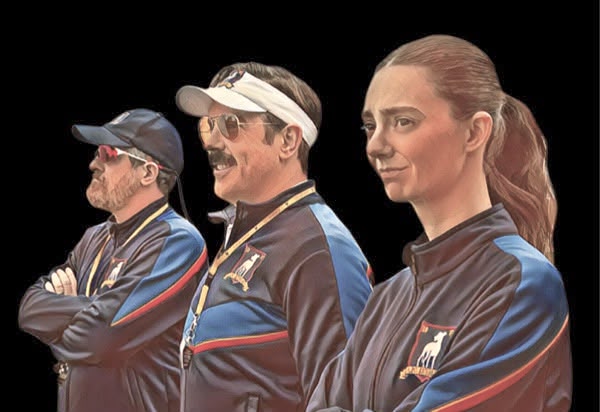
This time, the problem is cliques. After a few matches and reasonably encouraging results, the Lady Greyhounds are functioning as players, but not yet as a team. Forwards stick with forwards, defenders with defenders, midfielders with midfielders. Even Ted’s praise is acknowledged only by the small group to which the player being complimented belongs. Alice immediately sees the danger, while Ted and Beard, naturally, need to translate the situation into the language they have always understood best: pop culture.
When movies become football tactics
That has always been one of the most entertaining things about Ted Lasso. Ted and Beard use movies, television and music as an emotional vocabulary. When they cannot quite name a situation, they search for a metaphor in a film. This time, they go through Harry Potter before landing on Ferris Bueller’s Day Off, John Hughes’s classic, which turned 40 in 2026. The homage is already there in the title, “Greyhounds’ Day Off,” and gets another musical wink when the group ends up behind bars. It is hardly a hidden reference: Ted Lasso is practically winking at cinephiles.
But there is another movie the episode never mentions that immediately came to mind: The Replacements, the 2000 film starring Keanu Reeves and Gene Hackman. There, too, we have a group of players who cannot function as a team. There is rivalry, division, a bar fight and, eventually, jail. It is precisely behind bars that these men begin to discover that they belong to the same team, breaking into an improvised version of Gloria Gaynor’s “I Will Survive.”
In other words, the solution in “Greyhounds’ Day Off” is hardly original. And maybe it does not need to be. Ted Lasso has always found much of its charm in its ability to take familiar formulas, translate them into its own universe and make them work emotionally. For anyone who loves movies, it is especially fun to notice that even when the series does not directly cite its affectionate influences, it still looks to them for ways to solve its problems.
A fight as a team-building exercise
Ted decides to end the cliques not with training, but with a pub quiz. He deliberately separates the players who naturally chose to stay together and creates new groups. At first, nothing happens. They keep arguing, checking their phones and showing very little willingness to cooperate, until perhaps the most effective ingredient for uniting any group appears: a common enemy.
A bunch of openly misogynistic men turn the competition into something personal. It is a very Ted Lasso solution, although it is also one of the places where the season continues to oversimplify its point. Women’s football faces real, structural and everyday prejudice, but the series insists so often on representing it through men who are so obviously awful that it almost turns sexism into cartoon villainy. It is not that men like this do not exist. Of course they do. The problem is dramatic: Ted Lasso is usually better when it trusts us to understand a situation without underlining it three times.
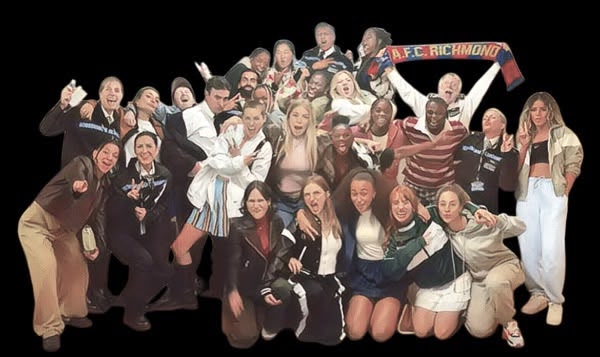
Still, it works. When the Lady Greyhounds stop competing against each other and start competing together, we finally see something resembling the old Richmond begin to emerge. They win the quiz, the provocation turns into a fight, a window gets broken and practically everyone ends up at the police station. It is not exactly the kind of team-building exercise recommended by any sports management handbook, but Ted is thrilled. The cliques are gone.
There is a very familiar Ted Lasso intelligence in that conclusion: Ted does not build the team directly. He simply creates the circumstances in which the players discover for themselves that they belong to the same group. It is the old Lasso philosophy working again — this time with some unintentional help from John Hughes and The Replacements.
Trent and Sharon, how we missed you
And then comes one of the episode’s greatest pleasures: seeing Trent Crimm and Dr. Sharon Fieldstone again. I loved it. Trent is as elegant as ever, now with a podcast, still carrying that wonderful combination of intelligence, curiosity and a certain ironic distance that has always made him one of the show’s most interesting characters. Sharon is still very much Sharon: precise, observant and perfectly capable of dismantling an emotional problem in just a few sentences.
As the two discuss trust, communication and the need to build a genuine collective culture, their conversation comments directly on the disaster Ted is managing in practice. It is almost as if Ted Lasso puts its theory in one room and its experiment in the pub. There is also a slight suggestion of a more personal connection between Trent and Sharon and, romance or not, it was simply wonderful to see them again. Some characters immediately restore a texture to the show’s universe that had been missing, and these two absolutely belong in that category.

Keeley is still a problem for the writers
But it is the relationships off the pitch that are becoming truly complicated. And here I need to talk about Keeley. I love the character, and perhaps that is precisely why I remain bothered by the way Ted Lasso has been treating her. Keeley has always been exuberant, free, funny, sexual, feminine and far more intelligent than people assumed. None of that ever meant she lacked competence. On the contrary, one of the character’s pleasures was precisely the way she dismantled that assumption.
That is why it is strange to see her now becoming almost a British Elle Woods — and not because of the pink, extravagant or deliberately childish clothes themselves. The problem is that the wardrobe increasingly seems to accompany an infantilization that is also appearing in the writing. Her ideas are often presented as “cute,” her wishes seem disconnected from budgets, and her creativity remains free and well intentioned as long as Rebecca is available to pick up the bill.
And Keeley knows what things cost. She ran a company. She had clients, investors, employees and financial problems. So if she believes the players need sweaters, massage booths or anything else, she should be able to defend those choices with far more professional conviction than we are seeing. Instead, she often seems like a child trying to persuade a wealthy friend to finance her next idea. That does not fit the Keeley we know.
Zelda, Keeley and Rebecca
Zelda Southport’s arrival makes all of this much more interesting. Zelda is extraordinarily confident, eccentric and appears to master exactly the world Rebecca is still learning how to navigate. She invests in women’s sports, understands money, influence and publicity, and knows how to turn even an arrest into a PR opportunity. Keeley is immediately fascinated. Rebecca is immediately suspicious.
And there is something far too familiar in Keeley’s response. Before, she became dazzled by Jack Danvers, the investor who financed KJPR, and ended up mixing admiration, power, money, work and romance. All that is missing now is for Ted Lasso to make Keeley fall for Zelda as well. I sincerely hope it does not.
The parallel is already interesting without romance. Keeley seems particularly susceptible to women who enter her life wielding authority with absolute confidence, and that could be a very good character trait if the series knows what to do with it. Repeating Jack by simply turning Zelda into another love interest would be much less interesting.
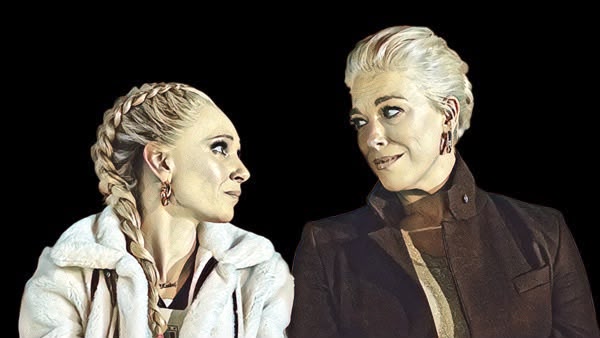
Because the real triangle already exists and does not need to be sexual: Zelda, Keeley and Rebecca. For those who spent seasons rooting for Ted and Rebecca, incidentally, it seems increasingly clear that Tedbecca is over. The series has stripped away almost every interaction that once allowed us to imagine a romance between them. Curiously, at the same time, Rebecca and Keeley’s friendship has become so intense that it has almost certainly inspired its own romantic fandom. But I hope that is not where the show is going. The friendship is already complicated enough.
Rebecca simply cannot be entirely professional with Keeley. She does not push her as hard as she should, does not establish clear limits, tries to protect her and signs cheques without necessarily discussing the consequences. Keeley relies on that generosity almost without questioning it. When Zelda appears and instantly earns her friend’s admiration, Rebecca reacts with a territoriality that could easily be mistaken for jealousy. It does not need to be romantic to matter emotionally.
Perhaps Rebecca’s real arc this season is hiding right there. She decided to invest in women’s football because she believes in it, but believing in something does not necessarily mean knowing how to run it. So far, we have watched Rebecca sign cheque after cheque while still trying to understand the financial, sporting and even emotional limits of the investment she has embraced. Zelda threatens precisely that insecurity because she appears to know how to play a game Rebecca is still learning. That triangle has enormous potential — as long as Ted Lasso resists the temptation to turn it into romance.
And does Keeley still love Roy?
Her relationship with Roy is another example of how difficult it has become to understand what Keeley actually wants. Roy is convinced enough time has passed and finally asks whether they can try again. Keeley responds with something tortuous, to say the least: he should date other women to figure out whether he truly wants her or has simply spent all this time idealizing his former girlfriend.
At first glance, the idea can sound mature. The more I think about it, the less it works. If Keeley still loves Roy and wants to be with him, sending him out with ten other women to prove that he is not idealizing her feels almost like manipulation disguised as emotional maturity. If she does not want to get back together, it is an equally complicated way of avoiding simply saying no. I love Keeley, but at this point I genuinely do not know what she wants. And maybe that is exactly the problem.
Roy, because he is still Roy and still in love with her, turns the suggestion into an administrative assignment. He goes on successive dates, tries to speed up the process and, naturally, everything goes wrong. His attempt to hook up with the bartender ends when his old footballer’s knee decides to remind him that Roy Kent is no longer 25. At the hospital, he meets Dr. Erin Beaumont, beautiful, direct and practically immune to his bad temper. Roy is immediately interested. Congratulations, Keeley. Your plan may have worked better than you expected.

The past keeps existing
Beard is also confronted by the past. Until then practically unbeatable at the pub quiz, he falls apart when he discovers Jane is putting on a show. The simple sight of the poster is enough to throw him completely off balance. It is funny, but it also helps reveal something that is beginning to connect several characters this season: what do we do when what we left behind continues to exist without us?
It is a question for Beard, for Roy, for Keeley and, above all, for Ted. Until now, the fourth season still seemed to be searching for a completely convincing reason for bringing us back into this universe. “Greyhounds’ Day Off” may be its first genuinely good answer.
Not because it invents anything new — The Replacements makes particularly clear that it does not — but because it recovers the language that always made Ted Lasso special. Movies become vocabulary, a fight becomes group therapy, jail becomes a team-building exercise, and a sports comedy remembers once again that its real sport was never football. It was always people.
Now the Lady Greyhounds finally look like a team. There is just one small problem: Chelsea are next, and unity helps a lot. But it does not perform miracles.
Descubra mais sobre
Assine para receber nossas notícias mais recentes por e-mail.

