
Spoilers ahead
Some films seem far more complicated than they actually are. The Whisper Man, Netflix’s new thriller based on Alex North’s bestselling novel, is exactly that kind of movie. And that may be its biggest frustration: behind Robert De Niro, Michael Keaton, Adam Scott, Michelle Monaghan and a fairly effective dark atmosphere, there is a relatively simple — and very good — story about fathers, sons, trauma and the way each generation chooses either to repeat or break the mistakes of the one before it. But the film insists on scrambling it.
Published in 2019, The Whisper Man is the first Alex North novel to make it to the screen, and it grew out of something far more intimate than its serial-killer premise might suggest. North has said he was writing the book when his own son was around Jake’s age, and that despite the suspense and horror trappings, the real heart of the story was always fatherhood.
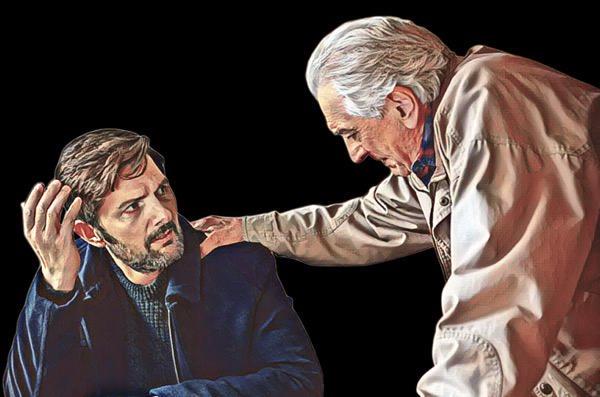
That is exactly where James Ashcroft’s film becomes most interesting. Tom Kennedy (Adam Scott) has lost his wife and is trying to rebuild his life with his son Jake (Acston Luca Porto). Their relationship is difficult, shaped by grief, guilt and Tom’s constant fear that he is a bad father. An understandable fear: he has barely spoken for 25 years to his own father, Pete Willis (Robert De Niro), a former detective whose obsession with an old case and his alcoholism destroyed his family.
That case involved Frank Carter (Michael Keaton), the serial killer known as the Whisper Man, who abducted children after luring them with whispers from outside their homes. Pete managed to catch him, but one victim’s body was never found. Decades later, Jake disappears. Except Frank is still in prison.
So there is a new Whisper Man. So far, so good. The problem begins when the film has to explain practically everything else after Jake has already been abducted.
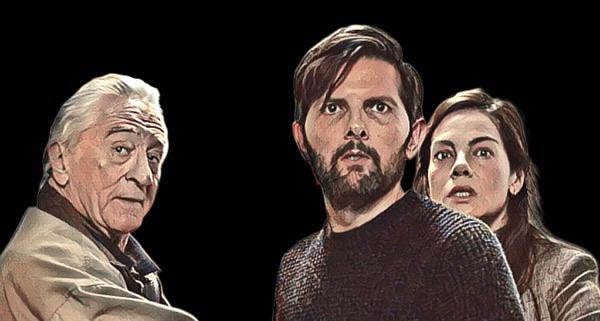
Enter Norman Collins (Hamish Linklater), a true-crime obsessive with a macabre connection to the murders; two corpses hidden inside Tom’s house; the victim Pete was never able to find; a former resident who was murdered; the letters Frank sent from prison; Amanda Beck’s investigation, played by Michelle Monaghan; Frank’s mysterious son; a psychiatrist connected to the original case; Jake’s imaginary friend; Pete’s past; Tom’s past; and a series of tapes sent by the kidnapper.
It is not impossible to follow. But it requires an amount of attention that the film itself seems determined to undermine. And the curious thing is that we know exactly why. In the novel, Jake is kidnapped much later. For the adaptation, screenwriters Ben Jacoby and Chase Palmer decided to move that moment forward. Alex North agreed with the choice because it allowed Pete and Tom to spend more time together searching for Jake.
Dramatically, it makes sense. It is also an excellent excuse to make the most of Robert De Niro. But the change produces a huge side effect: what the novel could reveal gradually now has to be explained during a race against time.
Instead of first learning the board and then watching the kidnapping unfold, the kidnapping begins while we are still trying to figure out who is even playing. That may be why Norman Collins takes up so much space and seems so important. He breaks into Tom’s house, collects murder memorabilia, and has visited a man connected to Frank Carter. Everything points toward him. Until it doesn’t.
Norman had merely arranged access to the missing body of Tony Smith, buried beneath the house. He also murdered Dominic Barnett, another man whose body is found there, but he did not kidnap Jake. It is a perfectly legitimate thriller red herring, except it takes up so much room inside an already congested narrative that by the time Norman exits the story, it almost feels as though another movie has started. And then we finally reach the real secret. The new Whisper Man is Frank Carter Jr. (Owen Teague), the original killer’s son. That is when The Whisper Man finally reveals the story it really wanted to tell.
Frank Jr. grew up trying to earn the love and approval of a father incapable of giving him either. Instead of running from his father’s legacy, he mythologized it. He repeats Frank’s crimes as a kind of desperate tribute, trying to turn himself into the person he imagines his father would want him to be.
Tom faces the exact opposite dilemma. He also grew up wounded by his father. He also carries resentment, abandonment, and fear. But he is desperately trying not to reproduce Pete in his relationship with Jake. On one side, then, Frank and his son. On the other, Pete, Tom and Jake. One son perpetuates the trauma. The other tries to break it. It is a terrific idea — probably better than the thriller built around it.
The scenes between De Niro and Keaton help enormously. The two actors had already appeared in Jackie Brown, but had never shared a scene. Here, they are finally face-to-face, and the film knows how to exploit the weight of that encounter. Keaton makes Frank Carter terrifying precisely because he does not need grand gestures; De Niro turns Pete into a man who seems to carry decades of guilt on his shoulders.
Adam Scott also works well because Tom is not exactly a traditional hero. He is angry, frightened, often lost and far from particularly likable. Michelle Monaghan, meanwhile, has to carry much of the police-procedural side of the story while the film rushes to pull all its pieces together.
There is also Jake’s imaginary friend, a young girl who appears from the beginning and seems to guide him at certain moments. By the end, we discover that she looks exactly like his dead mother did as a child.
This is not something invented for the film. On the contrary, Alex North considers this element essential to the heart of the novel, and Ashcroft deliberately keeps the meaning open. Jake may be psychologically creating a version of the mother he lost, or there may genuinely be some kind of supernatural intervention protecting him.
The idea is beautiful. After spending almost two hours talking about fathers and sons, The Whisper Man ends by returning the mother to the family. But once again, it is a delicate revelation placed inside a story that has already asked us to process far too much.
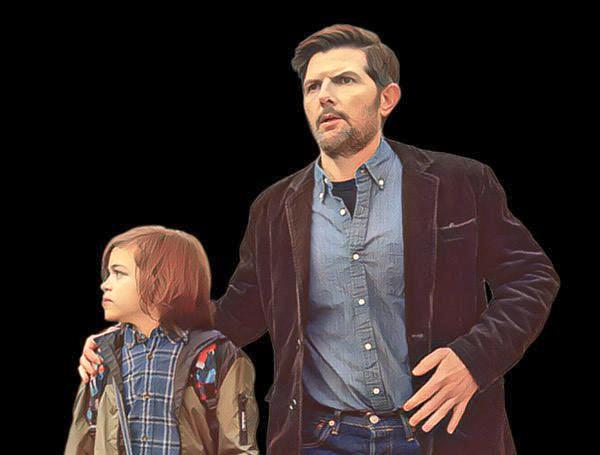
That may be why The Whisper Man is more frustrating than outright bad. It has atmosphere. It has excellent actors. It has a few genuinely tense scenes. And above all, it has a very good idea about emotional inheritance: what we receive from our parents does not necessarily determine what we pass on to our children.
Pete destroyed his relationship with Tom, but still manages one final act of redemption by saving Jake. Tom can finally understand his father without having to repeat his mistakes. Frank Jr., by contrast, spends his life trying to be loved by Frank and ends up literally destroyed by the man whose approval he spent his life chasing. The parallel is powerful. It simply takes us much longer than it should to see it.
At its core, The Whisper Man never needed to be this complicated. The film’s best mystery was never really about discovering who was whispering to the children. It was about understanding what a son does with the voice of a father that keeps whispering inside him long after he has grown up.
Descubra mais sobre
Assine para receber nossas notícias mais recentes por e-mail.

