
With only one episode left, The Shards finally puts Bret face-to-face with the question he has been avoiding ever since Robert Mallory entered his life. It is no longer simply, “Is Robert the Trawler?” The question is far more dangerous now: what if Bret is so obsessed with Robert because, on some level, he desires precisely what he fears?
“Hamlet,” the eighth and penultimate episode of the season, attempts to organize its sprawling stories around Shakespeare. It is such a Ryan Murphy idea that it almost requires no explanation: a literature teacher, played by Noma Dumezweni, discusses Romeo and Juliet, Macbeth, and finally Hamlet, while each play comments — sometimes painfully literally — on what is happening in the students’ lives.
Before that, we are back at the Hamburger Hamlet. Susan is already out of jail after Rhonda recanted her accusation, disposing within minutes one of the previous episode’s biggest cliffhangers. The group plays a private voting game to decide who is the poorest, the sexiest and, inevitably, who might be the Trawler. Bret submits that last question while staring directly at Robert. Someone, however, votes for Bret himself. And while everyone is still playing, he tells them Matt is dead — and that Bret was the one who discovered his severed head inside the school trophy case.
That is where Romeo and Juliet enters Susan and Thom’s story. Susan no longer believes that a love has to last forever simply because it feels absolute when you are 18. Thom, on the other hand, has turned their relationship almost into a matter of survival. When she finally breaks up with him at the Hamburger Hamlet, he grabs a knife and threatens to kill himself, even suggesting that they die together.
It is emotionally violent, manipulative, and pathetic, but Susan finally refuses to remain responsible for Thom’s existence. She wants to grow up, leave this world, and discover who she will become after high school. Thom appears incapable of imagining an identity that does not depend on her. The Romeo and Juliet comparison is almost comically obvious, but it makes one thing clear: Susan has understood that intensity is not necessarily love.
Then comes Macbeth, assigned to Liz Schaffer and Steven Reinhardt. Steven reveals that he knows about the pornographic film Liz made and has bought the negatives. He could be protecting her. Naturally, he is not. Instead, he turns the secret into leverage and wants Liz to convince Terry to produce an adaptation of Bret’s still-unpublished Less Than Zero.
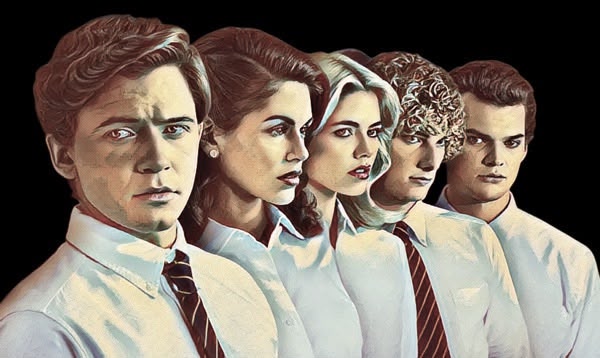
This is where the series returns to its most camp, most Murphy and least Ellis mode. Liz essentially becomes Lady Macbeth on commission, tasked with planting the idea inside her husband’s head. It is entertaining, but it also reinforces a problem The Shards has had from the beginning: at times, another entire television show seems to be fighting for space with the Trawler story.
It is only when we reach Hamlet that the episode truly finds some power. The police begin looking at Bret. The detectives know that he visited Matt’s house on the day Matt disappeared, and Robert has given them information about the nature of their relationship. They also remember Bret promising to help Debbie in the dance competition during which Cha Cha died. His obsession with concealing his sexuality is therefore producing exactly what he fears most: gaps, lies and contradictions that make him look suspicious.
Then someone enters his house. Bret finds an envelope containing photographs and a VHS tape. The footage shows his sexual encounter with Terry, Debbie’s father. It may be the episode’s most important sequence because, for the first time, adult Bret can look back at something his 18-year-old self interpreted as a choice and recognize the imbalance that existed within it. Terry was the adult — powerful and experienced — flattering the supposed maturity of a teenager who desperately wanted to believe he already understood the world.
Bret thought he was in control. He wasn’t. And perhaps the saddest idea in the entire episode is Bret’s realization that, in Los Angeles in 1981, he believed being exposed as a psychotic serial killer would have been less terrifying than being exposed as gay. The Trawler may be destroying bodies. Shame is destroying Bret from the inside.
But Robert still remains. His aunt Abigail reaches out to Bret and finally adds an important piece to the puzzle. After Robert’s mother died, his father had him institutionalized. Robert was the one who discovered her body. More disturbingly, during the summer of 1980, Robert went to see The Shining with Katherine Latchford — the girl who would later become the Trawler’s first known victim.
For Bret, that settles it. The equation is complete. Robert is the killer. Then Robert is suddenly waiting for him in his bedroom. And The Shards makes its best decision: it resolves absolutely nothing. Robert asks why Bret needs him to be a monster so badly. He admits to depression, anxiety, and trauma surrounding his mother’s death, but insists that he has never hurt anyone. Bret looks at the man he has spent the entire season chasing, investigating, desiring, and fearing, and kisses him. They end up in bed together. Or perhaps they don’t.
The episode deliberately leaves a crack between what we see and what actually happened. Even Igby Rigney and Homer Gere have offered different interpretations of whether the encounter should be understood literally. Robert wakes beside Bret and delivers the inevitable line from Hamlet: “To be or not to be.” And suddenly Shakespeare stops feeling like a gimmick.

Bret is Hamlet because he is trapped between certainty and doubt. He wants evidence, but he also wants Robert. He wants to discover who the Trawler is, but perhaps he is using the Trawler to avoid discovering who he is himself. Most importantly, he is a narrator trying to transform memories into a story decades later, when desire, guilt, fear, and memory have become too intertwined to separate.
That has always been the most fascinating part of The Shards: not necessarily finding out who killed whom, but asking whether Bret Easton Ellis can actually tell us what happened.
Murphy still explains too much. He still turns subtext into spectacle and silence into enormous scenes. The Shakespeare device is occasionally so obvious it feels like a caption flashing across the screen. But Hamlet, curiously enough, works. Because once Bret finally touches the man he has spent the entire season turning into a monster, the question is no longer, “Is Robert the Trawler?” It becomes something else. How much of the monster was Robert — and how much of him did Bret need to invent?
The finale, “Stairway to Heaven,” arrives on September 9. And The Shards now has a single episode to decide whether it intends to answer that question or do something potentially far more interesting: allow us never to know the whole truth.
Descubra mais sobre
Assine para receber nossas notícias mais recentes por e-mail.

