
Fuze starts with a premise simple enough to explain in a few lines and strong enough to sustain an entire movie. During construction work in central London, workers discover an unexploded bomb from World War II. The find forces authorities to evacuate a huge area of the city, mobilizing police and the military and turning normally crowded streets into an almost empty landscape. While everyone is focused on preventing a disaster, another group realizes exactly the same thing: the evacuation is also the perfect cover for a robbery.
Aaron Taylor-Johnson plays Major Will Tranter, a bomb-disposal specialist called in to assess the device. On the other side of the operation are Karalis, played by Theo James, and X, played by Sam Worthington, both involved in the heist, taking advantage of the chaos to reach a vault. Gugu Mbatha-Raw completes the main ensemble as police officer Zuzana, following a situation that very quickly starts to look far more complicated than an old bomb accidentally uncovered underground.
The director is David Mackenzie, the Scottish filmmaker who already proved with Hell or High Water that he knows exactly how to build tension around crime, trapped men and plans that appear perfect until they stop being perfect. Here, though, he is not aiming for the same emotional density. Fuze is much more interested in movement, mechanics, and surprise. Its pleasure comes from showing us an operation, allowing us to believe we understand what is happening, and then revealing that we were only looking at one part of the plan.

And perhaps the film’s greatest strength is precisely its economy. There is relatively little dialogue, very little concern with extensively explaining who these people are, and almost no attempt to turn every character into a psychological study. Mackenzie trusts looks, movement, silence and editing. Even the evacuated London streets become part of the suspense: we know there is a bomb beneath the city, we know a robbery is underway, and, above all, we know that not everyone seems to be following the same plan.
That could easily result in thin characters. And, to some extent, it does. Ben Hopkins’ screenplay is much more interested in the engineering of the heist than in the inner lives of the people carrying it out. But Fuze is smart enough to give those roles to actors capable of filling in the gaps.
Aaron Taylor-Johnson works through restraint. Will Tranter is a man trained to make decisions under pressure, and the actor never turns that competence into showmanship. Theo James operates on a different frequency: Karalis has more edge, more instability, and an energy that makes him immediately difficult to ignore. Sam Worthington may be the most extreme example of the film’s economy. X says very little and spends much of the movie watching, intimidating, and making his mere presence suggest that there is something we still do not know. Even when the script gives them little, all three actors make it feel as though much more is happening underneath.
And there is. Because Fuze lives on its twists. The first major turn reorganizes the very premise: what initially seems to be nothing more than a historical threat uncovered by accident turns out to be far more intimately connected to the robbery than we imagined. From there, the question is no longer simply whether the criminals will pull off the heist. It becomes who is actually carrying out which plan.
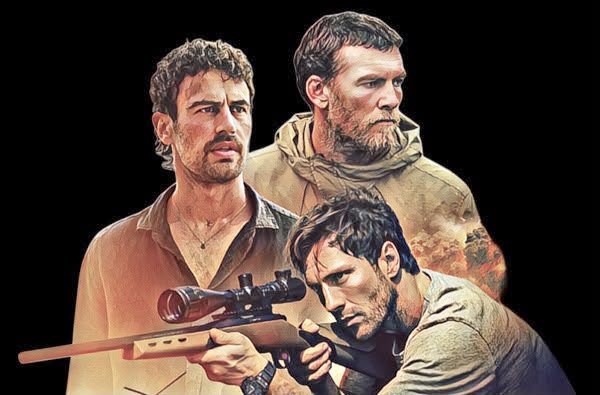
The alliances begin to blur. There are hidden interests within the group itself, information that arrives too late, betrayals, and a succession of revelations about who is manipulating whom. The film also plays with what is actually being stolen, the real value of what is inside the vault and the possibility that more than one deception is unfolding at the same time. The closer we get to the ending, the less safe it becomes to assume that any character is exactly where they appear to be.
It is not worth detailing every twist because much of the fun depends on discovering them. But it is important to say that Mackenzie does not treat the twists as giant moments designed to stop the movie in its tracks. They arrive while everything keeps moving. One piece of information changes our understanding of what we have already seen, another alters the relationships between the characters and, only a few minutes later, another layer is revealed.
It is a thriller that prefers to surprise quickly rather than explain at length. That also means some of the twists require a generous suspension of disbelief. The more the plan is revealed, the more we realize just how many variables would have needed to work exactly as expected. There are coincidences, overly elaborate strategies, and characters capable of anticipating reactions with almost impossible precision. But Fuze does not seem particularly interested in defending its plausibility. It wants to keep the machine running. And most of the time, it succeeds.
The critical reception reflected exactly that balance. The film landed at around 72% approval on Rotten Tomatoes, with the consensus highlighting its energy, style, and abundance of twists, while verified audience approval was even higher, close to 78%. More positive reviews praised the pacing, unpredictability and Mackenzie’s efficiency, while the main reservations focused on the lack of character depth, the implausibility of some of the turns and an ending that not everyone felt was necessary.

That seems fair. Fuze is not trying to be Hell or High Water, even though it comes from the same director. There is none of the same social or emotional density here. What it offers instead is a compact thriller of roughly 97 minutes that knows exactly when it needs to accelerate and, for the most part, refuses to waste time on explanations that might interrupt the tension.
Perhaps that is why the limited dialogue works so well. The film does not need Aaron Taylor-Johnson, Theo James or Sam Worthington to tell us who they are. It is enough to put them in a room, let them watch each other and wait. We know someone is lying. We know someone knows more than they should. And we know the plan we think we are following is probably not the real one.
Fuze does not reinvent the heist movie. But it understands one of the genre’s basic rules very well: the best plan is the one the audience only understands when it is already too late.
And when the pieces finally start to fall into place, it is the actors who make even the most improbable turns feel convincing.
Descubra mais sobre
Assine para receber nossas notícias mais recentes por e-mail.

