
Elton John had already completed his farewell tour, but something important had been missing from that long goodbye: Brazil had been left out because of the pandemic. On Monday night, September 7, he returned to Rock in Rio to correct that absence and, possibly, say goodbye to Brazilian audiences. This was not a performance designed to pretend that time had stood still. It was precisely the opposite.
At 79, with a deeper, more weathered voice and dealing with the eyesight problems that have restricted his life in recent years, Elton spent almost the entire night protected by his piano. Still, to say the piano protected him may be unfair, because from behind it he commanded the World Stage for more than two hours, accompanied by an impeccable band and more than 100,000 people singing as if they knew they might never have another opportunity.
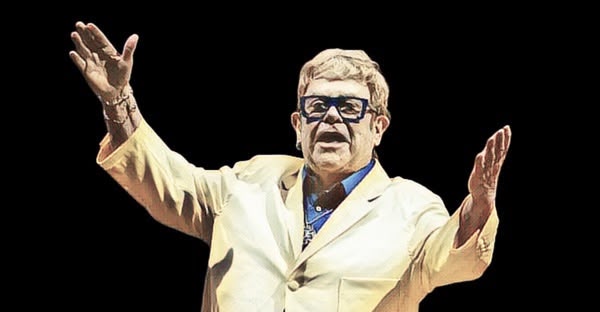
It was genuinely cold at the City of Rock. Temperatures hovered around 64°F, the air remained damp after the rain, and Elton himself, despite being accustomed to British weather, complained about the temperature several times. None of it diminished the audience’s response. People stayed until the end and turned a wet Monday night into a collective celebration of more than five decades of music.
Elton took the stage promptly at 11 p.m., wearing a yellow suit, and opened with the long, theatrical “Funeral for a Friend/Love Lies Bleeding.” From there, the setlist moved through virtually every phase of his career, from “Bennie and the Jets,” “Philadelphia Freedom” and “Tiny Dancer” to “Sacrifice,” “Rocket Man” and “Candle in the Wind.” There was no playback, no attempt to disguise the current state of his voice, and no effort to reproduce the man who once crossed stages in platform shoes and impossible costumes. There was an older gentleman at the piano, and an audience perfectly aware of the magnitude of that encounter.
On some level, that was what made the concert so moving. We have become accustomed to demanding that artists grow older without appearing to age, as though the body were not allowed to record the cost of a life lived onstage. Elton John did not try to compete with his own image. His voice has lost range and acquired a rougher texture, while his body no longer allows for the physical exuberance of earlier decades. The musician, however, is still there, unmistakable in the way he attacks the piano, stretches the arrangements, and guides songs the audience recognizes before the first lyrics are even sung.
It was also a generous setlist, with 23 numbers and 24 songs if the two parts of the opening medley are counted separately. After “Sorry Seems to Be the Hardest Word,” “Someone Saved My Life Tonight” and “Have Mercy on the Criminal,” the concert moved into an almost merciless sequence of classics: “Goodbye Yellow Brick Road,” “Sad Songs,” “Don’t Let the Sun Go Down on Me,” “Crocodile Rock,” “Saturday Night’s Alright for Fighting” and “I’m Still Standing.”
That last song inevitably carried a different weight. “I’m Still Standing” has always been a song about survival, but sung now by an artist who has endured addiction, health problems, partial loss of sight, and his own farewell from touring, it ceased to be merely an irresistible 1980s hit. It became a statement of fact.
Elton explained to the audience that he had indeed stopped performing regularly, but regretted not bringing the Farewell Yellow Brick Road tour to Brazil. When he received the invitation from Rock in Rio, he accepted it as an opportunity to thank the Brazilian public for the affection it had shown him throughout his career. “Thank you, Brazil, for being such a beautiful part of my life,” he said.
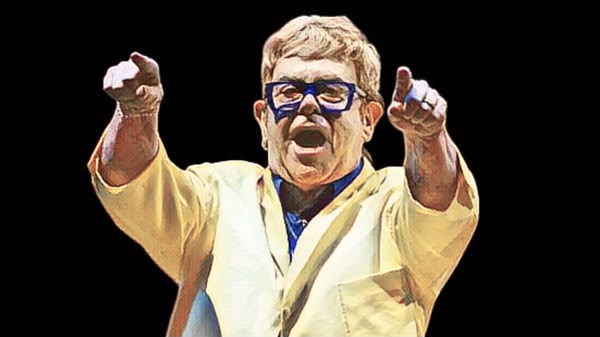
The encore began with “Cold Heart,” the song that introduced him to a new generation alongside Dua Lipa, but the most distinctly Brazilian moment of the night came next. Elton brought back “Skyline Pigeon,” which he had not performed live since 2019 and which became far more popular in Brazil than in other countries. Saving it for the end was an affectionate choice, almost a private message delivered in the middle of a festival attended by 100,000 people.
The farewell came with “Your Song,” the track that made the world pay attention to that English pianist more than half a century ago. There was no grand final speech or excessive staging. The audience sang, Elton gave thanks, and the meaning was complete.
Perhaps he will return. Artists have taught us to be wary of the word “last,” and Elton continues to give occasional performances despite having retired from major tours. But if this really was his farewell to Brazil, it was worthy of his history. Not because he tried to defeat time, but because he stood before it without disguise.
Descubra mais sobre
Assine para receber nossas notícias mais recentes por e-mail.

