
Once you reach a certain age, you accumulate historic moments about which you can say exactly where you were, what you were doing, and how you felt when everything happened. September 11, 2001, is more than one of those dates. It is the day the world changed.
Those who lived through the years before it know that, despite all the problems we already faced, there was still a kind of innocence. Perhaps it was only an illusion, and it was certainly a privilege reserved for those who did not live under wars, terrorist attacks, or authoritarian regimes, but it existed. There were habits, freedoms, and a relationship with fear that we would never completely recover. The wound opened that morning changed politics, travel, cinema, television, and the way we began looking at every stranger aboard an airplane.
I was living in New York in 2001. I had already written about how the World Trade Center had prepared for another terrorist attack following the 1993 bombing, when a bomb planted in a van in the underground parking garage killed six people and injured more than a thousand. Security and evacuation procedures had been revised, but no one imagined commercial airplanes being turned into weapons. Aircraft hijackings had long been absent from our daily lives and seemed to belong to another era.
One of my best friends worked at The Wall Street Journal, whose newsroom was located at One World Financial Center, across West Street from the World Trade Center complex. Because she covered Asian markets, she started work very early. That morning, I woke up late and turned on the television. The images showed what was still being described as “a plane that crashed into one of the towers.” It was the North Tower, struck at 8:46 a.m., but no one understood exactly what had happened. The initial assumption was still that it had been an accident.
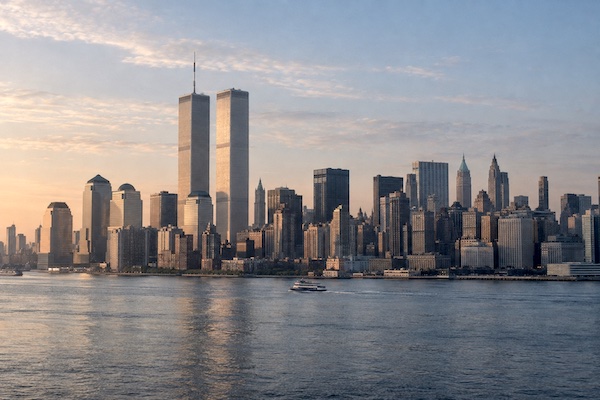
I immediately called my friend. She did not answer. I was still trying to reach her when I watched the second plane appear on the screen and strike the South Tower live at 9:03 a.m. It took me a few seconds to understand what my eyes were showing me. It was not a replay of the earlier footage or a simulation. It was another plane. I screamed for her and for everyone.
From that moment on, the uncertainty disappeared, but the panic was only beginning. We knew that the United States was under attack, although no one knew by whom, how many targets there were, or what might still happen. Then came the Pentagon, the flight that crashed in Pennsylvania, and the collapse of both towers. It all happened in less than two hours, but that morning never truly ended. We watched it unfold live, before our disbelieving eyes.
There was no social media. Google was still a new tool, far from the central role it would later occupy. People searched for one another by telephone as lines became overwhelmed and calls failed to go through. Everyone tried to reconstruct their friends’ routines mentally: who worked downtown, who might have been on the subway, who had a meeting in that area, who usually arrived early, and who, by sheer luck, might have been running late.
For hours, locating someone meant depending on an answered call, a message relayed by another person, or fragmented information on television. Today, when we follow a tragedy almost instantly on our phones, it is difficult to explain the feeling of being surrounded by news and, at the same time, unable to find out whether one particular person was alive.
I was lucky. All my friends who were in that area survived. They emerged traumatized and changed, as we all did, but they were alive. Nearly three thousand people did not return home that day. There were 2,977 victims, excluding the 19 hijackers, and even that number does not tell the complete story, because firefighters, police officers, workers, residents, and volunteers continued to become ill and die in the years that followed as a result of exposure to the dust and toxic substances released by the collapse.
The World That Existed Before
When we say that the world changed on 9/11, the phrase may sound so familiar that it has lost its meaning. But our habits really did change. Flying ceased to be a relatively simple experience. Cockpit doors were reinforced, airports became spaces of permanent surveillance, and everyday objects began to be treated as potential threats. Removing our shoes, limiting liquids, arriving hours in advance, and accepting searches of our bodies and luggage became a normal part of traveling.
The deeper transformation, however, did not take place only at airports. The attacks produced the so-called War on Terror, the invasion of Afghanistan, and later the war in Iraq, even though the Iraqi regime had not participated in 9/11. Fear made room for the Patriot Act, the expansion of government surveillance, imprisonment without trial, torture, Islamophobia, and a curtailment of civil liberties that might not have been accepted under different circumstances.
We began living under the justification that any measure might be necessary to prevent the next attack. The problem was that the “next attack” never had to happen for it to continue shaping politics and fueling fear. It only had to remain possible.
Language itself changed. Expressions such as terrorist threat, national security, weapons of mass destruction, and axis of evil became part of everyday life. For years, the news seemed to exist permanently between two alerts. Television kept continuous information tickers running across the screen, while cinema transformed collective anxiety into stories about invasions, surveillance, conspiracies, destroyed cities, and heroes authorized to cross any line in the name of security.
New York’s image also changed. For a while, films and television series removed the Twin Towers from posters, trailers, and completed sequences, as though the mere sight of the buildings might be offensive or unbearable. Then came the works that tried to process the trauma, some delicately and others by turning it into spectacle. Cinema took time to understand how to represent an image we had all seen far too many times.
The Pain Does Not Belong Only to the Past
Twenty-five years later, some adults had not even been born when the planes struck the towers. For them, 9/11 is history, studied through images, documentaries, and personal accounts. For those who lived through that day, especially in New York, distance works differently.
The images still produce a physical reaction. We know what will happen when the second plane appears, but some part of us relives those seconds when we did not know. We see people in the streets looking up and know what they do not yet know. We watch the towers burning and already know the moment when they will cease to exist. Historical memory moves forward; traumatic memory remains trapped in the present.
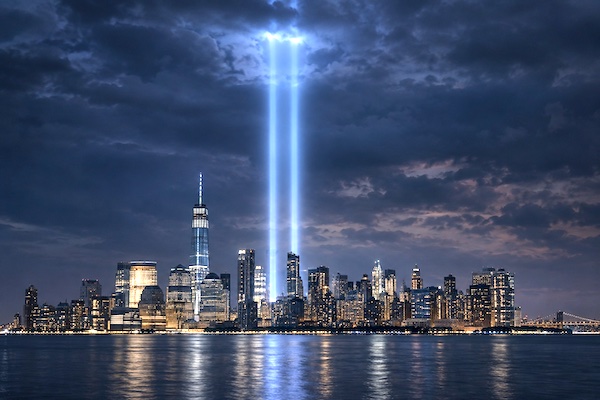
That is why talking about 9/11, 25 years later, remains as painful as it was on that now-distant morning. It is not because time has not passed, but because some events reorganize time itself. Everything that came before began to belong to the previous world; everything that followed carried some consequence of that day.
I was fortunate enough to find my friends again. Many families spent hours making the same calls and never received the answer they were waiting for. They are the people I think about when the images return, when the names are read aloud once more, and when someone asks where I was on 9/11, 2001.
I was in New York, standing in front of a television and trying to locate a friend, when I saw the second plane strike the South Tower. At that moment, I did not yet know everything we would lose. I knew only that nothing would ever be the same again.
Descubra mais sobre
Assine para receber nossas notícias mais recentes por e-mail.


1 comentário Adicione o seu