
As published on Blog do Amaury Jr./Splash UOL
There is a basic problem with every prequel: we already know too much. We know the characters who will come later; we often know who survives, who dies, who marries, and even which children will become important. In theory, the suspense is gone before the story even begins. Outlander: Blood of My Blood, however, has found a clever way to turn that limitation into part of its appeal.
The second season premieres on Disney+ in Brazil on September 19, with a new episode every Saturday, and picks up the stories of Jamie Fraser’s and Claire Beauchamp’s parents at a moment when both couples are once again separated. On one side are Brian Fraser and Ellen MacKenzie, at the beginning of the Jacobite Rising of 1715; on the other, Henry and Julia Beauchamp, trying to find their way back to their own time and to the daughter they left behind.
I spoke exclusively with Jamie Roy, Harriet Slater and Jeremy Irvine about this particular paradox at the heart of the series. Outlander viewers know far more about Brian and Ellen’s future than the characters themselves do. We know they will stay together, have children and build Lallybroch. We also know some of the losses that lie ahead. So how do you keep an audience curious when so much of the destination has already been written?
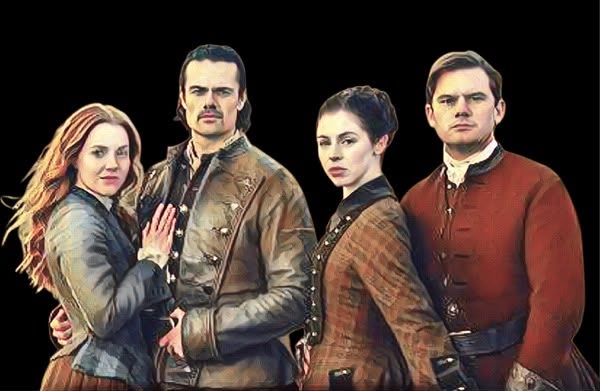
Jamie Roy, who plays Brian, has a simple and very precise answer. For him, knowing the ending is not the same as knowing the story. It is like opening a book at the last page: you may find out what happened, but it means very little if you do not know what it took to get there.
“We know some facts about Brian and Ellen’s life. We know that they get together, they get married, they have children, they build Lallybroch,” he says. What remains unknown occupies an enormous space. “Just because they were together doesn’t mean that they were happily together. Who’s to say that Brian and Ellen didn’t have fights? What would it look like if Brian and Ellen had an argument?”
It is an observation that explains much of what worked in the first season. Blood of My Blood did not need to invent a new destiny for characters who were already part of Outlander history. It needed to bring the space in between to life.
Lallybroch is a perfect example. For anyone who has followed Outlander, the house is almost a character in itself. We know what it represents to Jamie, we know its place in Fraser family history, and we know Brian built it. Roy looks at that familiar fact and asks the questions a prequel is able to answer: how long did it take? What happened while it was being built? Did anything have to be rebuilt along the way? An entire life can exist between two sentences of family history.
Harriet Slater faces something similar with Ellen MacKenzie. Ellen has always existed in Outlander, but mostly as a memory. We know her importance through the people who came after her. We never had access to the woman before she became that almost mythical figure within the Fraser family.
“We know that Ellen dies and that she has a few kids, but other than that, we don’t know a whole lot about her or her life,” Harriet says. “We’ve never seen her before. We’ve only heard a few things from other characters throughout Outlander.”
And perhaps this is where Blood of My Blood becomes most interesting for those of us who have spent so many years with Jamie Fraser. Harriet talks about discovering the trials that made Ellen who she was and, as a consequence, understanding a little more about the son she raised.
That does not mean reducing Jamie to his parents or turning personality into a simple equation of cause and effect. Still, it is impossible to watch Brian and Ellen without recognizing certain echoes. The sense of family, loyalty, the relationship between love and duty, the idea of belonging to a place and a clan. What arrived fully formed in Outlander now has a story that came before it.
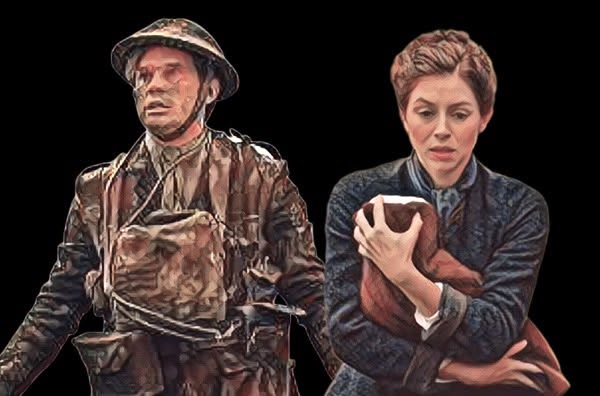
Jeremy Irvine has a different narrative problem. Henry and Julia Beauchamp do not enter the prequel carrying a future as detailed as Brian and Ellen’s. We know, of course, that Claire exists. Beyond that, there is far more unexplored territory.
“With Henry and Julia, their story hasn’t really been told previously,” Irvine says. “We’re not sure where they end up.” For an actor working inside a prequel, that is almost a privilege: while part of the cast is working within the boundaries of a known destiny, Henry and Julia still have much larger areas of uncertainty.
In the new season, Henry may also be the character paying the highest emotional price. When I spoke to Jeremy, I told him that I consider Henry one of the most tragic characters in this part of the saga. He is already traumatized, separated again, torn between wife, children, past and present, and is beginning to lose even the certainty of what he sees.
Irvine enjoys that side of the character as an actor. “He’s not quite sure what’s real and what isn’t real,” he explains. “Is something a hallucination or is it really there?” After everything Henry has already experienced, that fractured state of mind becomes part of the story itself. To our relief, Jeremy promises there will be a few lighter moments. Apparently, not too many.
If the first season introduced these two great love stories and brought us closer to both couples, the second once again places History between them. In Brian and Ellen’s case, quite literally.
They have only just won their freedom and the possibility of being together when the crosses are lit, announcing that war is coming. Ellen must return to the MacKenzies; Brian goes back to the Frasers. The Jacobite Rising of 1715 divides the Highlands and forces the clans to choose sides.
“The stakes are much higher for everyone,” Harriet says. For her, there is something particularly cruel about this new separation because Brian and Ellen already know they have found each other. Now they have to accept that they are part of a story larger than their own romance. “They’re fighting for each other as well as for their clans and for Scotland.”
There is also a cultural distance the series has to bridge. For viewers in the 21st century — and especially for those of us who did not grow up studying Scottish history — the immediate reaction can seem obvious: if Brian and Ellen want to be together, why not simply run away?
Jamie Roy is quick to remind us that this was hardly a real choice.
Abandoning one’s obligations to the clan, he explains, could mean exile or death. Belonging was not merely emotional; it organized family, protection, identity, and survival. “Love is important, but clan duties, especially when it comes to something as broad as war, kind of take precedence over that.”
Harriet adds another detail that helps explain the scale of the conflict: Scotland did not have, in that context, a standing national army in the way we would imagine one today. The clans themselves supplied the men, divided by different political loyalties. Ordinary people had to become soldiers because, as she puts it, there was simply no one else to fight in their place.
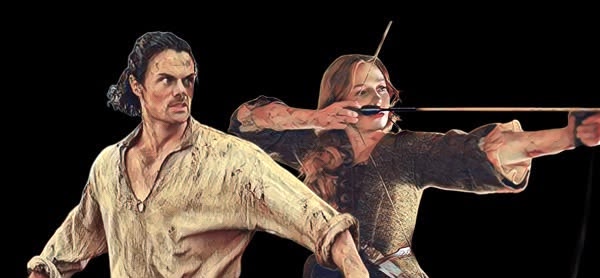
That connection with real history became a discovery for the cast as well. Jamie says he learned a great deal about the Jacobite risings simply by reading the scripts and then began researching them on his own.
“I’d read it and think, ‘Oh, that’s cool.’ Then I’d look it up and discover, ‘Oh, that’s actually how it happened in real life,’” he says. For him, the series manages something Outlander has always done particularly well: it entertains while quietly pushing the audience toward History.
Jeremy Irvine describes the same experience from another angle. In the large battle scenes, costumes, sets and production details help the actors enter that world. “You can really sort of look around you and go, ‘Wow. Yeah, this is probably really close to what it was like.’”
Perhaps that is the best answer to the question every prequel eventually has to face. Why go back when we know where everything ends?
Because knowing that Brian and Ellen will have Jamie does not tell us who they were when they fell in love. Knowing that Claire was born does not explain Henry and Julia. Knowing that Lallybroch exists does not tell us how that house was built. And knowing that some of these characters are headed toward tragedy may make every small moment of happiness more painful, not less.
During our conversation, I told them that, in a way, Blood of My Blood turns us into a rather cruel audience. The more obstacles appear, the more story we get to watch. We suffer when they are separated, but we also know that every separation gives us more episodes, more roads to follow, and more answers.
Jamie Roy laughed. Harriet Slater did too.
Perhaps they know that this has always been the pact Outlander made with us. Love was never a guarantee of happiness; it was simply the reason to keep fighting.
Descubra mais sobre
Assine para receber nossas notícias mais recentes por e-mail.

