
Warning: This article contains spoilers for Anniversary.
Anniversary is one of those films that remains unsettling even when it is not entirely convincing. Perhaps because its political dystopia combines disparate elements, simplifies the rise of an authoritarian regime and, in its final stretch, takes its allegory to an almost didactic extreme. Or perhaps because, beneath all of that, lies a truth that is much closer to home and harder to dismiss: how many families have already been divided, some of them permanently, by political differences?
Polish director Jan Komasa uses a single home to tell the story of a country’s transformation. The choice could have felt artificial, but it is one of the film’s best ideas. Politics stops being an abstract debate conducted through campaigns, parliaments or social media and begins to reorganize affection, loyalty and belonging. The Taylors continue to gather, celebrate anniversaries and inhabit the same spaces, but they can no longer recognize one another. The house remains. The family does not.
Diane Lane and Kyle Chandler are essential to giving this rupture any weight. As Ellen and Paul Taylor, they immediately create the sense of a long, loving and imperfect marriage, the kind in which two people have already learned to laugh at their own differences. Ellen is a political science professor at Georgetown; Paul owns a successful restaurant. On their 25th wedding anniversary, they welcome their four children into the family’s comfortable home: Anna, a comedian; Cynthia, an environmental lawyer; Birdie, the youngest, who is interested in science; and Josh, a writer who has never managed to turn his ambitions into a career.
Josh arrives with Liz Nettles, played by Phoebe Dynevor. It does not take Ellen long to recognize her as a former student whose thesis defended anti-democratic ideas and a one-party system. Liz reappears not only as her son’s girlfriend, but as the author of The Change, a book that promises to overcome political polarization and restore unity to the United States. It is seductive precisely because it does not present itself as authoritarian. No one announces an intention to eliminate democracy. They speak of unity, security, stability and an end to division.
The film moves through time by returning to new family gatherings. With each anniversary, Liz’s doctrine occupies more space in the country while the Taylors lose something: their jobs, safety, trust or simply the ability to remain together around the same table. The Change gains corporate support, alters the American flag and transforms the idea of the political center into a justification for a single project of power. Ellen loses her job after being filmed destroying a neighbor’s Change flag. Anna is assaulted for making jokes about the movement and goes into hiding. Cynthia refuses to have a child in a country she no longer recognizes, a decision that destroys her marriage. Birdie, initially drawn to a scientific opportunity offered by Liz, eventually becomes radicalized in the opposite direction.
Everything is concentrated within the same family, as though each character were required to represent a possible response to authoritarianism. This is where Anniversary becomes more schematic, but also strangely effective. How many of us know siblings who have stopped speaking, parents and children who have severed relationships, or family gatherings that have become minefields because any remark might start a war? The film pushes that experience to its limit, but begins with a perfectly recognizable sadness: politics has ceased to be an opinion and begun to determine who still belongs in the family.

The Resentment of a Weak Man
The most didactic arc belongs to Josh, played by Dylan O’Brien. He is introduced as a weak, resentful and vulnerable man, a failed writer who experiences his mother’s encouragement almost as a form of condescension. He has none of his sisters’ success, does not seem talented enough to achieve what he wants and occupies a secondary position within a family of strong personalities. Liz offers him everything he believes has been denied to him: importance, respect, money, visibility and, above all, power.
Josh does not need to be persuaded by a grand political theory. He joins because the new order makes him feel larger. He changes his appearance, gains confidence and begins to speak like someone who has finally discovered his own value, without realizing that this value was never really his. It is on loan from Liz and the movement for as long as he remains useful. The transformation may seem too obvious, but it may also be one of the film’s most truthful observations. Authoritarian regimes have always known how to recruit the resentful, people who interpret their own frustrations as proof that the world owes them something.
What is most disturbing is that Anniversary preserves an ambiguity: does Josh truly fail to understand that he is destroying his family, or does he take a perverse pleasure in punishing them? He reports Anna when she reappears at their parents’ party disguised as a clown, yet still tries to convince himself that he is acting within a legitimate order. He accepts persecution, violence and the disappearance of others because he continues to believe that the power he helped build will protect him.
He discovers too late that he never belonged to it. When the police storm the house, Josh asks them to keep his parents together and tries to exercise the authority he imagines he possesses. No one listens. In front of the officers, Liz places him among the Taylors and allows him to be taken away with them. Josh destroyed everything to earn a place beside her and ends up discarded as one more piece that has outlived its usefulness.
What Did Liz Really Want?
Phoebe Dynevor has the most difficult role because Liz must remain partly indecipherable. Her political ambition has been clear since the thesis advocating the end of democracy and a one-party system, but there is also a personal motive. Ellen did not merely reject her ideas when she was a student. Liz felt humiliated by that professor and returns years later attached to the family’s most vulnerable son. It is difficult to believe that their meeting was accidental.
Liz wants to realize the project of The Change, but she also wants to defeat Ellen. She enters her home, turns Josh into an ally, progressively occupies the center of the family and, at the 30th anniversary party, appears dressed in red just as Ellen was at the first celebration. Conquering the country is not enough. She needs to prove her former professor wrong, stripping her of her job, her authority and, ultimately, her family.
This is why the strange conversation in which Liz approaches Ellen and asks for help because Josh is not well is so important. There may be a rare moment of sincerity there. She inflated a resentful man, gave him a prominence he had never earned and may have realized that she can no longer control what she awakened. Josh has ceased to be merely arrogant: he has become paranoid, cruel and dangerous.
But the plea for help may also be preparation for abandoning him. Liz may not be saying “save my husband” so much as asking Ellen to help her solve the problem he has become. The slap she receives also gives her the perfect image of the intolerant and aggressive former professor. The film never explains which interpretation is correct, but the ending makes the second one more persuasive.
After Birdie carries out the attack on Cumberland headquarters, Josh reports Anna, Cynthia stabs him and the police storm the house. Even while injured, he still believes he has some authority and asks the officers to keep Ellen and Paul together. When a policeman asks Liz what he should do with him, she replies that Josh is with his parents. The sentence sounds almost protective, but functions as a verdict: Liz returns him to the family he destroyed and includes him among the enemies of the new order.
Only then does she look at a photograph of the Taylors in happier times. For a few seconds, she appears disturbed, as though she can still comprehend the scale of the destruction. Her small final smile, however, confirms her victory. Ellen has been silenced, Josh is no longer useful and the family that once made her feel inferior no longer exists. Liz may experience a moment of guilt, but not of regret.
An Exaggerated Dystopia, But for Whom?
It is in the transition from a divided family to a national dystopia that the film troubles me most. Anniversary combines authoritarianism, corporate power, surveillance, censorship, the persecution of artists, ideological control and police violence in an increasingly explicit reality. Census workers enter the house asking questions designed to locate Anna, Birdie is threatened, everyone is constantly monitored and, finally, a police raid turns Ellen and Paul’s 30th wedding anniversary into a massacre.
My first reaction would be to say that this kind of overt surveillance and the ease with which authorities invade a home belong to fiction. But that would mean speaking from a very particular social position. For those who have always been able to believe in the inviolability of their homes, the scene looks like a future dystopia. Residents of communities subjected to police raids, families living with arbitrary searches and people for whom the state has always arrived armed would probably disagree. What the film presents as the exceptional end of democracy already exists, to varying degrees, in the lives of poorer sections of the population.
Even so, perhaps only someone who has lived under an authoritarian regime recognizes that everyday fear is often more subtle. People continue to work, meet friends, choose what to wear, celebrate anniversaries and move through the city. Repression appears in the words we stop saying, the subjects we avoid, the people around whom we learn to remain silent and the disappearances no one knows how to ask about. The most efficient patrol is not always in the street. Often, it has already been installed inside each of us.
In that sense, Anniversary is more successful when it remains with the Taylors than when it attempts to explain the entire country. The family’s transformation shows how the intolerable becomes normal through small concessions. Paul tries to preserve the peace. Ellen believes intelligence and argument will be enough. Cynthia tries to survive. Birdie accepts an opportunity before understanding its price. Josh mistakes proximity for power. By the time they all recognize the scale of the change, there is no safe place left to return to.

Diane Lane and Kyle Chandler Carry the Story
Diane Lane carries the film without turning Ellen into a flawless heroine. She is intelligent, arrogant, loving, impatient and incapable of concealing her contempt for Liz. Her certainty that she can identify the danger before everyone else does not mean she knows how to stop it. Lane allows the anger to appear before the fear and then lets the character be slowly hollowed out by the loss of her job, her children and her confidence in her own ability to understand the world.
Kyle Chandler works in the opposite register. Paul tries to keep the family together, defuse conflict and find a practical way out of threats he does not entirely understand. His restraint could have made the character disappear beside Ellen, but it achieves the opposite. Chandler represents a decent man who believes familial love can survive politics until he discovers that politics has already occupied every part of the family.
Behind the scenes, Lane described Chandler as an especially warm presence, important during the filming of a story carrying so much emotional tension. That partnership is visible on screen. Ellen and Paul do not need to explain that they love each other; it is there in the intimacy of their gestures, their humor and the way they keep reaching for one another as everything collapses.
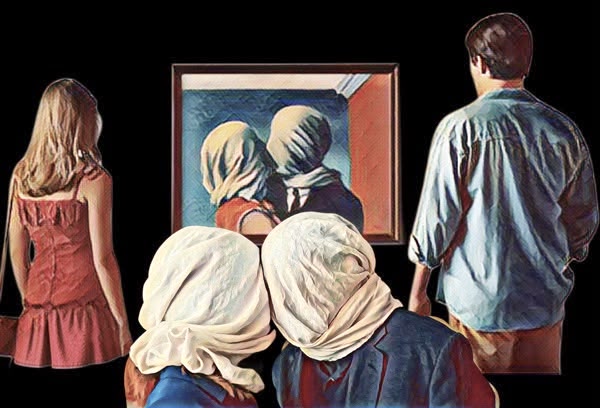
The final image of the two is both cruel and beautiful. With bags placed over their heads by the police, Paul tries to calm Ellen by recalling the first time they met in front of René Magritte’s The Lovers, a painting in which two people kiss with their faces covered by cloth. The film transforms a romantic memory into an image of repression, but preserves the one thing the regime has not yet managed to take from them: the history they built together.
Komasa, the director of Corpus Christi and The Hater, wanted to follow a family’s evolution over five or six years. He developed the story with screenwriter Lori Rosene-Gambino and made his first English-language feature with an extraordinary cast. Diane Lane also served as an executive producer. Filming began in Dublin in 2023 during the actors’ strike, and the independent production received permission to continue.
The film received a remarkably small American release for a production with this cast. People connected to it claimed that it had been buried for being politically incendiary, while producer Nick Wechsler acknowledged the difficulty of selling a political thriller at a time when audiences seem to avoid that kind of confrontation. The irony is obvious: a film about the inability to have a conversation was given a distribution strategy equally afraid of starting one.
A Film That Unsettles Every Side
Anniversary will probably unsettle viewers across the political spectrum, and that may be one of its virtues. The dystopia is excessive, the symbols are obvious and some characters exist more as ideological positions than as people. Yet the film does not need to predict exactly how an authoritarian regime would emerge in the United States to offer a valid warning. Political fiction is not prophecy; it is amplification.
What makes the story possible is not the new flag, the census workers or the one-party system. It is Josh’s resentment, corporate opportunism, the collective desire to end conflict without confronting its causes and the ease with which words such as unity and security can conceal projects of control. Above all, it is the willingness of ordinary people to tolerate the intolerable when they believe they will benefit from it.
The invasion of the house may seem extreme. A family divided by politics does not. That family already exists in many places, perhaps much closer to us than we would like. Anniversary gets right in its intimate portrait what it simplifies in its politics: regimes may promise unity, but they begin by teaching people to see relatives, friends and neighbors as enemies.
In the end, Ellen and Paul lose their home, their family and the life they knew, but Josh also loses the illusion that he would be spared. He was weak before meeting Liz and remains weak once she no longer needs him. For a few years, he simply mistook the movement’s strength for his own.
Perhaps that is the most disturbing conclusion of Anniversary. Authoritarianism does not need everyone to believe. It only needs people resentful enough to serve it, frightened enough to remain silent and confident enough to imagine that the violence will always be directed at someone else’s family.
Descubra mais sobre
Assine para receber nossas notícias mais recentes por e-mail.


1 comentário Adicione o seu