
Jane Austen wrote some of the most famous love stories in literature, and more than two centuries later we still return to Darcy, Wentworth, Knightley, Edward Ferrars or Colonel Brandon. Of course we do. But look a little closer and something else becomes obvious: the men arrive relatively late. Before them, there are almost always sisters.
There are five Bennet sisters. Three Dashwood sisters. Emma Woodhouse has Isabella. Anne Elliot has Elizabeth and Mary. Fanny Price comes from a large family and eventually finds in Susan a relationship that becomes essential. Even Catherine Morland, whose family virtually disappears once she leaves home, grows up surrounded by brothers and sisters. In a body of work this carefully constructed, that is hardly a small coincidence.
Jane Austen wrote female friendships too, of course, but there is an important difference between the two. Friends are chosen. And Austen seems to take considerable pleasure in showing how badly her heroines can sometimes choose them. Sisters are not chosen at all. They are simply there: to love, irritate, protect, envy, imitate and judge one another, and to know each other in ways no newly arrived Darcy ever could.
No novel makes this clearer than Sense and Sensibility. Elinor and Marianne Dashwood give the book not only its two heroines, but the very conflict suggested by its title. For a long time, we have reduced that opposition to something simple: Elinor is reason, Marianne is sensibility. One controls herself; the other feels. One is right; the other has something to learn. But Austen is never that simple.

Elinor feels deeply, perhaps too deeply. Her discipline does not come from a lack of emotion, but from the knowledge that someone in that family has to keep functioning. Marianne, meanwhile, is not wrong because she loves, suffers or throws herself into emotion. Her mistake is believing that intensity alone guarantees truth. They need one another because Elinor must learn that restraint cannot mean permanent silence, while Marianne must learn that feeling without judgment can turn into self-destruction. By the end, neither sister has won. Both have changed.
And then Austen places beside Elinor a woman who is neither her sister nor really her friend: Lucy Steele. She is almost an anti-friend. Lucy chooses Elinor as the person to whom she will reveal that she is secretly engaged to the very man Elinor loves. It is cruel, calculated and very Austen. The sister shares the pain; the false friend uses it.
The same distinction appears again in Pride and Prejudice. Elizabeth Bennet has Charlotte Lucas, a real friendship that is shaken when Charlotte agrees to marry Mr. Collins. Lizzie has to learn that loving a friend does not necessarily mean understanding the choices she will make. Charlotte looks at marriage, security and the future in a way Elizabeth cannot accept, but one that makes perfect sense within the limited possibilities available to a woman in her position.
Jane Bennet occupies a different place. Lizzie did not choose her, and she does not need to agree with her in order to trust her. Jane is her first confidante and, at the same time, her counterweight. Elizabeth is intelligent, observant and quick, perhaps too quick. Jane is determined to find the best possible explanation for other people’s behavior, perhaps too determined. One judges too much; the other, too little. Each exposes the other’s blind spot.
The other Bennet sisters matter too. Lydia is impulse without reflection; Kitty almost learns how to exist through imitation; Mary takes refuge in books and moral pronouncements without necessarily understanding what she reads. Austen places five young women inside the same household and gives us five very different ways of trying to build an identity. The sisters are not decoration around Elizabeth and Jane. They are part of the laboratory in which both women learn who they are.
Perhaps no novel makes the absence of that intimacy more painful than Persuasion. Anne Elliot has two sisters, yet finds in neither of them what Elizabeth finds in Jane or Elinor finds in Marianne. Elizabeth Elliot reproduces their father’s vanity and pride; Mary Musgrove turns almost everything into a matter concerning herself. Anne stands between them and, paradoxically, seems completely alone.
That loneliness begins long before Wentworth returns.

Anne has no Jane Bennet to listen to her, no Marianne to notice her pain. Her most important female friendship and influence is Lady Russell, the very woman whose judgment carried enormous weight when Anne rejected Wentworth years earlier. Once again, Austen complicates the idea of friendship: Lady Russell loves Anne and believes she is protecting her, but she is also wrong. Love and good judgment are not necessarily the same thing.
Emma offers another variation. Emma Woodhouse does have a sister, Isabella, but Isabella is already married, has children and is living her own life. For much of Emma’s upbringing, the most important female presence is Mrs. Weston, her former governess, who occupies an almost maternal place. When Mrs. Weston marries and leaves Hartfield, Emma chooses Harriet Smith.
And that is where the trouble begins.
Emma calls Harriet her friend, but at first she does not treat her as an equal. She decides who Harriet should be, whom she should know and, above all, whom she should love. It is a friendship built on a profound imbalance of power, and part of Emma’s growth lies in understanding that caring for someone does not give you the right to reorganize her life.
It may be significant that Emma has no sister present every day to challenge her. Isabella exists, but she is outside the small world in which Emma has grown used to being the cleverest person in the room. Harriet initially becomes much less a mirror than a surface onto which Emma projects all her certainties.
In Mansfield Park, Austen almost reverses the pattern. Fanny Price is removed from her own family and raised among the Bertrams, always reminded that she is there by favor and never quite one of them. She has female cousins, but never finds in them a true sisterly bond. When she returns to the Price household, she discovers that she no longer fully belongs there either.
It is Susan, her younger sister, who changes that experience. Fanny recognizes in her intelligence, energy and possibility — someone who can be guided, protected and perhaps spared some of what Fanny herself endured. Their relationship combines sisterhood, mentorship and something almost maternal. After years of depending on the generosity, or lack of it, of others, Fanny finally becomes the person capable of protecting someone else.
Even Northanger Abbey, perhaps Austen’s lightest novel, works through the difference between friendship and discernment. Catherine Morland arrives in Bath with little experience of the world and immediately believes she has found a great friend in Isabella Thorpe. Isabella is charming, intense and apparently devoted. Catherine simply does not yet know how to recognize self-interest, manipulation and opportunism. Then Eleanor Tilney appears, much less dazzling and far more genuine. Catherine has to learn, among other things, the difference between someone who declares friendship and someone who actually behaves like a friend.
This pattern repeats too often to ignore. Female friendships in Austen can be profound, but they also have to be judged. Charlotte, Harriet, Isabella Thorpe, Lady Russell, Eleanor Tilney, Mrs. Weston and Lucy Steele occupy completely different moral positions, but together they show that chosen intimacy requires discernment.
Sisters belong to another category. Not because they are necessarily good. Elizabeth and Mary Elliot prove exactly the opposite. Lydia can drag the entire Bennet family into scandal. Marianne can be infuriating. Isabella Woodhouse is distant. But these women belong to the heroines’ stories before the novels even begin.
And then, inevitably, we come to Jane and Cassandra Austen.
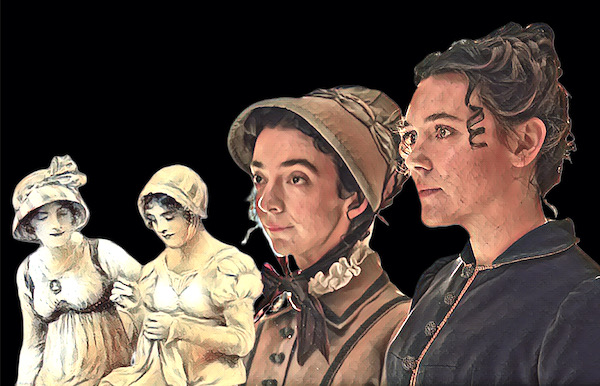
Cassandra was three years older and Jane’s great confidante. The sisters remained extraordinarily close throughout their lives. Many of Jane’s surviving letters were written to Cassandra, and the two lived together at Chawton during the years in which Jane revised, wrote and published her novels. When Jane died in 1817, Cassandra described the loss as though she had lost part of herself.
It would be simplistic to turn Jane and Cassandra into Elinor and Marianne, or to search for versions of them in every family Austen created. Literature does not work that way. But it is equally difficult to ignore the fact that a writer whose longest, most constant and most intimate relationship was with her own sister returned again and again to women who knew one another before either became the heroine of any story.
Perhaps that is the essential difference. A friend knows the woman you became. A sister also knew the girl who came before her.
Darcy knows Elizabeth for a matter of months. Jane Bennet knows who Lizzie was before Darcy ever entered her life. Edward Ferrars may love Elinor, but Marianne witnesses almost every stage of her pain. Wentworth meets Anne again after eight years, while Elizabeth and Mary belong to the family world that helped shape the quiet woman he finds again. Emma may discover love beside Knightley, but the way she relates to other women has been revealing who she is long before that happens.
Jane Austen knew exactly how to build a great romance. That is why we are still in love with Darcy, Wentworth and all the others more than two hundred years later. But her female relationships may reveal something even more intimate about her heroines.
The men enter their stories and may change their futures. Their sisters were already there to know the past.
Descubra mais sobre
Assine para receber nossas notícias mais recentes por e-mail.
 miscelana.com