
Lizzie Borden was acquitted in 1893, but a little more than half a century later Agnes de Mille resolved the case in her own way. In Fall River Legend, the ballet created for Ballet Theatre — today the American Ballet Theatre — and first performed on April 22, 1948, at the Metropolitan Opera House in New York, there is no doubt, no mystery and no room for another theory. The protagonist killed her father and stepmother and, unlike what happened in real life, she is found guilty.
That is precisely the first surprise of Fall River Legend. Agnes de Mille believed Lizzie was guilty, but she does not simply turn her into a monster. The Lizzie of her ballet, called only The Accused, is a woman cornered and emotionally suffocated by her family, by the small town where she lives and by the rules of a society too narrow to allow any possibility of escape. She appears at once as guilty of the crime and as a victim of the environment that pushed her toward it.
And there was an extraordinary ballerina at the center of all this: Alicia Alonso was the first Lizzie Borden of Fall River Legend. The Cuban dancer, who would become one of the greatest figures in 20th-century ballet and a legendary interpreter of roles such as Giselle, created The Accused at the 1948 premiere. The association is fascinating precisely because this is not a classical, romantic or ethereal heroine, but a repressed, disturbing and psychologically complex character who ends as a murderess sentenced to death.

The original cast also included Diana Adams as the Mother, Muriel Bentley as the Stepmother, Peter Gladke as the Father, Ruth Ann Koesun as the Accused as a Child and John Kriza as the Pastor. Morton Gould composed the music, Oliver Smith designed the sets, and Agnes de Mille compressed this entire story of family, repression, desire, murder and punishment into approximately 45 minutes.
The idea had come several years earlier. After the success of Rodeo, playwright Edward Sheldon suggested that the Lizzie Borden story might make a compelling ballet. The project was delayed by de Mille’s marriage, the birth of her son and the demands of her increasingly busy Broadway career, but it never disappeared. She even took a copy of Edmund Pearson’s The Trial of Lizzie Borden on her honeymoon, which shows that she was not working merely from the popular image of Lizzie and the axe. De Mille studied the case and made deliberate decisions about what she wanted to keep, discard or transform.
The biggest of those decisions was the ending itself. De Mille and Morton Gould decided that Lizzie would be convicted. Gould said he could write music for a guilty verdict but had no idea how to write “acquittal music,” and so history ultimately lost to the theatre. The composer later summed up the choice by saying that changing history was poetic license.
The ballet virtually begins with the verdict, so the audience knows from the start that this woman has been condemned. From there, what we see becomes almost a journey into her inner life, an attempt to locate the source of the act we already know she committed. It is precisely at that point that Fall River Legend moves radically away from the historical Lizzie.
In Agnes de Mille’s version, The Accused is a shy, sensitive and receptive young woman marked by the loss of her mother and then by the psychological abandonment of her father, who turns his attention toward his second wife. The stepmother is portrayed as bitter, jealous, manipulative and hostile, while the father appears weak, unable to protect his daughter or recognize what that household is producing. Gradually, the domestic space becomes an emotional prison.
When the American Ballet Theatre revived the work in 2007, a New York Times review emphasized how Oliver Smith’s set conveyed that airless world, at once stylized and almost realistic. That sense of claustrophobia is essential because, within the logic of the ballet, the crime does not emerge simply from an argument or a sudden explosion. It is presented as the final result of years of frustration, loss and confinement.
One of the most beautiful images in the work comes when the adult protagonist watches herself as a child dancing with her mother. Two versions of the same person share the stage: the girl who does not yet know what will happen and the condemned woman looking back at her own memory. Past and present stop obeying ordinary time, and memory becomes almost physical.
De Mille also adds something that simply does not exist in Lizzie Borden’s known biography: a love story. The Accused grows close to the community pastor, and the two dance a pas de deux that briefly offers the possibility of another life. The music echoes an earlier dance between the protagonist’s parents, connecting what she lost as a child with what she tries to recover as an adult.
The pastor is not there because Agnes de Mille believed she had uncovered a secret romance in Lizzie’s life, but because dramatically he represents an escape. Within that world made up of the house, the father, the stepmother, the town, social convention and the memory of her mother, love appears as the possibility of freedom. When that possibility also collapses, the tragedy closes around her.
It is a very deliberate psychological construction. Lost maternal love, paternal abandonment, a hostile stepmother, frustrated romance and, finally, murder form an emotional chain that leads the character toward the crime. Agnes de Mille was not merely trying to humanize Lizzie. She was creating an explanation for her.
That does not mean she believed she was literally reconstructing Lizzie Borden’s life. On the contrary, freedom with the facts is part of the project. De Mille seems less interested in the judicial truth of the case than in a dramatic truth: what kind of woman could reach the point of killing her own father and stepmother, and what kind of world could produce that woman?
Even the violence is handled in an unusual way. De Mille did not want to turn the murders into spectacle and believed that violence onstage almost always ended up looking ridiculous. The ballet therefore avoids exploiting the bodies and the blows that made the case famous. Curiously, the moment when The Accused takes up the axe — first to chop wood and later to kill — was still provoking laughter from part of the audience during the 2007 revival, perhaps proof of how difficult it had become to escape the almost caricatured symbolic weight the axe acquired in the Lizzie Borden legend.

The real interest of Fall River Legend lies much more in gestures, silences and the sense that the protagonist cannot breathe inside that small universe. It is in this atmosphere that the ballet finds its greatest power, and it is also where Agnes de Mille emerges as the choreographer who helped transform the relationship between dance and narrative in American theatre.
In her work, choreography does not exist simply to interrupt the story with beautiful steps. Dance tells the story, and movement, pantomime, repetition and social behavior reveal what the characters do not say. De Mille had already done this in Rodeo and, above all, in Oklahoma!, the 1943 musical that transformed her career.
The kinship between those worlds was still evident when Fall River Legend returned to the stage in 2007. There was something of Oklahoma! in the lines of townspeople crossing the stage, the soaring lovers, the gossiping hands and the community constantly watching, commenting and judging. The difference is that here there is no open Western landscape, but a small town, a suffocating house and a woman trapped inside it.
That may also be the greatest challenge for any ballerina dancing The Accused. It is not enough to perform pain or madness; she has to make the full weight of that existence visible. In the 2007 revival, Julie Kent was praised especially for the moment when her character realizes the magnitude of what she has done, but the review felt that the earlier density was missing, that contained rage and suffocation that need to build throughout the ballet for the ending to reach its full force.
After Alicia Alonso, Nora Kaye became one of the dancers most closely associated with the role and appeared in a televised version of Fall River Legend in 1957. Decades later, Virginia Johnson danced The Accused in the Dance Theatre of Harlem production, and the American Ballet Theatre would return to the work with ballerinas including Julie Kent and Gillian Murphy. Every interpreter ultimately has to answer the same question Agnes de Mille placed at the center of the ballet: who is this woman before she picks up the axe?
The real Lizzie Borden was acquitted. She lived for more than three decades after the trial, bought a larger house, began using the name Lizbeth and died without ever confessing any role in the murders. Agnes de Mille’s Lizzie does not receive that second life because her story ends with a sentence.
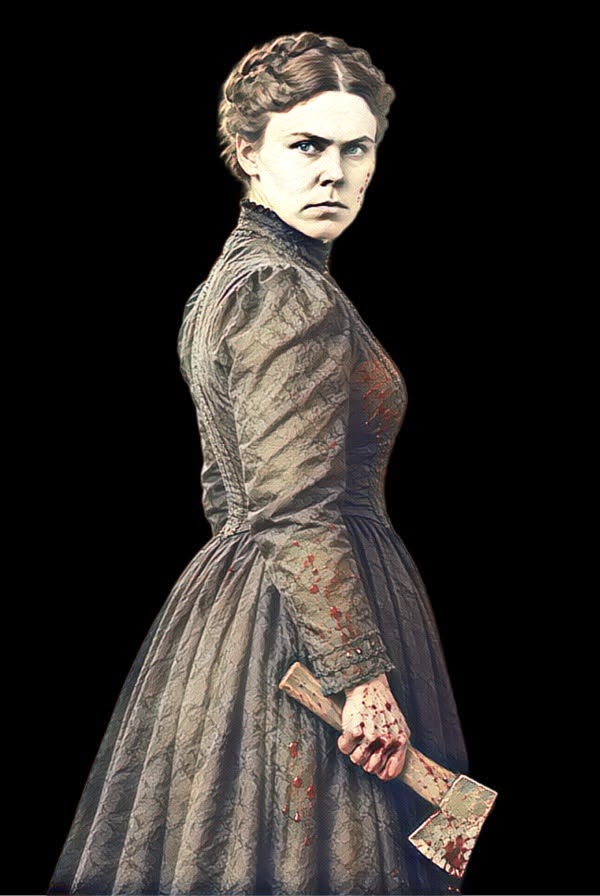
That alteration is exactly what makes Fall River Legend so interesting within the endless cultural construction of Lizzie Borden. The court could not convict her, but the popular imagination never completely acquitted her. Books, plays, films, series and theories have continued to judge that woman for more than a century, and Agnes de Mille simply made that judgment literal.
What makes the ballet even more complex is that de Mille convicts Lizzie of the murders while simultaneously placing the family and society around her in the dock. In 1948, long before Lizzie became a recurring character in documentaries, television dramas and true crime, Fall River Legend already understood that there were two women in this story: Lizzie Borden, the person acquitted by a jury in 1893, and Lizzie Borden, the character American culture chose to keep judging.
On Agnes de Mille’s stage, that second Lizzie is found guilty, but she is never presented as simply cruel. The ballet chooses instead to ask what happened to that woman before the axe, and it is precisely in that question, far more than in the answer to who killed Andrew and Abby Borden, that Fall River Legend remains so powerful.
Descubra mais sobre
Assine para receber nossas notícias mais recentes por e-mail.

