
If you are 50 or younger, chances are you have never seen a woman compete in a Formula 1 race. More than that: you may not even know who Lella Lombardi was. To anyone following the sport today, her name seems to belong to a distant past, when cars were extraordinarily dangerous, Niki Lauda, James Hunt, and Emerson Fittipaldi were on the grid, and survival was still part of the narrative of almost every race weekend. But there was a woman there. And, even more strikingly, at the time it did not seem absurd to imagine that others would follow.
On August 15, 1976, Lella Lombardi lined up in a Brabham at the Austrian Grand Prix at the Österreichring, started 24th and finished 12th. It was her final Formula 1 race. It was also, although no one knew it that Sunday, the last time a woman would start a Grand Prix counting toward the World Championship for the next 50 years. In 2026, half a century later, that statistic still stands.
For my generation, Lella remains a distant memory. I was little, but there was a woman in Formula 1. That mattered because her mere presence created a quiet expectation of continuity. If a woman had made it there in the 1970s, when almost everything in motor racing was more hostile to women than it is today, it seemed logical to assume this was only the beginning. It was not. Lella became not the first in a long line, but almost the last chapter of a story that simply stopped.
Her full name was Maria Grazia Lombardi. She was born in Frugarolo, a small town near Alessandria in northern Italy, in 1941, the daughter of a butcher. Her family had neither money nor motor racing connections. Long before there was a career, there was simply a girl fascinated by speed. She learned to drive in the family delivery van, worked transporting meat along the Ligurian Riviera and liked racing Lambrettas against the boys in town. She was unconventional enough for provincial Italy at the time that, according to accounts later collected about her life, even the local priest approached her family in an effort to temper her behavior.
It was hardly a childhood designed to produce a Formula 1 driver. Lella did not come from a racing family, from wealth or from any development program. She saved money, sought help from relatives and from Fiorenza, her partner, and bought her own car. She began in Formula Monza in 1965 and moved forward however she could. She slept in trucks to save money, chased sponsors, and took the longest possible route because there was no other one available. In 1970 she won the Italian Formula 850 championship, moved into Formula 3 and later reached the brutal world of Formula 5000, with its huge V8 engines, at a time when such cars were routinely presented as an almost mechanical expression of masculinity. Lella raced them anyway — and she was competitive.
Fiorenza is an important figure in this story, although Lella spent much of her life trying to keep her out of it. The two remained together for years, and Fiorenza was there from the beginning, helping finance the purchase of Lella’s first racing car. Lella was a lesbian, a Catholic, and intensely private, living in an Italy far more conservative than the one we know today. According to Jon Saltinstall, who spent years researching her life for the first major authorized biography, she built something of a wall around her private life, above all to protect her partner. Her discretion was so complete that Italian journalists who knew the couple and had even dined at their home did not know Fiorenza’s surname.
This is intimate information, and it would not matter merely as gossip about the sexuality of a woman who died more than three decades ago. It matters because it speaks directly to the environment she had to navigate. Women entering spaces defined as male faced — and still face — a peculiar trap: if they conformed to traditional ideas of femininity, their competence was often questioned; if they showed aggression, independence, competitiveness, or little interest in performing that expected role, their femininity, and often their sexuality, became the subject of scrutiny.
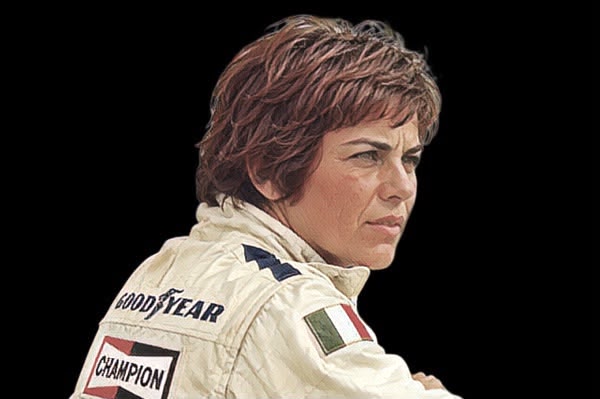
Lella never seemed especially interested in that debate. Her position was much simpler: she wanted to race. She said she never framed the question as men against women, but as driver against driver, because under a helmet men and women were equal. The problem was that the world around her was not nearly as willing to forget that she was a woman.
That may be one of the clearest examples of structural sexism in motor racing history. Not because all the pioneering women who tried to reach Formula 1 were gay — they were not — but because the discomfort existed regardless of sexual orientation. Maria Teresa de Filippis, who came before Lella, married and had a daughter, and she was still told that she did not belong there. The issue was never simply whom these women loved. It was the fact that they were entering a space that had long defined itself as male.
By 1974, Lella had built enough of a reputation to try Formula 1. She rented a Brabham to attempt qualification for the British Grand Prix at Brands Hatch and missed the grid by only nine-tenths of a second after suffering a mechanical problem. Around the same period, in Formula 5000, she even raced as James Hunt’s teammate in the United States. At Sandown Park in Australia, she finished third against some of the best local drivers and shared the fastest lap with winner Max Stewart. It mattered because it dismantled the easy explanation that Lella was there simply because she was a woman. She had speed.
Her real Formula 1 opportunity came in 1975 with March. At the South African Grand Prix, she became only the second woman in history to qualify for a World Championship race, after Maria Teresa de Filippis in the 1950s. And in only her second start came the result that remains unmatched today.
At the Spanish Grand Prix, held at Montjuïc, Lella finished sixth. The race was stopped after Rolf Stommelen’s horrific accident, when his rear wing failed and sent the car into the crowd, killing spectators. Because the race ended before enough of the scheduled distance had been completed, only half points were awarded. Instead of receiving one point for sixth place, Lella received 0.5. The statistic ended up becoming larger than the driver herself: to this day, she remains the only woman ever to score points in the Formula 1 World Championship.
That half point sometimes reduces her career to a curiosity. It should not. A few months later, she finished seventh at the old Nürburgring, a circuit more than 22 kilometers long that now seems unimaginable for a Formula 1 race, while also managing a tire problem. Under the scoring system of the time, only the top six scored points. Lella finished one place short. It later emerged that the March she was driving that season had a cracked rear structural component. For months she had complained that the car switched unpredictably from understeer to oversteer, but her observations were not taken seriously enough. When another driver tried the same chassis, it became clear that something was wrong. Robin Herd, one of March’s founders, later acknowledged that the team had compromised her performance by failing to identify the problem sooner.
The episode is almost too neat an illustration. A woman enters a male environment, describes a technical problem with her equipment, and is not fully heard. Then a man identifies that, yes, the problem was real. There is no need to turn it into a manifesto to understand why the story still sounds so familiar half a century later.
Lella was not a hidden world champion denied greatness by history, and there is no need to turn her into one to recognize what she achieved. Her teammate Vittorio Brambilla was faster in qualifying, and she never had a car capable of fighting for victories. But Formula 1 has had dozens of mediocre men, pay drivers and competitors who lasted only briefly without their performance being used to decide whether men as a group belonged in motor racing. With Lella, it was different. Every result was treated as evidence for or against all women.
That difference in expectations is essential to understanding these pioneers. A man could simply be a bad, average, or good driver. A woman carried something closer to a collective test. If she failed, it was not only her failure; it became proof that women did not belong there. If she succeeded, she had to prove it repeatedly because an exception, by definition, never seemed enough to overturn the rule.
In 1976, Lella lost her regular seat at March because of a lack of financial backing and began surviving on sporadic opportunities. At that year’s British Grand Prix, something happened that now seems extraordinary: two women were entered in the same race weekend, Lella and British driver Divina Galica, a former Olympic skier. Neither qualified. A month later, Lombardi arrived at the Austrian Grand Prix in a RAM-entered Brabham BT44B. She qualified, raced, and finished 12th. After August 15, she would never again compete in a World Championship Grand Prix. She was 35. Formula 1 was over for her, but Lella Lombardi’s racing career was far from over.
That may be another part of her story that has been lost. Lella did not disappear after that half point in Spain. She made a NASCAR appearance at Daytona in 1977 and focused much of the rest of her career on endurance racing and touring cars. She competed four times at the 24 Hours of Le Mans, finished 11th overall in 1977 alongside Christine Beckers, and won major endurance races. She scored victories in the World Sportscar Championship and numerous strong results in the European Touring Car Championship. Her professional career stretched from 1965 to 1988 — more than two decades, far beyond the short Formula 1 chapter that made her famous. Research for her biography identified 17 pole positions and 20 fastest laps across her career.
She also lived with considerably more freedom than Italy at the time generally allowed women. Fiorenza remained beside her and had helped make the beginning of that adventure possible. Lella, however, did not seem interested in presenting herself as a symbol of anything. She did not want to race as “the woman against the men”; she wanted to be judged as a driver against other drivers. There is an irony in that, because decades later we inevitably turned her into a symbol precisely because no one managed to follow her path.
And Lella kept racing until her body began demanding a different price.
Around 1985, after suffering a blow to the breast during a water-related activity, she began experiencing pain she initially associated with the accident. What seemed to be the consequence of an injury turned out to be breast cancer. Lella kept the illness almost entirely private, known only to family and a small circle of friends, underwent surgeries, and continued racing. She still competed in the European Touring Car Championship and only left racing for good in 1988, when her health would no longer allow her to continue.
Even then, she could not simply walk away from motor racing. She created Lella Lombardi Autosport and became a team owner, turning her experience into a way of opening doors for other drivers. It was a way of remaining inside the only professional world she had truly known. When her condition worsened, she asked friends to keep the team running after her death. They did.
Lella was hospitalized at the San Camillo clinic in Milan and died on March 3, 1992, only three weeks before her 51st birthday. She was 50. The cancer she had fought for years ended a life spent almost entirely in motion. In Frugarolo, her hometown, her story is still remembered. Beyond motor racing, however, her name faded in a way that is difficult to understand.
After Lella, other women tried to reach the grid. Divina Galica attempted further qualifications but never started a race. South African driver Desiré Wilson won a race in the British Aurora Championship using Formula 1 machinery in 1980, but never started a World Championship Grand Prix. In 1992, Giovanna Amati attempted to qualify for three races with Brabham and failed; she was eventually replaced by Damon Hill. She remains the last woman entered with the intention of racing in a Formula 1 World Championship Grand Prix. In 2014, Susie Wolff took part in official practice sessions for Williams but never raced. In total, only five women have been entered for a World Championship Grand Prix, and only two — Maria Teresa de Filippis and Lella Lombardi — actually started a race.
That is why the 50th anniversary is so uncomfortable. Formula 1 has changed almost beyond recognition since 1976. The cars are different, the circuits are different, safety is different, television is different, the audience has become global, and a significant share of the new generation of fans is female. The sport talks about diversity; more women now work in engineering, strategy, technical, and management roles, and F1 Academy was created specifically to strengthen a female talent pool that for decades barely existed. All of that is real progress. None of it changes the fact that the race grid remains entirely male.
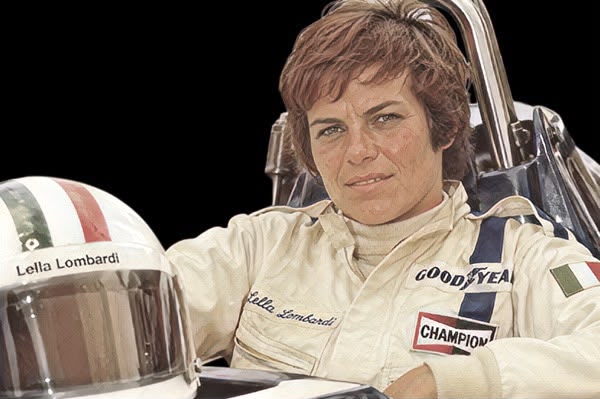
The problem does not begin in Formula 1, of course. It begins much earlier, in karting, in the money required to build a career, in the far smaller number of girls encouraged to enter motor racing, in access to sponsors and in a brutal pyramid in which thousands of drivers disappear before they ever get close to the top level. It is not enough, then, simply to ask why an F1 team does not hire a woman. We also have to ask why, for decades, so few women were given the same conditions to reach the door.
But 50 years are still 50 years. And there is another aspect of Lella’s story that may be almost as striking as the absence of a successor: we have almost forgotten that she existed.
We live in an era when film and television actively search the past for extraordinary women who were ignored, diminished, or reduced to footnotes by traditional narratives. Streaming platforms comb through biographies looking for exactly these characters. Scientists, athletes, artists, criminals, aviators, journalists, and women who challenged the conventions of their time have all been turned into documentaries, series, and films. It is difficult to understand how Lella Lombardi has remained almost entirely outside that movement.
Her life contains almost everything a screenwriter could want. A girl from a small Italian town, the daughter of a butcher, driving the family van and racing Lambrettas against boys. A woman without wealth trying to finance her own career. A partner helping her buy her first race car in a Catholic Italy where the two women protected their relationship from public scrutiny. Formula 5000, Formula 1, James Hunt, Niki Lauda, Emerson Fittipaldi, Nürburgring, Le Mans, NASCAR, endurance victories, sexism, money, defeats, courage, cancer, a racing team created while she was already ill, and death at 50. And, as an epilogue, a record no one could have imagined would still be standing half a century later.
There is a documentary, Beyond Driven, released in 2020, which uses Lombardi’s legacy as a way into the broader subject of women in motor racing. But it did not produce the kind of major popular rediscovery that a drama series or feature film might have done. More surprisingly still, the first truly comprehensive authorized biography of her life, Lella Lombardi: The Tigress of Turin, by Jon Saltinstall, was only published in 2025. The author himself has spoken about spending years puzzled by the fact that a driver with such a career had never received a full biography, not even in Italy.
Perhaps the difficulty of telling her story contributed to that erasure. Lella gave few interviews, was deeply private, and fiercely protected her life with Fiorenza. She did not leave behind the kind of intimate archive that makes the later construction of celebrity easier. She seems to have had little interest in creating a mythology around herself. She raced, went home, and moved on. What worked as protection while she was alive may, unintentionally, have helped the world forget her after her death.
Even Formula 1’s enormous recent success as entertainment has done little to change that. F1, the Brad Pitt blockbuster produced with Lewis Hamilton’s involvement, features women working within the fictional APXGP team and was itself criticized for the way some of those women were portrayed, but it does not reclaim Lella Lombardi as part of the history that made it possible to imagine a woman in that environment at all. Of course, a fictional film had no obligation to recount the sport’s history, but even a brief reference could have introduced her name to millions of viewers who came to Formula 1 through cinema and streaming.
Perhaps that is the greatest irony. For years we have discussed the importance of finding female role models for girls who want to enter spaces where they rarely see women. Formula 1 does not need to invent all of those role models. One of them was already there in 1975, in overalls and a helmet, scoring a point in a world championship. We are the ones who stopped telling her story.
And telling that story does not require turning Lella into a saint, into a champion she was not, or into a contemporary figure transplanted into another era. Quite the opposite. What makes her interesting is precisely her complexity. She did not appear to want to be an activist, disliked turning her gender into an explanation for her career, fiercely protected her private life, and made competing her almost absolute priority. She was a woman who wanted to race.
When Lella Lombardi lined up in Austria in 1976, no one was watching a historic farewell. She was a racing driver trying to keep her career alive, in an old car, in a Formula 1 world full of men who also needed money, connections and opportunities to survive. She finished 12th, put away her helmet and moved on to other races. There was no reason to imagine that half a century later we would still be looking back at that grid and saying: there is the last woman who managed to make it this far.
Perhaps that is the saddest part of the story. To those who saw her race, Lella Lombardi seemed like a glimpse of the future. To those born later, she became an almost forgotten figure from the past. Formula 1 has still not found her successor. And, perhaps just as surprisingly, popular culture has still not fully rediscovered Lella herself.
Descubra mais sobre
Assine para receber nossas notícias mais recentes por e-mail.

