
Few books have managed to turn the name of a character into an idea. Don Quixote did it. Frankenstein did too, although many people still give the creature the name of its creator. And Moby-Dick may have accomplished the strangest feat of all: 175 years later, you do not even need to have read Herman Melville to understand what it means when someone says they have found their “white whale.” It is the thing that must be conquered, avenged, destroyed or understood at any cost, precisely when the cost begins to become everything.
That is why Moby-Dick’s presence in Unabomber, Netflix’s new film about Ted Kaczynski, is more than an elegant literary reference. The novel is woven into the way the film tries to explain obsession, knowledge and arrogance, but there is an important irony here: the most fascinating historical connection between Moby-Dick and Kaczynski’s story is not exactly with Kaczynski. It is with Henry Murray, the Harvard professor played by Russell Crowe, whose relationship with Herman Melville was far deeper and more extraordinary than the film is able to show.
Before that, however, we have to go back to the sea.
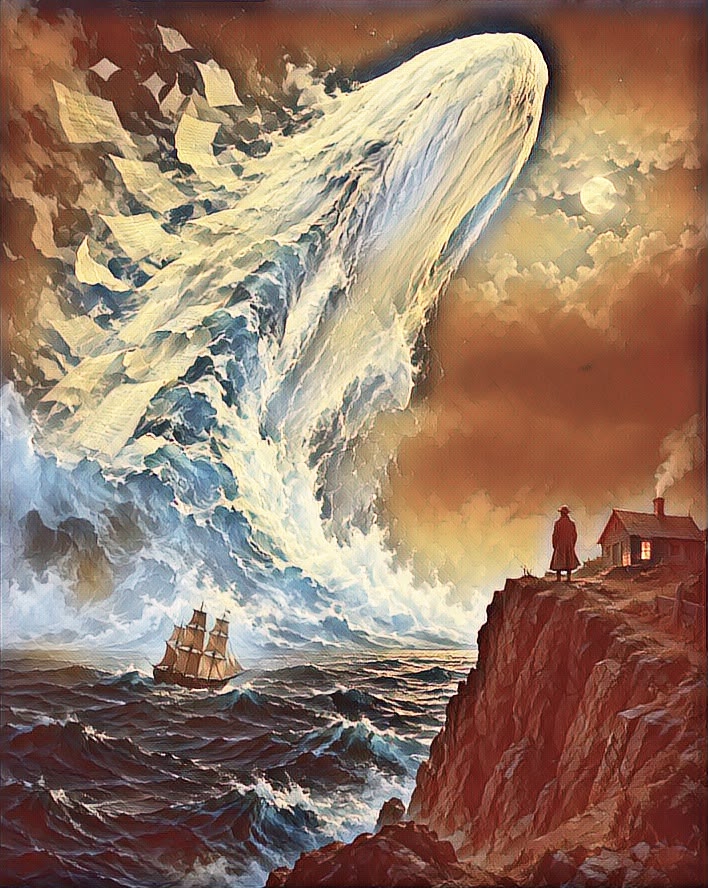
Published in the United States on November 14, 1851, Moby-Dick; or, The Whale follows Ishmael, a man who decides to go to sea and boards the Pequod, a whaling ship commanded by Captain Ahab. Only after the voyage begins does the crew discover that this will not be an ordinary commercial expedition. Ahab lost a leg to an enormous white sperm whale named Moby Dick and has transformed the animal into the object of an absolute revenge. The Pequod, its crew and any other purpose the voyage might have had gradually become nothing more than instruments in his pursuit.
That matters because, reduced to cultural memory, Moby-Dick can sound like a book about a man chasing a whale. It is, but that is almost like saying Hamlet is about a prince who has to avenge his father. Melville wrote about obsession, destiny, God, evil, fear, nature, power and the human inability to accept that the universe may have no obligation to give us answers. And he placed all of that inside a novel that can also spend pages on sperm whale anatomy, hunting techniques, harpoons, blubber, ropes and the daily life of men confined aboard a ship in the middle of the ocean.
Even its opening line became one of the most famous in literature: “Call me Ishmael.” Three words are enough to establish an almost conspiratorial intimacy between narrator and reader. Ishmael will be our survivor, observer and interpreter, while Ahab will become something else entirely: the man who stops observing the world because he has decided he already understands what it means.
For Ahab, the whale stops being a whale. Moby Dick took his leg, but what he begins to pursue is everything he believes exists behind the animal. In one of the book’s most important passages, Ahab describes visible objects as masks hiding some force behind them. The white whale becomes the wall he must break through to reach that force. It does not even matter whether it really exists. Ahab needs it to exist.
That is where Moby-Dick stops being only a maritime adventure and becomes frighteningly modern. Ahab’s obsession depends on the conviction that there is an intention behind what happened to him. The whale cannot simply have wounded him because it is an animal reacting to human violence, or because nature, accident and chance exist. It must represent something. Starbuck, the Pequod’s sensible first mate, understands the madness of it: what sense is there in taking revenge on an irrational creature? Ahab does not care. He would “strike the sun if it insulted me.”
Perhaps that is one reason the book keeps producing Ahabs long after 1851. The white whale does not have to be a whale. It can be a person, a government, an ideology, a technology, an illness, a theory, a career, a real or imagined injustice. The mechanism is the same: something begins to offer a total explanation for a frustration, until defeating it becomes more important than any consequence caused by the battle.
And the story that inspired the novel was already extraordinary before Melville transformed it into fiction. In November 1820, the Nantucket whaling ship Essex was sailing in the Pacific when an enormous sperm whale struck the vessel. It attacked again and the hull was eventually destroyed. The survivors spent months adrift; hunger, thirst and disease killed most of them, and some resorted to cannibalism to survive. Melville encountered the account written by Owen Chase, first mate of the Essex, during his own years at sea, and the story became one of the seeds of Moby-Dick.
The other whale also came from reality. Mocha Dick was a huge white sperm whale famous among Pacific whalers in the nineteenth century and described by Jeremiah N. Reynolds in 1839. Its name came from Mocha Island, off Chile, where it was often seen. Scarred by previous encounters with hunters and surrounded by stories that grew with every retelling, it helped give Melville not only the appearance of his creature but part of the mythology surrounding it.
What is curious is that the book that now feels inevitable was not received that way at all. The British edition, simply titled The Whale, appeared first, in October 1851, and reached bookstores without the epilogue, a particularly disastrous omission in a first-person novel in which apparently everyone dies. The American edition followed a few weeks later under the title we know, but sales were disappointing and reviews were divided. Melville died in 1891 without seeing Moby-Dick transformed into one of the great American novels; its major rediscovery would come mainly in the 1920s.
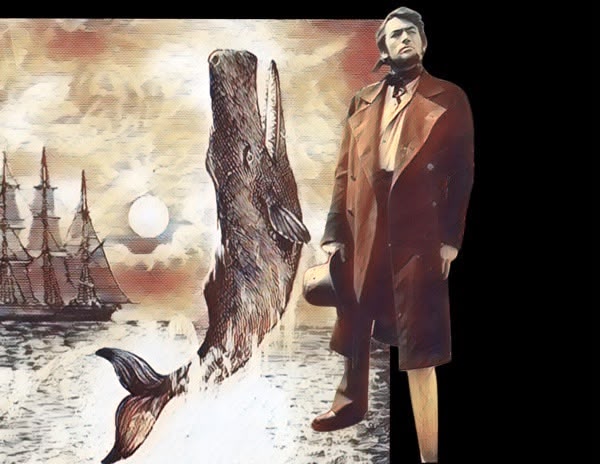
Cinema, naturally, found Ahab. There had been earlier versions, but the adaptation that still remains the definitive visual image of the novel is Moby-Dick, directed by John Huston in 1956, with Gregory Peck as Ahab, Richard Basehart as Ishmael and a screenplay by Huston and Ray Bradbury. Peck, interestingly, never believed he was the ideal choice for the role; Huston had initially imagined his own father, Walter Huston, as Ahab. Even so, it is difficult now to separate the captain from Peck’s tall, dark, rigid figure staring at the sea as if he could force it to give him an answer.
The story would return in different forms, including the 1998 miniseries with Patrick Stewart as Ahab and Gregory Peck himself, in a beautiful passing of the torch, as Father Mapple. Later came new adaptations, reinterpretations and even versions in which the whale stopped being a whale. That happens because the structure Melville created survives perfectly well when the setting changes: all you need is an Ahab, something he decides to turn into Moby Dick, and people close enough to him to be dragged along.
Ron Howard took the opposite route with In the Heart of the Sea in 2015, returning to the Essex and the true story that preceded the novel. Curiously, that creates a kind of circle: a sperm whale destroys a real ship; the episode helps Melville imagine a fictional whale; the fiction becomes one of the most famous stories in literature; and more than a century later, cinema returns to the real event because we have already learned to see it through Moby-Dick.
But perhaps no contemporary franchise has used Melville as explicitly as Star Trek. In The Wrath of Khan, Khan’s pursuit of Kirk is built on the model of Ahab, even reaching the captain’s final words from Melville, “from hell’s heart I stab at thee.” Years later, Star Trek: First Contact does something even more interesting: Lily directly accuses Picard of behaving like Ahab when his revenge against the Borg begins putting everyone around him at risk. The comparison works instantly because, by then, Ahab no longer belongs only to Melville. He has become a cultural diagnosis for self-destructive obsession.
That is exactly where we return to Unabomber, and where reality and fiction begin to blend fascinatingly.
In the film, Henry Murray uses Moby-Dick to talk to his students about perception, personality and different points of view. Later, the fictional relationship constructed between him and Ted Kaczynski returns to the novel, leading to an extremely calculated image: Ted leaves Murray a copy of Moby-Dick, marked at the passage in which Melville reminds us that, no matter how proud man may be of his science and skill, the sea will always remain capable of destroying him. Within the film, the message is transparent. Ted rejects the technological and scientific world represented by Murray and begins to see that world as something that must be fought.
But this is one of Unabomber’s greatest dramatic liberties. There is no evidence that this exchange ever happened, nor that Kaczynski gave Murray that copy. The screenwriters themselves acknowledge that the personal relationship built between the two men is speculative. The documented connection between Moby-Dick and this story lies on the other side of the table: Henry Murray really was obsessed with Melville.
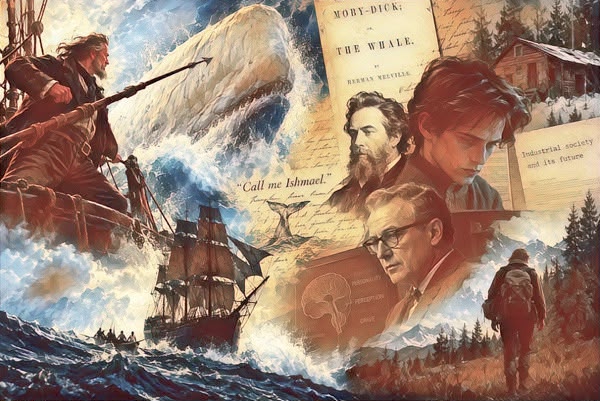
And “obsessed” is not an exaggeration. Murray discovered Moby-Dick when he was young, and the impact of the novel helped redirect his intellectual and professional interests. Melville became an object of his psychological studies; Murray wrote about Ahab, tried to interpret the characters through the lens of depth psychology and continued working on Melville for decades. Later, he played a decisive role in creating the Herman Melville Memorial Room in Pittsfield, which brought together manuscripts, first editions, letters and objects connected to the writer. A book about obsession became, rather fittingly, one of the great intellectual obsessions of the man who would later conduct at Harvard the experiments in which Kaczynski participated.
Murray saw in Ahab something far more complex than a mad captain. In his essay on Moby-Dick, he interpreted the conflict among Ahab, Starbuck and the whale through a psychoanalytic lens: impulse, repression, reason, inner forces at war. To him, Melville seemed to have found in literature a way of mapping areas of the personality that psychology was still trying to turn into science. Murray’s interest in the writer ran so deep that he even used Melville as a case study in developing his own ideas about personality.
That makes the use of Moby-Dick in Unabomber much smarter than it first appears, but also much more dangerous. The film takes a real obsession of Murray’s and turns it into a symbolic link between professor and student, creating a symmetry we cannot historically prove. Murray reads Ahab. Fictional Ted learns that language. And when he turns against Murray’s world, he begins to look like the man who has chosen his own white whale.
It is a great image for cinema, as long as we do not mistake it for biography. In real life, Kaczynski spent years constructing a radical worldview against industrial and technological society and decided that violence was a legitimate means of attacking it. In the symbolic universe proposed by the film, technology, science, and modern society become his Moby Dick. The comparison is understandable, but it only works up to a point, because Ahab also gives us precisely the warning that prevents any romantic reading of Kaczynski. What destroys Ahab is not Moby Dick. It is Ahab’s conviction that Moby Dick must be destroyed.
He has several chances to stop. Starbuck tries to make him see what is happening. Other ships offer stories, warnings and possibilities of return. Ahab sees all of it and chooses to continue. He finally finds the whale, and what was supposed to prove his mastery ends up destroying the Pequod, its crew and the captain himself. Ishmael survives to tell the story because, unlike Ahab, he is still capable of existing in a world where not everything has to be reduced to one answer.
Perhaps that is why Moby-Dick remains so unsettling in 2026. We are surrounded by people being invited every day to find their white whale: an enemy that explains everything, a system responsible for everything, one person to blame for everything, one idea that must be fought above every other consideration. Social media is particularly efficient at turning frustration into certainty and certainty into obsession, especially because there is always someone willing to confirm that, yes, the thing you have chosen to hate really is the source of all evil.
That is where Melville and Unabomber meet in a way far more interesting than the simple reference created by the screenplay. Ted Kaczynski does not need to have been an obsessive reader of Moby-Dick for Ahab to help us understand him. In fact, turning that association into fact would weaken it. What matters is recognizing the mechanism Melville described a century earlier: a wounded man chooses one object on which to concentrate everything he believes is wrong with the world, decides that destroying it will give meaning to his own existence and gradually becomes willing to accept any price necessary to do so.
At the end of Moby-Dick, the great irony is that perhaps the whale was never what Ahab believed it to be. It does not need to represent God, evil or some force conspiring against him. Moby Dick may simply exist. Ahab is the one who gives the whale absolute meaning, and Ahab is the one who turns his own life and the lives of others into fuel for that interpretation.
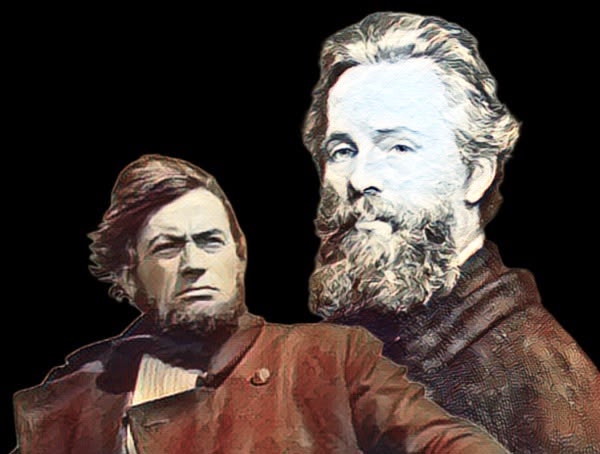
That is probably why we keep returning to Moby-Dick. The novel begins in the nineteenth-century ocean, moves through Gregory Peck, Patrick Stewart, Star Trek, countless films, series and metaphors, and reaches a story about terrorism and technology in the twenty-first century without any difficulty. The whale changes, but Ahab remains recognizable.
And perhaps the most frightening question Melville left us is not why Ahab failed to kill Moby Dick. It is why, even after we understand what his obsession is destroying, we can still understand so perfectly his need to keep chasing it.
Descubra mais sobre
Assine para receber nossas notícias mais recentes por e-mail.

