
Twenty-three years after her last performance at the VMAs, Madonna returned to the stage of an awards show she helped turn into a pop culture event. At 68, she opened a night that would celebrate her career, surrounded by artists from a generation that grew up watching music videos influenced by her. In that meeting between the show’s history and its present, Madonna found room for a joke: many of the people there had not even been born when she was already making history at the VMAs.
The joke said a great deal about the night. Madonna understood early on that a music video could do more than promote a song: it could build an image, tell a story and start a conversation that would continue long after the music ended. The VMAs owed part of their identity to her, and seeing her back on that stage made the connection especially clear.
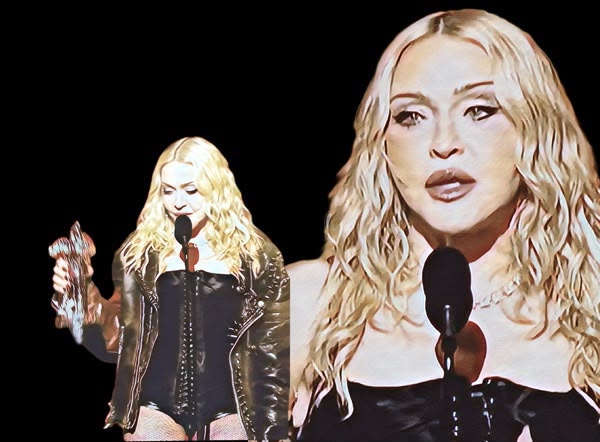
You only have to look back at her performances to see it. In 1984, at the first VMAs, she sang “Like a Virgin” dressed as a bride and turned a seemingly simple bit of staging into one of the most memorable moments in music television history. In 1990, she brought “Vogue” to a setting inspired by the French court, as though Marie Antoinette had discovered dance clubs. In 2003, she shared the stage with Britney Spears and Christina Aguilera in a performance still remembered for the kiss. Different eras and different ideas, connected by Madonna’s understanding of what an image can do for a song.
That instinct was never confined to live performances. Madonna brought directors, artistic references, fashion, religion, sexuality and entire narratives into her music videos. She understood the power of the medium while its language was still being invented, and helped establish a visual approach that remains essential to launching and sustaining pop music. The platforms have changed, but the need for an image that can travel around the world has not. There was something beautiful, then, about seeing artists from another generation gathered around her. Many of them grew up in a visual world Madonna helped create.
But it would feel strange to write about her return without addressing what was also right in front of us. Madonna has always sung with her whole body. Dance was part of the way she interpreted a song, and she helped create the expectation that a pop star should sing, dance, command the stage and make something happen all at once. Last night, her movements were more restrained. Her difficulty moving around, including as she climbed the steps to the stage, was visible. She spoke about her knee herself, so there is no reason to pretend nobody noticed.
I found it moving. There is a particular sadness in watching time place limits on the body of someone who has always used movement as a form of expression. It does not mean Madonna has run out of creativity, or that she owes the audience a display of stamina. Those of us who have watched her dance for decades could see the effort behind every gesture. She kept trying, kept commanding the performance and remained as defiant as ever. Perhaps that is why the change was so hard to ignore.
And yet Madonna still managed to make the broadcast reach for the bleep button and turn the camera away at a few moments. At 68, even without the physical freedom she once had, she can still make American television uncomfortable. Her joke about recognizing former boyfriends in the audience also had the humor of someone who knows her own history and has no need to hide it in clues. Madonna has never relied on codes to say what she means. Her provocations tend to be explicit, however elaborate the presentation around them.
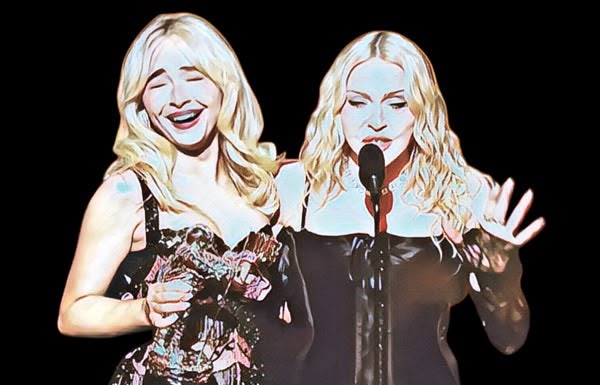
Of her 11 nominations, she won seven awards, three of them announced during the broadcast, in a year of renewed attention driven by an album I liked very much. Her collaboration with Sabrina Carpenter is not one of my favorites — I prefer, for instance, her pairing with Kylie Minogue — but there is something interesting about her connection with younger artists. The night did not have to convince them that Madonna mattered. Her influence was already everywhere.
Last night’s VMAs showed an artist facing the limits of her own body, yet still determined to occupy the space she built. That was what made the performance emotional. Madonna can no longer dance the way she once did, and acknowledging that loss also means recognizing what her dancing meant. When the music ends and she can still provoke, entertain and make the camera hesitate, it is clear that her presence was never only about the steps.
Descubra mais sobre
Assine para receber nossas notícias mais recentes por e-mail.

