
Fifty years ago, a woman ran in slow motion, leaped impossible heights, heard conversations from absurd distances, and could bend steel with her right hand. For an entire generation, just a few seconds of that unforgettable “ts-ts-ts-ts” were enough to signal that the good part was about to begin. The Bionic Woman premiered in the United States on January 14, 1976, and half a century later, it is tempting to look first at the vintage charm of its special effects. But reducing Jaime Sommers to her powers would mean missing exactly what allowed the character to age so well. Our beloved cyborg had drama, elegance, and a great deal of strength.

Jaime was not even created to have her own series. Lindsay Wagner first appeared in 1975 in a two-part arc of The Six Million Dollar Man as Steve Austin’s former girlfriend, one of the top tennis players in the United States. The two rekindle their romance until a skydiving accident destroys her legs and right arm and leaves her with severe head injuries. Desperate, Steve convinces Oscar Goldman to put her through the same process that had transformed him into a bionic man.
Jaime receives two bionic legs, a right arm with extraordinary strength and, instead of Steve’s bionic eye, an ear capable of picking up frequencies and sounds from enormous distances. She could run at more than 60 miles per hour, leap great heights and bend steel. She was, quite literally, a superwoman created by technology.
Except her first story ended in tragedy. Jaime’s body begins rejecting the implants; she suffers excruciating pain, loses control and eventually dies on the operating table. That was supposed to be the end of her story, but the audience reaction changed everything. The character had made such an impact that ABC asked the writers to find a way to bring her back. They did: cryogenics, surgery and retrograde amnesia that preserved almost all of her memory except, crucially, her love for Steve Austin.
It may have been the best thing that could have happened to Jaime Sommers, because by erasing that romance, the series also gained the opportunity to rebuild her as something more than the hero’s girlfriend. By the time The Bionic Woman premiered, Jaime was no longer simply “Steve Austin’s woman.” She was a schoolteacher in Ojai, living an apparently ordinary life while occasionally working as an agent for the Office of Scientific Intelligence, the OSI, carrying out dangerous missions for Oscar Goldman. The series would run for three seasons and 58 episodes, moving from ABC to NBC for its final year.

The success was immediate. Only 14 episodes aired between January and May 1976, yet The Bionic Woman still finished the season as the fifth most-watched program on American television and even ranked slightly ahead of The Six Million Dollar Man. It was no longer a spin-off trying to survive in the shadow of the original. Jaime Sommers had become a phenomenon in her own right.
1976 would turn out to be a particularly interesting year for women in pop culture. Charlie’s Angels would premiere a few months later; Lynda Carter was consolidating her version of Wonder Woman and, the following year, Star Wars would introduce us to Princess Leia. There is an entirely different story to tell there, especially for those of us who grew up discovering that playing house was nowhere near as much fun as playing detective, running in slow motion or imagining ourselves as a princess perfectly capable of picking up her own weapon. But Jaime deserves to remain at the center here, because there was something very specific about the nature of her strength.
Jaime was not invulnerable. Creator Kenneth Johnson established very precise rules for her bionic abilities. She could jump two stories, but not three; she could overturn a car, but not a truck. When she exceeded those limits, her body paid the price. In “Kill Oscar,” for example, a fall greater than her bionic legs could withstand nearly destroyed them. That mattered because it prevented her powers from eliminating risk altogether. Her reconstructed body could still break, the technology could still fail, and Jaime remained vulnerable.
Lindsay Wagner understood something even more important: being strong did not mean playing Jaime as a female version of Steve Austin. Her approach was actually less violent. While Steve often resorted to physical force to complete his missions, Jaime avoided using hers directly against other people and rarely in a lethal way. She investigated, infiltrated and assumed identities. Over the course of the series, she posed as a nun, a police officer, a college student, a flight attendant, a singer, a professional wrestler and even a Las Vegas showgirl.

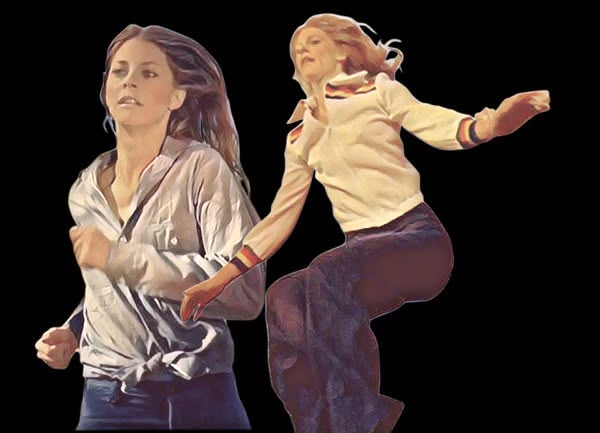
Of course, she also faced some of the most wonderfully absurd creations 1970s television could produce, including the Fembots, nearly indestructible female robots that became some of the show’s most memorable villains. Jaime also faced scientists threatening to destroy the planet, impostors and even Lisa Galloway, also played by Lindsay Wagner, who undergoes plastic surgery to look exactly like Jaime and gradually begins to believe that she is the real Jaime Sommers.
It may sound like pure camp when described that way, and sometimes it was, but there was a surprisingly persistent question running underneath those stories: how much of Jaime was still Jaime after part of her body had been replaced by machines? That question becomes almost explicit in the series finale, “On the Run.” A little girl calls Jaime “Robot Lady,” and after years of carrying out missions, she decides that she wants her life back and tries to leave the OSI. The government, however, believes that someone carrying so many secrets and so much technology cannot simply walk away.
Jaime runs and is forced to confront the question that had been present since her first appearance: was she still a woman, or had she become something else? The series gives a simple and beautiful answer. The mechanical parts had not changed who she was. Jaime agrees to continue working for the OSI, but on her own terms, with fewer missions and more room for a life of her own.
That is where The Bionic Woman becomes even more interesting 50 years later. Technology that seemed futuristic in the 1970s no longer feels quite so impossible. Sophisticated prosthetics, cochlear implants and interfaces between the human body and machines have made parts of that science fiction oddly familiar. What remains special is the way Jaime Sommers was built within that world, because Lindsay Wagner never allowed the machine to swallow the woman.
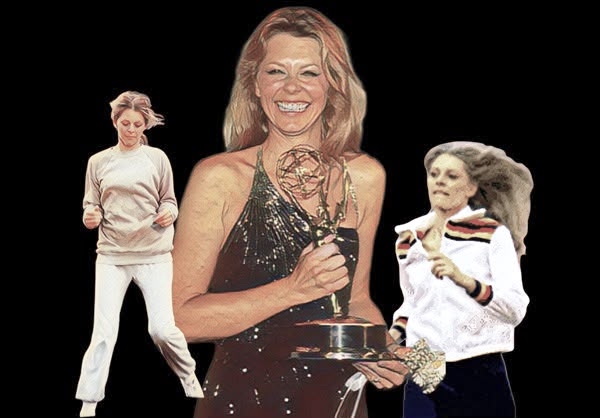

Jaime could suffer, fall in love, feel fear, doubt herself and have fun. She could be gentle without seeming weak and extraordinarily powerful without having to behave like a man. There was an elegance to Wagner’s performance that made even the most improbable situations feel as though they belonged to the same woman. In 1977, that performance earned her the Emmy for Outstanding Lead Actress in a Drama Series for “Deadly Ringer.” It was not exactly the kind of recognition commonly associated with an actress running in slow motion and fighting robots. It was recognition that there was a real character there.
The series ended in 1978, but Jaime would return in three television movies between 1987 and 1994. In the last one, she finally married Steve Austin. Decades later, in 2007, NBC tried to revive Bionic Woman with Michelle Ryan in a much darker version of the story. It lasted only a handful of episodes, and Lindsay Wagner did not like it. Her criticism of the remake may explain better than almost anything else why the original remains so beloved: in her view, the new version was technically accomplished but far too “angry and dark.” In other words, it confused darkness with depth.
Jaime Sommers never needed that. She could knock down a door, run faster than anyone else, hear what nobody else could hear and face the Fembots without losing her humor, compassion or femininity in order to prove that she was strong. Perhaps that is why, 50 years later, the sound effect feels delightfully vintage, while Jaime Sommers does not.
Descubra mais sobre
Assine para receber nossas notícias mais recentes por e-mail.

