
Eva Marie Saint began her film career in a way few actresses could imagine: starring opposite Marlon Brando in Elia Kazan’s On the Waterfront (1954) and winning the Academy Award for Best Supporting Actress for her debut. Five years later, she would become the unforgettable Eve Kendall in North by Northwest, opposite Cary Grant, under Alfred Hitchcock’s direction. The actress died on Tuesday, October 6, at 102, of natural causes at her home in Los Angeles.
According to her publicist, Jeff Sanderson, she was surrounded by family and loved ones. With her, cinema loses one of its last great living connections to the generation of Brando, Grant, and Hitchcock—but also an artist whose talent should never be reduced to the illustrious company she kept.
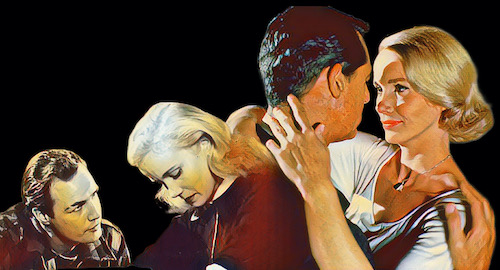
It is difficult to imagine two more different presentations of the same face than those that made Saint a star. In On the Waterfront, she was the young woman confronting the violence of a male world with a moral insistence nobody could silence. Five years later, in North by Northwest, she became a sophisticated, sexually confident woman who was practically impossible to decipher. The delicacy remained, but its meaning changed completely.
Saint won the Oscar for playing Edie Doyle in On the Waterfront. It was an extraordinary beginning, but it would be unfair to describe her performance merely as a newcomer’s encounter with Brando’s magnetism. Edie needed to sustain the film’s conscience without becoming an abstract figure of purity. Saint found a frightened, grieving, determined woman capable of seeing in Terry Malloy a possibility of change he had already abandoned himself.
In the famous glove scene, when Terry picks up the accessory Edie drops and begins playing with it, the romance emerges from an almost silent negotiation. She wants to leave but stays; he searches for a way to keep her close without knowing how to ask. Saint does not compete with Brando’s gestures. Her attention gives them meaning. It is a performance in which listening matters as much as speaking, and vulnerability never means an absence of strength.
When she accepted the statuette in March 1955, she was pregnant and close to giving birth. Onstage, she joked that she might have the baby right there; her son Darrell was born two days later. The story became part of Oscar history, but it also helps explain a career that was never organized exclusively around Hollywood’s demands. Saint wanted to work, but she was not prepared to surrender her entire life to the profession.
Hitchcock recognized a sensuality in her that her early screen image had not explored. In North by Northwest (1959), Eve Kendall meets Roger Thornhill, played by Cary Grant, on a train and takes control of their encounter with a composure that still feels modern. She chooses her words, holds his gaze, and allows him to believe he is participating in a flirtation when much more is happening.
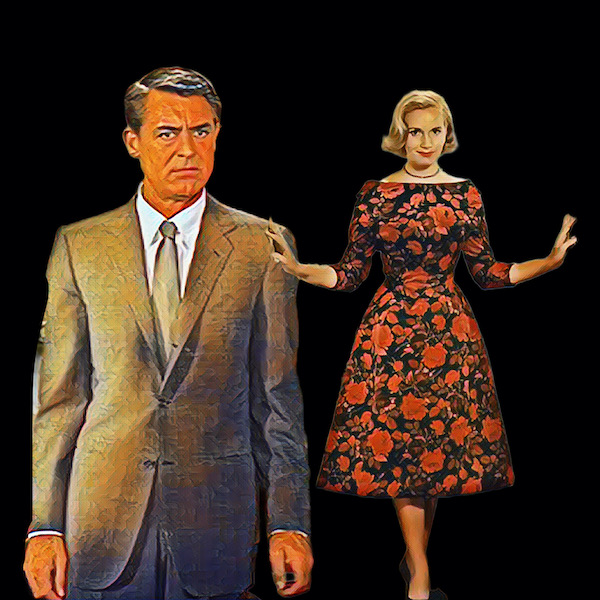
Their conversation in the dining car remains one of cinema’s great seduction scenes. Grant offers charm, humor, and a confidence the plot has already begun to dismantle. Saint responds with the serenity of someone who knows more than she reveals. The eroticism lies in anticipation, in her voice, and in the distance between what the characters say and what they desire. Nobody needs to remove any clothing for the scene to be extraordinarily sensual.
The actress recalled that Hitchcock supervised every element of Eve’s construction: hair, makeup, costumes, and accessories. But it would be a mistake to confuse that visual control with the idea that Saint was merely a carefully arranged image. Her performance makes elegance function as a disguise. The woman who appears to command every situation must also manage fear, desire, and a dangerously vulnerable position.
She arrived in cinema with experience in radio, live television, and theater. Born in Newark, New Jersey, on July 4, 1924, she studied at Bowling Green State University and discovered in acting a path she had not initially planned to follow. In The Trip to Bountiful, she worked with Lillian Gish, whom she considered her mentor. Before becoming a face associated with Hollywood glamour, Saint had learned to build a character through discipline and attention to her fellow performers.
Her filmography would follow varied paths: Exodus, with Paul Newman; Grand Prix, directed by John Frankenheimer; The Russians Are Coming, the Russians Are Coming, directed by Norman Jewison; and The Sandpiper, opposite Elizabeth Taylor and Richard Burton. She did not endlessly repeat either Edie’s innocence or Eve’s mystery. Nor did she accumulate films simply to remain visible. Choosing her work was part of choosing how she wanted to live.
On television, she won an Emmy in 1990 for People Like Us, playing Lil Altemus in an adaptation of Dominick Dunne’s novel. Decades after her Oscar, she was still finding different characters and places in which to work. For another generation of viewers, she would become Martha Kent in Superman Returns (2006), bringing to the superhero’s world a comforting presence that required no effort to establish emotional authority.

She was married to director Jeffrey Hayden from 1951 until he died in 2016, a union of 65 years. They had two children, Darrell and Laurette. Her longevity eventually became news in itself, but living to 102 should not eclipse what she accomplished when the camera was rolling.
Eva Marie Saint knew how to make a character luminous without removing her shadows. With Brando, her delicacy confronted brutality; with Grant, it concealed an intelligence the seducer took time to grasp. Revisiting those films means recognizing that she was never there merely to accompany a great actor. Often, it was precisely her presence that revealed what he did not yet know about himself.
Descubra mais sobre
Assine para receber nossas notícias mais recentes por e-mail.

