
We talk so often about Slow Horses as the anti-James Bond that we sometimes forget Gary Oldman had already dismantled that fantasy long before putting on Jackson Lamb’s filthy overcoat. In 2011’s Tinker Tailor Soldier Spy, he played George Smiley, one of the most important characters in espionage literature and practically everything Bond is not. Discreet, unassuming, meticulous, and emotionally wounded, Smiley does not need to enter a room announcing that he is the smartest man there. He would rather nobody noticed until it was too late.
Lamb would certainly make some offensive remark about that man’s glasses, clothes, or dignity. Smiley would probably endure the insult in silence and register everything the aggression was trying to conceal. They might not like each other, but neither would fail to recognize the other’s competence. They are opposites in the way they exist and almost relatives in the way they understand the world. The wonderful detail is that they share the same face, even though Gary Oldman makes us forget it.
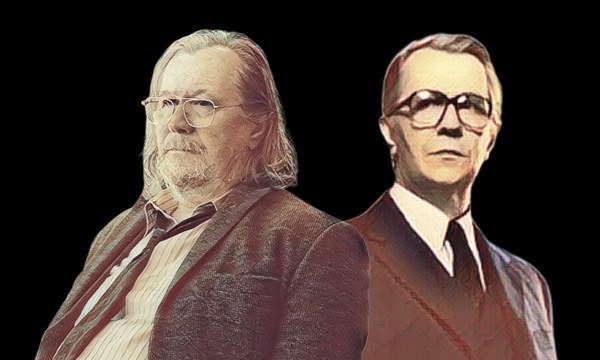
For me, Oldman is one of the greatest actors of the past few decades, possibly the greatest. If Meryl Streep has become the universal measure of transformation, he deserves to be in the same conversation and, at several points, ahead of her. Not because he has more accents or unrecognizable characters on his résumé, but because he can be excessive and economical with equal precision. His talent does not lie in doing a lot or a little. It lies in knowing exactly how much that person needs to reveal and how much must remain hidden.
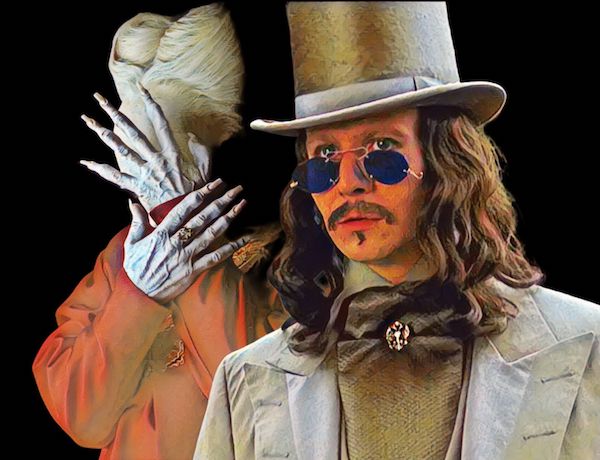
That intelligence made his Dracula such an extraordinary performance. Francis Ford Coppola’s monster could be grotesque, sensual, ridiculous, frightening, and profoundly romantic without ceasing to belong to the same man. Oldman, who was far from the conventional leading-man ideal, turned that vampire into an object of desire. Later, with Luc Besson, he gave us Stansfield’s volatility in Léon: The Professional and Zorg’s extravagance in The Fifth Element. Where other actors might have disappeared beneath the caricature, he found a logic for the excess.
He also appeared in some of cinema’s biggest franchises, as Sirius Black in Harry Potter and Jim Gordon in Christopher Nolan’s Batman trilogy. That means appearing in films that generated billions, not being a billionaire himself—an important distinction. And Gordon is precisely an exception to the impression that Oldman rarely plays heroes: here is an essentially decent man trying to preserve some integrity in a city where corruption has become the rule. Even so, conventional heroes never seemed to be his specialty. Oldman is more interested in contradictions than in striking a pose.
For a long time, he was an actor’s actor: someone his colleagues admired, cinephiles recognized, and the industry relied on to elevate a film without necessarily treating him as its main event. Audiences knew his performances even when they did not immediately connect one to another. It is possible to have watched Dracula, Sirius Black, Gordon, and Stansfield without realizing you had just seen a small retrospective of the same actor.
George Smiley should have ended any doubt about the scale of that talent. And before returning to Lamb, it is worth revisiting why Tinker Tailor Soldier Spy remains an essential classic for anyone who enjoys espionage stories.
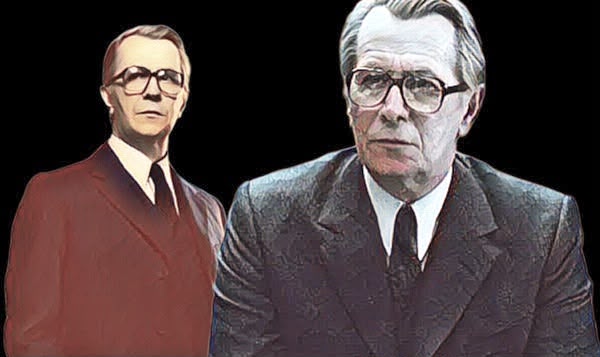
John le Carré published Tinker Tailor Soldier Spy in 1974, opening the Karla trilogy, which would continue with The Honourable Schoolboy and Smiley’s People. It was not Smiley’s first appearance, but it gave him one of his most complex and painful investigations: discovering who, within the upper ranks of British intelligence, was secretly working for Moscow. The enemy was not on the other side of a border. He sat at the same table.
Le Carré knew the world he described because he had worked for British intelligence. His espionage did not need spectacular cars, sexual conquests, or villains explaining their plans. It depended on incomplete information, memory, vanity, unstable loyalties, and the ability to notice a small inconsistency in the behavior of someone known for decades. The danger was not merely dying. It was discovering that an entire life had been built on misplaced trust.
In 1979, the BBC adapted the novel into a series starring Alec Guinness as Smiley, followed by Smiley’s People in 1982. Guinness made the character such a definitive reference that playing him again meant confronting two sets of expectations: those of le Carré’s readers and those of viewers who believed they had already seen the ideal Smiley. Oldman did not merely need to live up to the book. He needed to find room within a performance that seemed to leave none.
The 2011 film, directed by Sweden’s Tomas Alfredson, achieved that without trying to reproduce the series. With a screenplay by Bridget O’Connor and Peter Straughan, it compressed an intricate narrative into just over two hours and found a language of its own: enclosed rooms, faded colors, interrupted conversations, and faces on which an almost imperceptible change could matter more than a chase. Hoyte van Hoytema’s cinematography makes that world feel permanently deprived of air.
And what a cast. John Hurt, whom we miss, as Control; Colin Firth as Bill Haydon; Benedict Cumberbatch as Peter Guillam; Tom Hardy as Ricki Tarr; Mark Strong as Jim Prideaux; Toby Jones as Percy Alleline; Ciarán Hinds as Roy Bland; Kathy Burke as Connie Sachs. It is difficult to assemble so many extraordinary actors without turning a film into a succession of appearances competing for attention. Here, each contributes a different form of exhaustion, ambition, fear, or resentment.
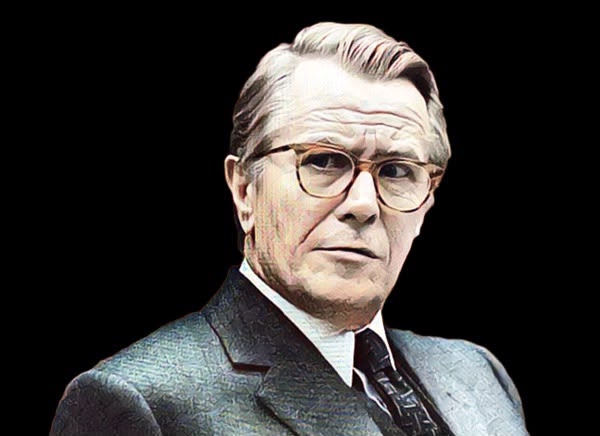
Firth arrived already established and fresh from winning an Oscar for The King’s Speech. Cumberbatch, propelled by Sherlock, was beginning to expand his international profile. Hurt had absolutely nothing left to prove, nor did several of his colleagues. And yet Oldman outshines them all without needing to raise his voice. Not because the others fall short, but because the film’s center of gravity rests in that apparently motionless man.
The story begins with a disastrous operation in Budapest. Control sends Jim Prideaux to meet a source who can identify a Soviet mole inside the Circus, le Carré’s name for the British intelligence service. Prideaux is shot and captured, Control loses command, and Smiley is also forced out. When new information suggests the suspicion was correct, Smiley is brought back to investigate his former colleagues discreetly.
It is a plot that demands attention because the film does not arrange every discovery to keep the viewer comfortable. There are names, code names, previous operations, and conflicting accounts. But the apparent difficulty is part of the experience. Smiley, too, is reconstructing a story whose participants have concealed, distorted, or forgotten what they knew. We need to learn to observe alongside him.
One of the best scenes comes when Smiley tells Guillam about his earlier encounter with Karla, the Soviet strategist who would become his great adversary. Karla is not there. Oldman has to create both sides of the conversation almost entirely on his own, allowing the other man’s silence to survive within the memory. As he explains how he tried to persuade his enemy to defect, he reveals more about himself than he would like. The intelligence is impressive; the vulnerability, even more so.
Smiley realized too late that, by speaking about his wife, Ann, he had shown Karla his weakness. The detail of a lighter she had given him turns a small object into a kind of emotional map. That man, capable of assessing the risks of an operation, cannot protect the most intimate point of his own life. Oldman lets that discovery pass through the scene without asking the audience to pity him.
And here come the spoilers, because the film is fifteen years old and its revelation deserves discussion beyond the simple question of “Who is the traitor?” The mole is Bill Haydon, played by Colin Firth, a brilliant, admired, apparently indispensable man within the Circus. The intelligence operation its leaders regarded as a major triumph was, in fact, covering the leak of British information to the Soviets. The institution was so pleased with its own success that it could not see the trap producing it.
Haydon had also been involved with Ann. This was not merely a marital betrayal running parallel to the investigation: the affair functioned as a means of compromising Smiley’s judgment. Karla knew the relationship between those men would become harder to assess if it were entangled with humiliation, jealousy, and affection. The spy needed to separate what he suspected as a professional from what he suffered as a husband.
The betrayal also reaches Jim Prideaux, whose bond with Haydon the film presents with a painful romantic intimacy. Haydon allows him to be sacrificed to preserve his own position. In the ending, Prideaux kills the man who betrayed him. The mole’s defeat restores no innocence: Prideaux’s wounded body remains, as does Smiley’s humiliation, alongside an institution forced to recognize that it had mistaken familiarity for loyalty.
That is the true scale of the book and film. Discovering the traitor resolves the investigation, but it does not resolve what the betrayal destroyed. Smiley can return to command; he cannot return to being the man he was before understanding everything.
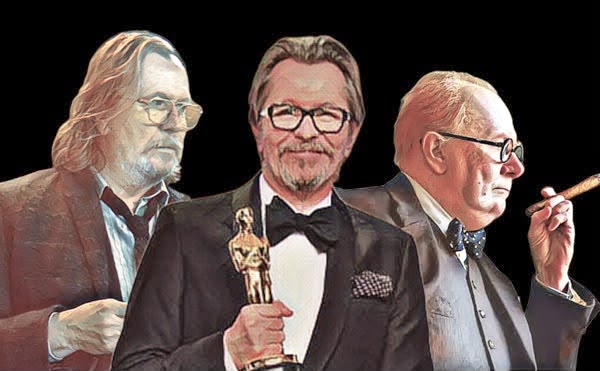
Oldman received his first Oscar nomination for this performance and lost to Jean Dujardin in The Artist in 2012. Dujardin was excellent, but, for me, that Oscar should have gone to Oldman. Churchill would bring him the statuette in 2018, with an impressive physical transformation. Smiley had already demonstrated something perhaps even more difficult: completely changing an actor’s presence without needing to turn that change into a spectacle. www.oscars.org
That is why Jackson Lamb should not be understood merely as James Bond’s opposite. Smiley had already stripped espionage of its fantasy of glamour and moral certainty. Mick Herron adds another layer to that legacy: the cruel comedy of an institution that, besides producing secrets and deaths, operates like any workplace riddled with rivalry, incompetence, and self-preservation.
Smiley controls his body to avoid revealing his thoughts. Lamb uses his body to divert attention from them. The first hides in discretion; the second, in excess. The dirt, rudeness, and repulsive habits do not mean Lamb has stopped understanding social rules. Often, they mean he knows how to use those rules against anyone expecting to encounter them. His adversary sees a washed-up man and takes too long to realize he is facing someone who has already calculated his next moves.
Oldman himself made that connection in an interview with Australia’s ABC. He explained that Smiley’s silent mental activity is also present in Lamb when he appears to be doing nothing. The appearance changes radically, but the man who observes, processes, and anticipates remains, while everyone else believes they are directing the conversation. Our comparison, therefore, does not depend solely on the coincidence of one actor playing two spies: there is a conscious continuity in his work.
The biggest difference may lie in how each man manages suffering. Smiley still preserves a form of composure that allows him to serve the institution even after seeing its corruption. Lamb seems to have abandoned any appearance of respect, yet continues to respond with fierce loyalty when his agents are threatened. One keeps pain within convention; the other has turned his rejection of convention into a defense against pain.
Neither is as simple as that opposition suggests. Smiley can be ruthless. Lamb can be tender, although he does everything possible to keep anyone from noticing. That is where Oldman becomes extraordinary: one man’s restraint does not eliminate his violence, just as the other’s verbal violence does not eliminate his affection. He does not merely change the tone of the performance. He changes where we need to look for the character.
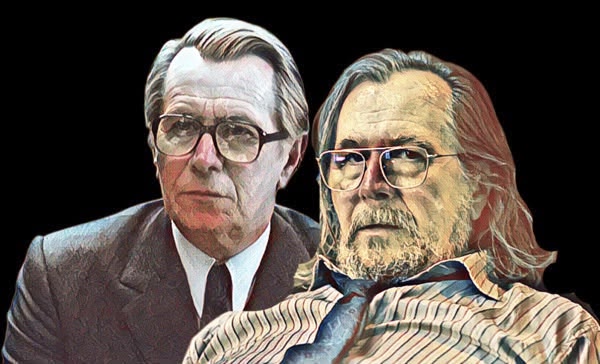
Today, Jackson Lamb is so closely associated with Oldman that the risk is the reverse of the one that accompanied much of his career. Before, audiences did not always recognize the actor behind so many transformations. Now, they may struggle to separate the actor from that filthy, unbearable spy. For anyone who knows him only through Slow Horses, revisiting Tinker Tailor Soldier Spy is a particularly good way to understand the scale of what he is doing.
George Smiley might ask Jackson Lamb to behave. Lamb would certainly respond with an obscenity. But if they needed to discover who had betrayed them, both would understand very quickly why they should work together. Gary Oldman convinces us they are radically different men while allowing a recognizable intelligence to survive between them. It is the kind of kinship an ordinary actor would reveal through resemblance. He reveals it through difference.
Descubra mais sobre
Assine para receber nossas notícias mais recentes por e-mail.

