
A few months ago, I discovered Haute & Freddy, and ever since, “Shy Girl” has been on my playlist. It’s one of those songs that immediately wins you over with its rhythm, energy, and a certain pop extravagance that combines 1980s influences, theatricality, and a delightfully unfashionable irreverence. But the lyrics are far more interesting than their apparent lightheartedness might suggest.
So, when I started watching Mike Flanagan’s new adaptation of Carrie on Prime Video, I immediately recognized that musical universe. And not simply because the series features several songs by the duo. I later discovered that “Shy Girl” played a much greater role in shaping the story than we might imagine.
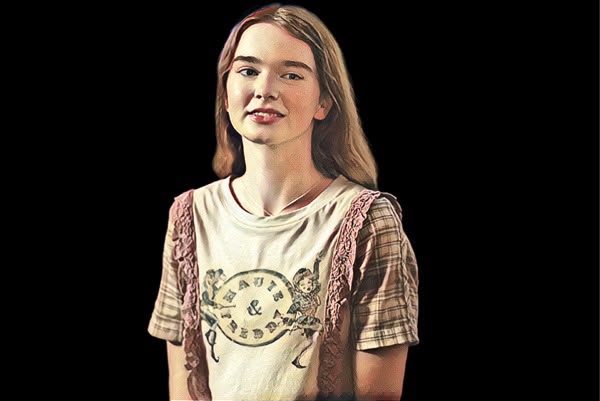
In an interview with the Television Academy, Flanagan revealed that his team heard a demo of the song while the scripts were still being developed, long before its official release. Its impact was so significant that the track eventually became the foundation of the soundtrack. Practically the entire duo’s debut album, Big Disgrace, released in March 2026, appears in the series, and Carrie even wears a Haute & Freddy T-shirt in episodes two and three.
This was no casual choice. In fact, when we pay attention to the lyrics of “Shy Girl,” we realize that the song could almost have been written for Carrie White.
Who Are Haute & Freddy?
Formed by Michelle Buzz and Lance Shipp, the American duo blends synthpop, electronic music, glam rock influences, and an aesthetic that seems to emerge from a meeting between a cabaret, a circus, and an extravagant 1980s party. Everything is colorful, exaggerated, theatrical, and deliberately strange.
There are echoes of Kate Bush, the more theatrical pop of that decade, and a musical tradition that has never been afraid of appearing eccentric. That doesn’t mean Haute & Freddy simply reproduce those influences. On the contrary, the duo seems particularly interested in transforming excess into a form of identity.
Before joining forces, Michelle and Lance already had experience as songwriters in the music industry. But the project emerged from a desire to create without the limitations imposed by the market and the pressure to produce songs that fit neatly into commercial expectations.
In interviews, they frequently discuss the freedom to be strange, to reject conventions, and to reclaim a creativity that is often gradually suppressed throughout life.
It is within this context that “Shy Girl” emerged, originally released in April 2025 and later included on Big Disgrace.
The Shy Girl Who Wants to Conquer the World
The song’s title seems straightforward enough, but its entire premise is about challenging that identity.
Michelle Buzz explained that she wrote the song as a conversation with herself, or rather, with the insecure girl she had been for many years. She was afraid to reveal who she truly was and often prioritized other people’s approval over her own happiness.
The lyrics are almost a provocation. Instead of accepting shyness as a permanent characteristic, they question why that girl continues hiding when there is a much bigger, bolder, and perhaps even slightly crazy personality inside her, waiting to emerge.
There are references to family judgment, people rolling their eyes at unconventional behavior, and the discomfort that something as simple as changing one’s hair or clothes can provoke in others.
And the message is quite clear: why do we need other people to understand who we are before allowing ourselves to live?
Musically, this idea takes on an even more interesting dimension. The repetitive chorus, synthesizers, and growing energy transform a private insecurity into something resembling an anthem of liberation. The song doesn’t gently encourage the shy girl to find her courage. It practically demands that she stop hiding.
There is something beautiful about that idea, particularly when we think about adolescence, a period when the desire to belong frequently clashes with the discovery of one’s own identity.
But there is also a less obvious interpretation, one that helps explain why Mike Flanagan chose this particular song for Carrie.
Carrie White and the Identity That Was Never Allowed to Exist
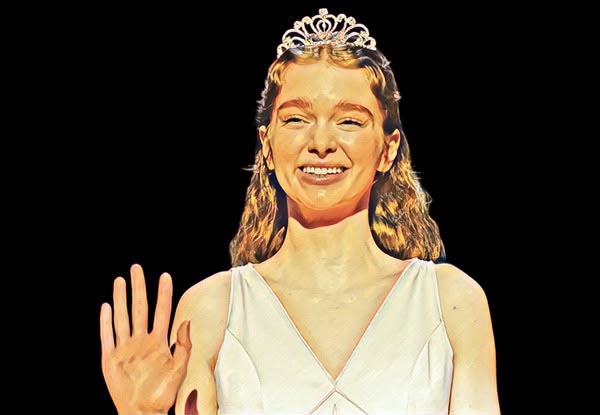
In Flanagan’s adaptation, Carrie, played by Summer H. Howell, is a teenager who has grown up almost completely isolated from the world. Her mother, Margaret, played by Samantha Sloyan, controls her routine, her behavior, her clothes, and, above all, the way she understands her own body.
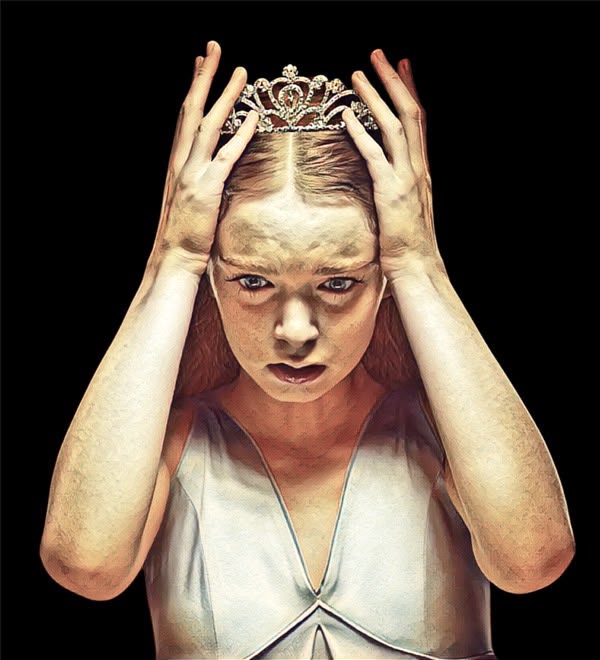
Carrie isn’t simply a shy girl. She has been raised to fear herself.
When she arrives at school, she encounters a world whose rules she doesn’t understand. She doesn’t know how to dress, how to hold a conversation, how to recognize other people’s intentions, or even how to interpret the natural changes of adolescence.
Her desire is remarkably simple: to make friends, to be accepted, and to experience what other teenagers consider perfectly normal.
And this is precisely where “Shy Girl” establishes such an interesting connection with the character.
In the song, the shy girl is encouraged to abandon an identity that doesn’t correspond to what she truly feels. In Carrie, the protagonist begins to discover that there is something inside her that her mother has spent a lifetime trying to repress.
The difference is that, in Carrie’s case, that force isn’t merely symbolic.
We’re talking about telekinesis, a power she initially doesn’t understand, cannot control, and that manifests itself more intensely in situations involving fear, humiliation, and anger.
The song is about allowing what’s inside us to emerge. But what happens when that liberation also has the potential to become destructive?
When Liberation Becomes Horror
This is where Flanagan’s choice becomes particularly interesting.
“Shy Girl” is originally a song about self-esteem, authenticity, and courage. But when associated with Carrie, it acquires an ambiguity that isn’t nearly as intense when we listen to it on its own.
The idea of allowing our true personality to emerge is positive when we’re talking about someone who has spent a lifetime trying to adapt to other people’s expectations. In Carrie’s case, however, that discovery comes with an enormous accumulation of suffering, resentment, and violence.
The girl who wants to conquer the world also has the power to destroy it.
And that doesn’t mean her violence is simply a consequence of the abuse she has endured. In fact, this is one of the issues I find most delicate in Flanagan’s adaptation. By expanding the supernatural universe and introducing Emaline, the series changes Carrie’s responsibility for what happens, particularly during the tragedy at the prom.
I believe this decision somewhat weakens the character’s moral ambiguity, which is so important in Stephen King’s novel. After all, understanding the origins of someone’s suffering doesn’t necessarily mean justifying everything they do.
But the musical choice remains remarkably powerful.
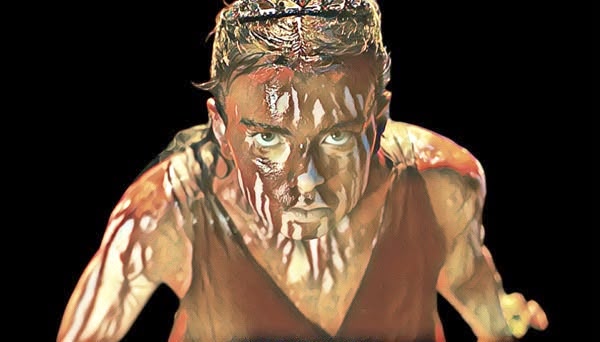
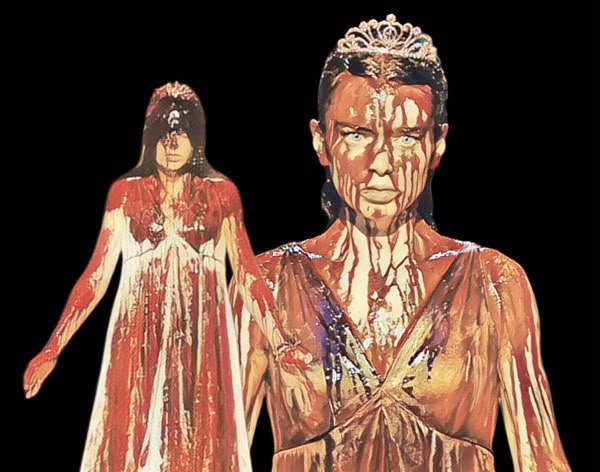
In the final episode, “Shy Girl” accompanies Carrie and Emaline as they dance through the streets of Chamberlain while the town burns around them. It is a visually striking sequence and, at the same time, profoundly unsettling.
The two girls seem to experience a kind of absolute, almost childlike freedom while everything around them has been destroyed.
It is a scene that places two apparently incompatible emotions side by side: the joy of finally being allowed to exist as oneself and the horror caused by the consequences of that liberation.
The Importance of Music in Building Carrie’s World
Flanagan went far beyond simply including a pop song in an important scene. Composers The Newton Brothers incorporated the theme of “Shy Girl” into the instrumental score, creating variations that return throughout the season.
This means that even when we aren’t hearing the original recording, its musical identity remains present, connecting different moments in Carrie’s journey to the same emotional idea.
The soundtrack also features other Haute & Freddy songs, including “Femme Hysteria,” which appears in the very first episode. It is a particularly significant choice for a story built around the fear a young woman inspires when she stops behaving as others expect her to.
And there is a fascinating irony in using a duo whose aesthetic celebrates excess, extravagance, and the right to be different in a story about a girl who is punished precisely because she cannot be like everyone else.
While Haute & Freddy transform difference into a celebration, Carrie discovers that being different can make someone a target.
The Shy Girl Was Never Just Shy
Perhaps this is what fascinates me most about the connection between music and image.
When I listen to “Shy Girl,” I hear an infectious, entertaining, and liberating song. Michelle Buzz wrote about the need to overcome the fear of being who we truly are, and it is this energy that makes the track so irresistible.
In Carrie, however, the same message takes on a much darker meaning.
Because there is an enormous difference between discovering who we are and believing that everything we feel must necessarily be expressed, without limits or consequences.
From a psychological perspective, repression does not eliminate desires, impulses, or conflicts. But expressing them does not automatically constitute working through them or achieving freedom. Not everything that has been hidden becomes a solution simply because it finally emerges.
This is one of the most interesting aspects of Carrie White. For practically her entire life, she has had no room to develop an independent identity. When she finally begins to experience that possibility, she lacks the emotional resources necessary to understand everything that is happening to her.
“Shy Girl,” therefore, functions as both an invitation and a warning.
For Michelle Buzz, it is an anthem of personal affirmation. For Carrie, it becomes the soundtrack to a liberation accompanied by destruction.
And perhaps that is Mike Flanagan’s greatest insight: recognizing that such an apparently joyful song could express his protagonist’s deepest conflict.
After all, the shy girl always had something much bigger inside her. The question was never simply how to let it emerge, but what would happen when it finally did.
Descubra mais sobre
Assine para receber nossas notícias mais recentes por e-mail.

