
Warning: This article contains spoilers for MobLand through Season 2, Episode 4.
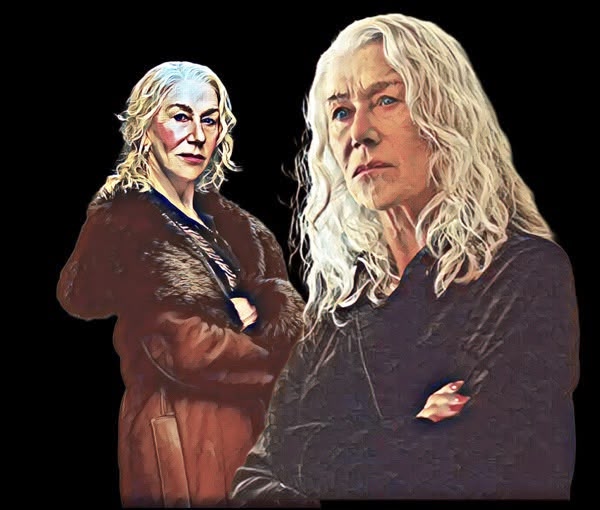
Some characters are dangerous because they cannot control their impulses. Others are even more threatening because they know exactly how to exploit them. Maeve Harrigan, played by Helen Mirren in MobLand, belongs to a particularly disturbing category: people who confuse love with possession, protection with control, and family with an extension of their own ambitions. Since the first season, we have known she can manipulate everyone around her, including her husband and children. But in Season 2, her actions are beginning to reveal something even darker. Maeve does not seem interested merely in preserving the Harrigans’ criminal empire. She wants to decide who gets to exercise power, how that power will be used, and, above all, who will remain subordinate to her will.
At first, it is easy to see her as a version of Lady Macbeth, the woman who encourages her husband to commit atrocities to seize or maintain power. The comparison makes sense, but perhaps it does not go far enough. Maeve does not exert her influence exclusively over Conrad (Pierce Brosnan), a violent, impulsive, and increasingly unpredictable man. She has built a family structure in which practically everyone has been conditioned to seek her approval, fear her reactions, or carry out her decisions. And to understand her, we need to pay particular attention to two characters: Kevin, her son, and Eddie, the grandson who discovered that he is also Conrad’s biological son.
Kevin: The son who could never be enough
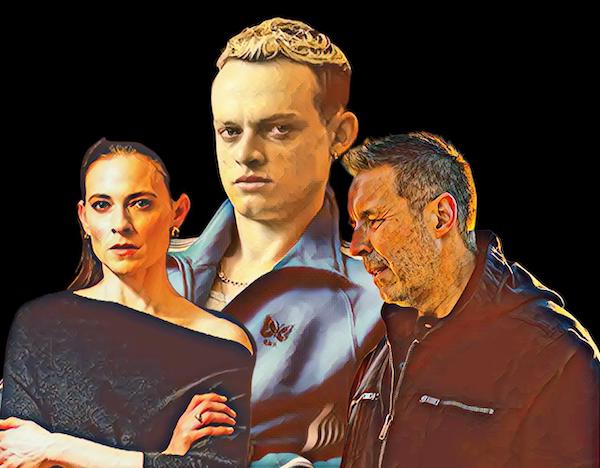
Kevin Harrigan (Paddy Considine) may be Maeve’s greatest emotional victim, precisely because he has never managed to break free of his mother completely. We are not talking about an innocent man, incapable of violence or detached from the family’s criminal operations. Kevin is part of that world and remains responsible for his choices. Yet there is something in him that still attempts, however inconsistently, to preserve a sense of identity not entirely defined by the Harrigans’ brutality.
The first season revealed the sexual abuse he suffered while imprisoned as a teenager, an experience that helps us understand his difficulties with intimacy, his need for recognition, and his particularly complicated relationship with his own masculinity. Kevin has spent much of his life trying to prove that he is strong enough to meet his father’s expectations, but there is an additional cruelty in his relationship with Maeve. She does not simply demand strength. She seems to regard vulnerability as a weakness that must be eliminated.
What is most revealing is that Kevin understands part of this mechanism. In the first-season finale, he recognizes his mother’s responsibility for Eddie’s development and for his own trajectory, describing how Maeve turns the men in her family into monsters so they can protect her. This realization is essential because it moves her beyond the familiar image of an overprotective mother into something far more perverse. Maeve does not raise her children so they can live independently of her. She creates instruments of protection and continuity for her own power.
Then there is the humiliation running through Kevin’s marriage to Bella (Lara Pulver). Conrad had been involved with her before she became Kevin’s partner, and Eddie, raised as Kevin’s son, is actually his half-brother. Maeve knows this history and participates in perpetuating a family dynamic in which her son is constantly diminished by his own father. When she finally reveals Eddie’s true parentage, she is not concerned with correcting a family injustice. She uses the truth as another weapon.
Eddie: Maeve’s preferred monster
If Kevin represents a son who still attempts to exercise some independent judgment, Eddie (Anson Boon) seems to offer Maeve an opportunity to recreate the model she desires. Impulsive, cruel, vain, and desperate for recognition, he possesses qualities his grandmother not only tolerates but appears to encourage. Discovering that Conrad is his biological father changes his position within the family and adds a particularly cruel dimension to the struggle for succession.
It is important to recognize that Eddie was not corrupted overnight. The series suggests a process of influence that began when he was still very young. Kevin and Bella attempted to protect him from that world but failed to prevent Maeve from drawing close and shaping his behavior. It is almost a repetition of Kevin’s story, with one decisive difference: Eddie seems to embrace the very qualities that the man he believed to be his father has spent his life trying to manage.
In Season 2, Maeve continues to use him as a piece in her plans. The mysterious assignment in Ireland, with Gina accompanying him, is one of the developments that most intrigues me through Episode 4. Why send him away from London precisely when the family is facing such a serious threat? Why allow Gina to accompany him after expressing such strong objections to their relationship? We still do not know exactly what Maeve intends to achieve, but we do know that she rarely acts without calculating the usefulness of the people involved.
What interests me most is the possibility that Maeve is replacing Kevin with Eddie not only in the Harrigan succession but also in her emotional preference. Not necessarily because she loves her grandson more, but because she sees in him someone more willing to carry out her wishes. For a woman like Maeve, obedience can easily be mistaken for loyalty, and cruelty for competence.
Seraphina: The daughter who represents a threat
Maeve’s relationship with Seraphina (Mandeep Dhillon) adds another dimension to her personality. Conrad’s daughter from another relationship, Seraphina represents a marital betrayal that Maeve has never truly accepted. But her resentment does not appear to be merely emotional. Seraphina also possesses intelligence, ambition, and the ability to compete for influence in the family’s business, making her existence doubly inconvenient.
In the second season, Maeve’s sudden attempt at reconciliation immediately raises suspicions, and with good reason. When she begins investigating the properties of antifreeze as a poison, and Conrad later discovers the substance hidden among her belongings, the series points toward the possibility that she is preparing to murder Seraphina. We have not seen the plan carried out, nor do we have a definitive confession establishing every detail, but the threat is concrete enough to make any affectionate gesture suspicious.
It is one of Maeve’s most frightening characteristics: the possibility of staging a maternal reconciliation while preparing to eliminate someone. Seraphina is not her biological daughter, but she belongs to the family Maeve claims to defend. This forces us to ask what family actually means to Maeve. Blood ties? Obedience? Or simply the convenience of each relationship?
Conrad and Harry: Two men she cannot completely control
Her marriage to Conrad is a partnership built on ambition, violence, and complicity. For a long time, Maeve seems to have found in her husband the ideal instrument through which to exercise an indirect form of power. But Conrad is becoming increasingly unstable, and his decisions are putting everyone at risk. Season 2 suggests that she has recognized the need to develop alternatives, even without sharing her plans with him.
The problem is that Conrad also knows the woman he married. When he discovers the antifreeze, he realizes something is happening behind his back. We do not yet know how he will react, but the possibility of a war within their marriage may prove as dangerous as the conflict with their external enemies.
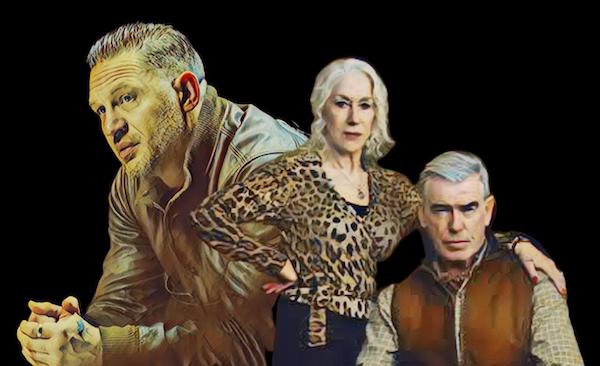
Harry Da Souza (Tom Hardy) represents another obstacle. He is the one who can usually anticipate the consequences of the Harrigans’ disastrous decisions, manage conflicts, and prevent family rivalries from destroying the business. His loyalty, however, does not mean blind obedience to Maeve’s every whim. And that makes his presence particularly uncomfortable for her. Harry possesses an authority that does not depend on blood ties and a competence that Conrad’s children do not always demonstrate.
For Maeve, someone like Harry is both indispensable and threatening.
A mother who needs her own monsters
There is a particularly interesting psychological reading of this family dynamic. Maeve seems incapable of fully recognizing other people as independent individuals, with desires, boundaries, and needs that may differ from her own. Her children and grandchildren exist as extensions of her will. Love, whenever it appears, comes with expectations, competition, guilt, and manipulation.
It would be simplistic to reduce her to a diagnosis or assume that some traumatic childhood, which the series has not sufficiently explored, would automatically explain her behavior. What we can analyze are her actions and the repetition of a pattern in which other people’s vulnerability becomes an opportunity for control. Kevin must prove that he is strong. Eddie must prove that he deserves the Harrigan name. Seraphina must accept that her place in the family will always be questioned. Conrad must remain powerful, but within limits Maeve considers acceptable.
And all of them, in one way or another, must need her.
Helen Mirren is particularly effective because she does not play Maeve as a villain who announces her intentions in every scene. Often, the calculated gentleness of a sentence, a smile, or an apparently innocent expression of concern is enough to suggest that something is being planned. Mirren makes the character appear maternal and threatening almost simultaneously, without allowing either quality to cancel out the other.
By the fourth episode of Season 2, I still do not know exactly what her ultimate move will be. Whether she intends to sideline Conrad, eliminate Seraphina, establish Eddie as her successor, or simply make sure nobody can act without her approval. Perhaps these possibilities are not even mutually exclusive.
But one thing seems increasingly clear to me: Maeve does not merely want to survive the war between the criminal families. She wants to determine what will remain of the Harrigans when it is over.
And perhaps the most important question about this character is not how far a mother will go to protect her children, but what happens when the children need protection from their own mother?
Descubra mais sobre
Assine para receber nossas notícias mais recentes por e-mail.

