
For those of us who experienced the Oasis phenomenon in the 1990s, followed Noel and Liam Gallagher’s turbulent relationship, witnessed their breakup in 2009, and regarded their eventual reconciliation as virtually impossible, Oasis: Don’t Look Back in Anger, available on Disney+, was one of the most anticipated documentaries of the year. After sixteen years apart, the two most quarrelsome brothers in British rock were finally sharing a stage again, embarking on one of the biggest tours of 2025. Naturally, we expected revelations, backstage footage, previously unseen conversations, and, above all, some explanation of how they managed to overcome so many years of insults, grievances, and resentment. That is not exactly what we get, and I confess that I finished the film, which runs for a little over two hours, feeling disappointed, although I also recognize that it reveals something far more interesting than its filmmakers seem to realize.
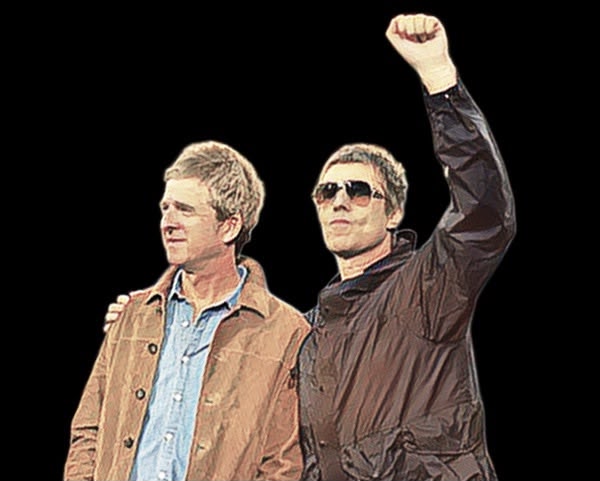
Created by Steven Knight (Peaky Blinders) and directed by Dylan Southern and Will Lovelace, the documentary devotes far too much time to celebrating the magnitude of the Oasis phenomenon, with lengthy concert sequences, emotional fans, and testimonials about the band’s importance in people’s lives. I don’t question that importance, much less the genuine emotion of those who waited so many years for the reunion, but there is something excessively self-important about the constant insistence on explaining just how extraordinary Oasis is. The film seems to confuse the band’s historical significance with the need to reaffirm it continuously, becoming repetitive and considerably longer than necessary. For those familiar with this story, no fan testimonial could possibly be as fascinating as a spontaneous conversation between Noel and Liam, especially since those are precisely the conversations we barely get to see.
The narrative choice, however, has a justification worth considering. Noel admits that he had never fully grasped the extent of Oasis’s legacy and is genuinely surprised to discover an entire generation of young people who had never seen the band perform live but know their songs and sing every word as though they had experienced the cultural explosion of the 1990s firsthand. During the years when the brothers were estranged, Oasis continued to exist in the memories of its longtime admirers while attracting countless new ones, including people who hadn’t even been born when Definitely Maybe and (What’s the Story) Morning Glory? were released. For Noel and Liam, discovering that lasting influence seems to have been a transformative experience. For those of us who never stopped listening to their music throughout those years, perhaps not quite so much. A handful of carefully selected sequences would have been enough to demonstrate the strength of that legacy without sacrificing so much time that could have been spent with the protagonists themselves.
After all, the Gallagher brothers’ relationship has always been a spectacle in its own right. Anyone who has watched the previous documentaries knows the peculiar mixture of love, aggression, admiration, and rivalry that defined their history. Noel was the songwriter, the man responsible for the songs that made Oasis one of the defining bands of their generation, but Liam was the one commanding the stage, with an unmistakable voice, a magnetic presence, and an arrogance that became an essential part of the band’s identity. I always had the impression that Noel somewhat resented his younger brother’s position as the frontman, while Liam struggled with his dependence on Noel’s songwriting talent. It was a relationship in which each needed the other to achieve the extraordinary success they enjoyed together, yet both seemed determined to prove that they were individually more important.
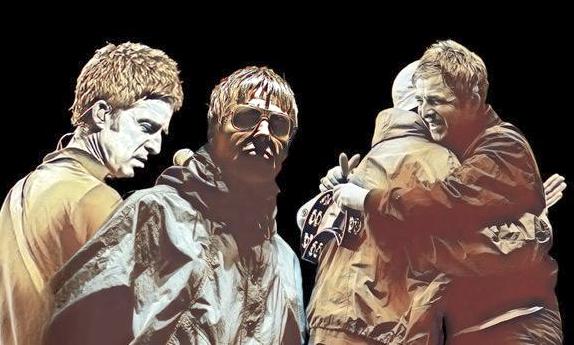
Their separation ultimately allowed them to test that theory. For more than a decade, Noel developed a successful and consistent career with Noel Gallagher’s High Flying Birds, exploring different musical influences and establishing himself as an independent artist. I am admittedly a Noel fan, and I believe that, although he never reproduced the cultural impact of Oasis, he successfully built an identity of his own and an impressive body of work. Liam also found his audience, preserved his charisma, and maintained the attitude that made him one of British rock’s great frontmen, but he never became a songwriter of his brother’s caliber. Both enjoyed success in their individual careers, and perhaps it was precisely that experience that made their reconciliation possible. After spending so many years trying to prove their worth, they no longer needed to compete with each other.
I have always seen Noel and Liam as two opposing forces who, somehow, managed to create extraordinary music together. Noel is methodical, organized, restrained, the man who writes, plans, and seems to need everything under control. Liam is instinct, provocation, unpredictability, and pure chaos. That combination was fundamental to Oasis’s success, but it also fueled the conflicts that eventually destroyed the band. What has changed, as the documentary reveals, is not either brother’s personality, but the way they have learned to live with their differences. Noel acknowledges that the power struggle no longer exists and that they now meet as equals, while Liam offers a surprisingly mature reflection on authenticity and responsibility, summed up in the phrase “You have to care a lot to not give a fuck.” For someone who spent much of his career defending his right to say exactly what he thought, regardless of the consequences, recognizing that the freedom to be ourselves also requires consideration for the impact of our words represents an important transformation. Liam is still Liam, but he seems to have developed a greater awareness of his own behavior, recognizing that he needs to remain mindful if he doesn’t want chaos to take over. It is almost a form of conscious chaos, a contradiction that suits him perfectly. Noel, meanwhile, seems to have realized that he doesn’t need to control everything anymore, least of all his own brother.
What makes it particularly interesting is that neither brother describes their reconciliation as the result of a dramatic conversation, an apology, or some extraordinary gesture. They simply acknowledge that they have reached a different stage in life, one in which the things that once irritated them have lost their importance. The grievances have not necessarily disappeared, but they no longer determine the relationship. It is a realization that seems possible only with the distance provided by time, when we can look back at the conflicts of our youth and understand that some battles do not need to be fought forever.
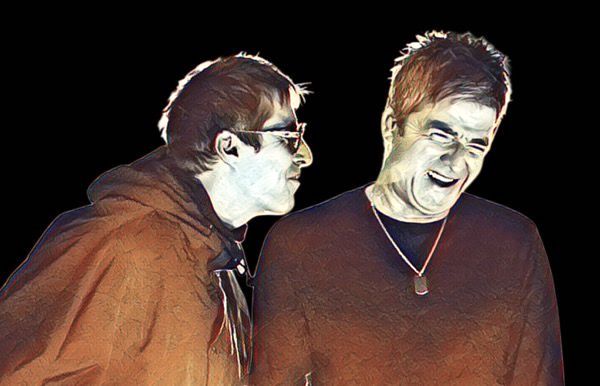
One of the most revealing scenes involves the next generation. Noel recalls, amused, how the brothers’ sons, now close to one another, went out together, drank too much, and ended up helping each other while feeling sick. Watching them, he immediately recognized himself and Liam in their younger days and joked with his brother about the resemblance. It is a seemingly trivial moment, but it says more about their reconciliation than any grand declaration could. The Gallaghers can now look back at their own excesses, recognize the youth they shared, and laugh at behavior that, decades earlier, might have triggered yet another argument. Their children can experience the same camaraderie and recklessness without inheriting the burden of their fathers’ rivalry.
Nostalgia, in this context, takes on a very different meaning from the one usually associated with famous bands reuniting. This is not simply about reliving youth, revisiting old hits, or commercially exploiting the audience’s longing for the past. For Noel and Liam, there also seems to be an opportunity to revisit that past without repeating its mistakes, recognizing that the anger, excesses, and grievances belonged to a stage of life that no longer needs to define who they are. It does not mean denying what happened, but accepting that growing older also means learning to live with our own history.

This is where the unexpected appearance of Father Luke Bradbury, from St. Bernard’s Church in Burnage, the Manchester neighborhood where the brothers grew up, provides one of the film’s most important messages. During a homily about forgiveness, the priest explains that forgiving does not necessarily mean forgetting what happened, but deciding that we no longer want to carry that burden with us. The scene has a particular connection to the Gallagher family, especially to the brothers’ mother, Peggy, a devout Catholic, and offers a key to understanding a reconciliation that does not require grand gestures. We do not need to rewrite the past in order to move forward, just as we do not have to agree on everything that happened to stop living under the weight of resentment.
And then we arrive at the ending, which I consider one of the documentary’s most intelligent choices. Rather than closing with one of Oasis’s countless anthems, the film turns to What the World Needs Now Is Love, written by Burt Bacharach and Hal David in 1965. Noel Gallagher’s admiration for Bacharach is hardly a secret. A framed photograph of the composer was already featured on the cover of Definitely Maybe in 1994, and Noel even shared the stage with him to perform This Guy’s in Love with You. The choice, therefore, goes far beyond a sentimental message about two brothers making peace. It connects one of Noel’s most important musical influences with the moment when the songwriter finally seems to understand that the story of Oasis is bigger than his old disputes.
The delicacy of Bacharach’s song contrasts with the aggression that has always accompanied the Gallaghers’ public image, but it also reveals something present in Oasis’s music from the beginning. Behind the arrogance, the insults, and the defiant attitude, their finest compositions have always been about belonging, loneliness, hope, and the need to find someone who understands how we feel. Perhaps Noel and Liam were unable to express that vulnerability to each other for many years, even though they managed to share it with millions of strangers through their music.
None of this turns Oasis: Don’t Look Back in Anger into a great documentary. I still believe it lacks backstage access, genuine revelations, and a deeper exploration of one of the most fascinating and turbulent sibling relationships in recent rock history. The film spends far too much time celebrating its own importance and wastes some of the potential of a story that never needed so many outside voices to be moving. There is a certain irony in that choice: a documentary about two men who finally seem to have stopped taking themselves quite so seriously ends up taking their cultural importance far too seriously.
Even so, I came away thinking that perhaps its greatest revelation lies precisely in the absence of what we expected to find. There was no dramatic reconciliation because, apparently, it no longer needed to happen that way. Noel and Liam had time to build their own lives, raise their children, test their talents independently, and discover that the past did not need to remain a competition. Meanwhile, their music crossed generations and became bigger than any personal disagreement.
For those of us who experienced this entire story, there is something profoundly moving about realizing that the brothers did not have to reclaim their youth to reclaim their relationship. They simply had to grow old enough to finally look back on it with a little tenderness. Perhaps that is, after all, the true meaning of Don’t Look Back in Anger: not forgetting what happened, but learning to look back without anger.
Descubra mais sobre
Assine para receber nossas notícias mais recentes por e-mail.

