
Spoilers ahead!
After three seasons of watching Nicol Trowbridge (Rory Kinnear) explode at practically everyone around him, The Diplomat finally allows us to see the world from the British prime minister’s perspective. And the result is every bit as theatrical as the character himself. The fourth episode, titled Pagliacci, draws on Ruggero Leoncavallo’s opera to portray a man who sees himself as the protagonist of a grand tragedy, yet also seems aware of the absurdity of his own predicament.
It is an interesting choice by Debora Cahn, particularly because Austin Dennison’s (David Gyasi) death could easily have been treated as just another political twist. Instead, the series uses the tragedy to explore the emotional fragility of a character who has always confused authority with aggression.
The episode begins by revealing that Trowbridge will resign. Before reaching his public announcement, we follow the two days leading up to his decision. And in this reconstruction, we discover what was really happening during his meeting with Kate and Hal Wyler.
Trowbridge already knew about Dennison’s death when he received the Americans. Devastated and unable to process his grief, he begins experiencing a series of visions that blend his insecurities, his guilt, and the imaginary presence of Margaret Roylin. She appears to provoke him, accuse him, and torment him, while the American representatives become grotesque figures in his distorted perception.
This is hardly a demonstration of emotional stability. But it is a remarkably effective way of portraying the internal disintegration of a man who must continue exercising power when his judgment appears seriously compromised.
Trowbridge says he loved Dennison like a brother. Perhaps he did, although their relationship was always marked by conflict. Dennison was the rational counterweight to an impulsive, frequently arrogant prime minister who tended to turn every disagreement into a battle for authority. More than a colleague, he was the man who prevented Trowbridge from making even greater mistakes.
And now he is dead.
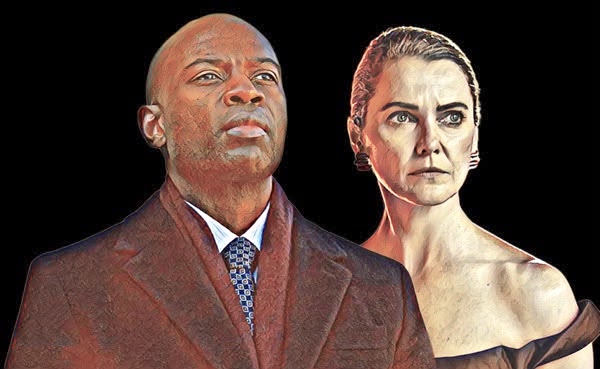
His replacement hardly promises the same reassurance. Robyn Palmer, played by Jodie Whittaker, takes over as foreign secretary. She had already appeared earlier, helping coordinate the British response to the attack on Grace Penn, but her position now becomes considerably more important. Robyn makes it clear that she has no intention of serving as the political and moral restraint Dennison once provided.
It is a significant declaration. Without Dennison, British politics loses a figure capable of confronting its own prime minister.
While Trowbridge struggles with his breakdown, the Americans attempt to manage the disaster created by Hal (Rufus Sewell). By revealing that the United States secretly removed the Poseidon nuclear weapon from the Russian submarine and transported it to Georgia, the vice president has compromised America’s position and jeopardized its relationship with its most important European ally.
Grace Penn (Allison Janney) is furious. And rightly so. But it is curious to watch how Hal, despite accumulating reckless decisions, somehow manages to preserve his political influence. He reframes the revelation as an initiative that ultimately benefited the British. After all, the nuclear weapon no longer poses an immediate threat to the United Kingdom’s coastline.
It is a convenient justification, but one that ignores the fact that the Americans violated their allies’ trust. The problem was never simply the weapon’s existence. It was the unilateral decision to remove it, conceal it, and lie about what had happened.
Eidra Park must also deal with the consequences. Her professional relationship with Tom Libby, which had begun to recover, suffers another setback. The CIA and British intelligence services are supposed to share essential information, but the Americans seem to interpret that partnership rather selectively.
The greatest risk, however, is that Trowbridge might decide to reveal everything publicly.
This is when Hal proposes a solution that says a great deal about the direction these characters have taken: using Margaret Roylin as blackmail material.
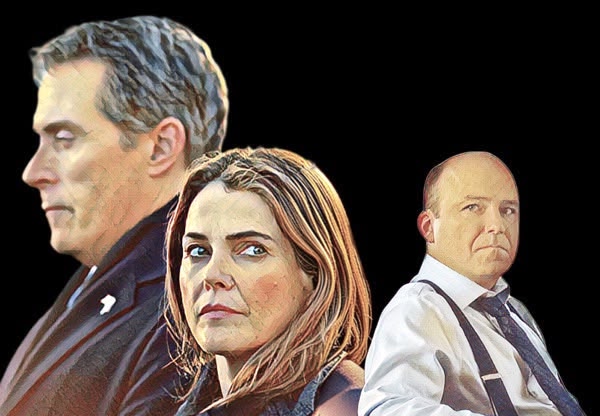
The Americans possess compromising footage of Trowbridge attempting to strangle Roylin. Threatening to release it could guarantee the prime minister’s silence about Poseidon. Kate (Keri Russell) reacts with outrage. After all, turning diplomacy into personal intimidation means abandoning the very principles she is supposed to defend.
But her outrage does not last quite as long as we might hope.
Trowbridge announces Dennison’s death and delivers a speech filled with resentment toward the United States. Without directly exposing the nuclear secret, he describes Britain’s former allies as an arrogant, bullying superpower. It is a harsh speech, but not entirely unjustified, considering Grace and Hal’s decisions.
Before leaving London, Hal also takes steps to protect Kate, concerned about the growing hostility toward Americans. It is one of the character’s permanent contradictions: he may be arrogant, manipulative, and politically reckless, but his concern for Kate is genuine.
The decisive confrontation comes when Kate approaches Trowbridge. He refuses to promise absolute silence about Poseidon and makes it clear that neither she nor Hal will be welcome at Dennison’s funeral.
It is a personal rejection that deeply wounds Kate. Austin was her ally, her friend, and, for a long time, represented a romantic possibility that never fully materialized. Now, she will not even be able to say goodbye to him officially.
But Kate also crosses a line. Instead of consulting Hal, as she had promised, she decides to use the threat involving Roylin. And she does so in front of Robyn Palmer, ensuring that the new foreign secretary also understands the weight of the compromising information.
It is the moment when Kate stops being merely the diplomat trying to contain everyone else’s excesses and begins reproducing those same methods herself.
The final sequence returns the spotlight to Trowbridge. His resignation is staged with all the theatricality the episode has promised from the beginning. Imagining himself first dressed as a king and then as the tragic clown of Pagliacci, he turns his own defeat into a spectacle.
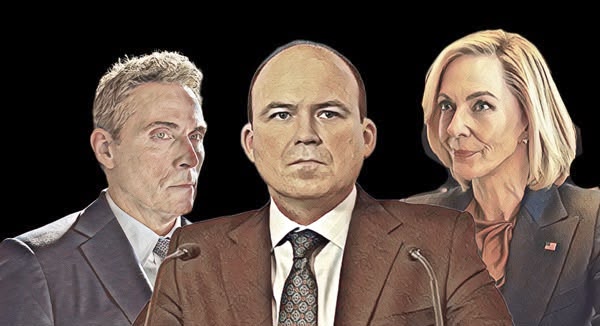
Rory Kinnear is excellent. His Trowbridge remains a difficult man to defend, but the performance allows us to glimpse the loneliness, guilt, and humiliation concealed beneath the arrogance. It is rather remarkable that one of the show’s most insufferable characters manages to deliver one of its most human moments.
And there is something particularly meaningful about the operatic reference: in Pagliacci, the boundary between performance and reality collapses in the face of tragedy. Trowbridge appears to be experiencing precisely that confusion. The public figure continues playing his part, even when the man behind the mask can no longer sustain the performance.
By the end of the episode, Dennison’s death has triggered much more than a change in the British government. It has also eliminated one of the few figures capable of representing a certain degree of political integrity in The Diplomat‘s universe.
Kate threatens, Hal manipulates, Grace imposes her will, and Trowbridge falls apart. They all seem convinced that their decisions are necessary to prevent an even greater catastrophe. Yet with every episode, it is those very decisions that create new crises.
And one question remains: how much is left of the diplomat Kate Wyler once believed herself to be?
Descubra mais sobre
Assine para receber nossas notícias mais recentes por e-mail.

