
After a season marked by attacks, deaths, blackmail, marital crises, and increasingly absurd political decisions, The Diplomat finally finds what it seemed to have forgotten: diplomacy. And, ironically, to defend it, Kate Wyler (Keri Russell) has to resign as ambassador. It is a powerful, theatrical, and, let’s face it, rather satisfying ending. Debora Cahn’s series continues to rely on extreme situations, but this time, it manages to turn the excess into an interesting discussion about the limits of power, the responsibility of those who govern, and the obligation to say no when obedience is no longer a virtue.
President Grace Penn (Allison Janney), traumatized by the assassination attempt that nearly cost her life, has become increasingly authoritarian, impulsive, and incapable of accepting disagreement. At the center of the conflict is still Poseidon, the Russian nuclear weapon the Americans secretly removed from a sunken submarine near the British coast. It was an operation orchestrated behind the scenes by Grace and Hal Wyler (Rufus Sewell), without the knowledge or authorization of the British government. Now, with Bethan Vaughn (Jodie Whittaker) leading the United Kingdom, the situation becomes even more delicate. The new prime minister is no Nicol Trowbridge. She is intelligent, composed, and knows exactly what she is doing, including when she decides to allow a Russian presence in British waters. Grace, however, interprets any resistance as a personal affront.
The president demands that Kate deliver an ultimatum: either the British prevent the Russians from approaching, or the United States will send its own warships to resolve the situation. Kate tries to soften the message. After all, we are talking about two historic allies, both NATO members, who could end up pointing weapons at each other. But Grace does not want negotiation. She wants obedience. And this is precisely where the season begins to make sense.
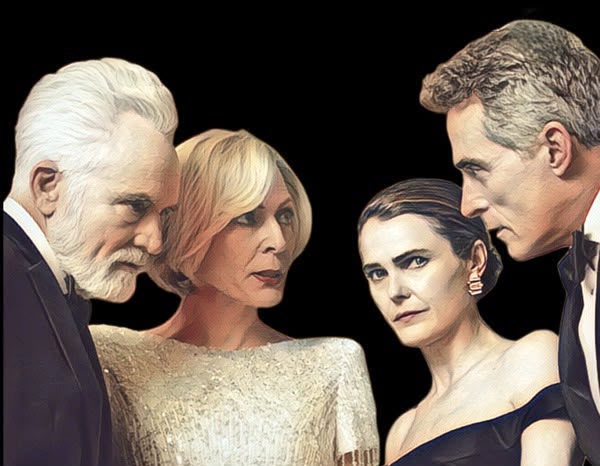
One of the most interesting storylines of this fourth season has been Todd Penn’s (Bradley Whitford). The president’s husband, who feels increasingly excluded from his wife’s political world, desperately tries to reclaim some space in her life. He wants to be heard, to participate in decisions, and to earn the admiration he sees between Grace and Hal. Instead, he is sent to London as a special representative, on a mission for which he is completely unprepared. The result is disastrous. During a conversation with British Foreign Secretary Robyn Palmer, Todd practically suggests that the Americans could use force against British citizens who stand in the way of their military operation. It is exactly the kind of statement capable of turning a diplomatic crisis into an armed confrontation between allies.
Bradley Whitford is excellent as this displaced figure, trying to preserve some dignity in an environment where practically everyone considers him irrelevant. And the parallel with the traditional role of first ladies is impossible to ignore. Todd is a man who wants to be recognized by the powerful woman he married, but who does not fully understand the rules of the world he desperately wants to belong to. Grace, meanwhile, seems incapable of offering her husband what she offers Hal: intellectual complicity, trust, and participation. There is a fascinating reversal of roles here, but also a familiar story about how power interferes with intimacy in a marriage.
As Grace continues making dangerous decisions, Kate realizes that her ability to manage the situation has reached its limit. Their confrontation during a dinner in Italy is revealing. Kate dares to say what everyone else is thinking: Grace changed after being shot. Her leadership has become more aggressive, her judgment more unstable. For a few moments, the president seems willing to acknowledge that something might be wrong. But admitting weakness would mean surrendering an authority she believes she must constantly demonstrate. And Grace chooses to demonstrate it in the worst possible way.
The tension also reaches Stuart Hayford (Ato Essandoh), who uses the State Department’s formal dissent channel to register his objections. The president’s response is to remove him from London, making it clear that not even institutional mechanisms for disagreement will be respected. The episode therefore raises a fundamental question: when a government turns disagreement into disloyalty, who will still have the courage to challenge it?
The defining moment comes during the G7 meeting in Italy. In front of international leaders, Grace Penn decides to abandon any attempt at negotiation. She publicly adopts a confrontational position, making it clear that the United States is prepared to use military force against anyone who attempts to interfere with its operation. It does not matter that the potential adversaries are America’s own allies. It is an extraordinary threat, one that endangers not only relations between the United States and Britain but the very principle of cooperation upon which NATO was built.
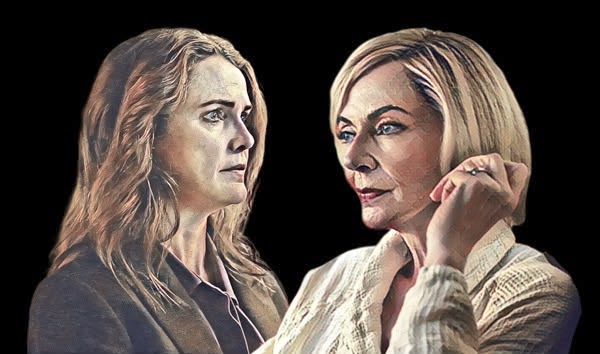
Kate watches everything and understands that there is no longer any room for compromise. Then she stands up. Before leaving, she kisses Hal, removes her credentials, approaches the president, and submits her resignation. It is a scene deliberately designed for emotional impact, and it works. Because Kate, after so many concessions, finally draws a line. But the bigger surprise comes next. Billie Appiah (Nana Mensah), the White House chief of staff, also walks out of the meeting. Secretary of State Miguel Ganon (Miguel Sandoval) follows. This is no longer simply a dissatisfied ambassador. It is a rupture within the very heart of American power.
And then comes Hal. The vice president, who throughout the season appeared committed to his own plans and political maneuvering, also decides to break with Grace. It is an important reversal, especially because Hal and Kate’s relationship has always been built on a constant mixture of complicity, rivalry, admiration, and distrust. Kate never entirely knows what her husband is planning. Neither do we. That is why his decision carries such obvious emotional weight. Hal chooses his wife’s side, but also the side of a political resistance to a crisis he himself helped create. Still, it would be naive to imagine that this gesture is entirely selfless. Shortly before, Grace had humiliated Hal in front of the other leaders by preventing him from speaking. And we know this character well enough to suspect that his wounded ego also plays a part in his decision.
Rufus Sewell makes Hal irritating, fascinating, and almost impossible to decipher. Even when he appears to be doing the right thing, there is always a lingering question about his true motivations. The final scene captures that ambiguity perfectly. Facing the press, Kate announces that the vice president has something to say. Hal approaches the microphones, and the screen cuts to black. We do not hear a single word. The series ends exactly where another story should begin.
So, what does all of this mean? Kate’s gesture carries significance far beyond her resignation. For four seasons, we have followed a brilliant diplomat frequently overwhelmed by her own personality, her husband, and circumstances beyond her control. A professional who would rather solve problems than give speeches, even though she cannot always control her temper. Now, finally, Kate understands that there is a difference between serving a government and serving a country. It is an ethical decision, but also a political one. By publicly abandoning Grace Penn, she stops trying to change the system from within and begins confronting it openly.
Hal’s decision makes everything even more meaningful. The couple who spent years competing for space, influence, and power finally find a common cause. It does not mean their marital problems have disappeared. But in that moment, they recognize each other again. And there is something particularly interesting about this political reconciliation: Hal has always been the man of grand maneuvers, while Kate represented, at least in theory, negotiation and consensus-building. For the first time, they seem to understand that neither strategy works when the person holding power simply refuses to listen.
The ending leaves plenty of questions. What is Hal about to reveal to the press? Is he planning to denounce Grace, expose the Poseidon operation, or announce an institutional challenge to the president? And can Grace Penn remain in office after publicly losing such important members of her administration, including her own vice president? NATO’s situation also remains extremely delicate, especially with the possibility of an armed confrontation between allies. But perhaps the greatest uncertainty concerns Kate’s future. Without her position as ambassador, will she be able to exercise influence differently? And, more importantly, can she preserve her principles once she is outside the institutional structure that has defined her professional identity?

Then there is Todd Penn, who strikes me as one of the characters with the greatest potential for a continuation. His marriage to Grace has reached a point where admiration has been replaced by resentment, exclusion, and jealousy. Todd wants to participate in his wife’s life, but she finds in Hal the intellectual partnership that no longer seems to exist at home. It is a dynamic reminiscent of House of Cards, although with the roles reversed, and one that Debora Cahn could explore in much greater depth. The first gentleman will have to decide whether he will continue accepting the decorative role he so clearly despises or finally confront the woman he loves.
A potential fifth season would therefore have more than enough material to completely change the show’s dynamics. Kate would no longer have to deal exclusively with diplomatic crises in London. She could become a central figure in the opposition to Grace, while Hal would face the consequences of publicly challenging the president who brought him into the vice presidency. And Grace, naturally, cannot simply be reduced to a deranged villain. Her behavior after the assassination attempt raises questions about trauma, fear, paranoia, and the difficulty of distinguishing conviction from omnipotence. Allison Janney has enough material to develop an even more complex character, provided the writers resist the temptation to turn her into a caricature.
Ultimately, however, the main reason to look forward to more The Diplomat is still Kate Wyler. Keri Russell has found in this character a wonderful combination of intelligence, humor, vulnerability, and impatience. Kate is brilliant precisely because she is incapable of being flawless. She makes mistakes, talks too much, explodes when she should listen, and sometimes turns a delicate conversation into a battlefield. But when she finally has to choose between her career and what she believes in, she does not hesitate.
And that is why, despite all its excesses, I consider this one of The Diplomat‘s most effective finales. The season began by eliminating Austin Dennison, one of the characters who best represented the possibility of negotiation, and ended by forcing its protagonist to make a choice he would probably have understood. After so many explosions, conspiracies, and threats, Kate finally does what the show’s title always promised: she defends diplomacy. Even if, to do so, she must stop being a diplomat. And knowing Hal Wyler, I suspect that microphone is about to cause far more problems than it solves.
Descubra mais sobre
Assine para receber nossas notícias mais recentes por e-mail.

