
Spoilers ahead!
There comes a moment when trying to control a crisis stops being a demonstration of political skill and becomes a succession of lies. Kate Wyler (Keri Russell) seems to have finally reached that point. In the penultimate episode of The Diplomat‘s fourth season, she tries to prevent Grace Penn (Allison Janney) from provoking a military confrontation with Russia, but ends up putting her career, her marriage, and the trust of practically everyone around her at risk.
And it all culminates in a dinner so uncomfortable that it manages to turn a conversation between two married couples into a government crisis.
The episode, titled Phony Negroni, takes the characters to Italy, where the G7 summit is being held. Under normal circumstances, the meeting should provide an opportunity for negotiations between the world’s leading Western powers. But this is The Diplomat, a series in which international gatherings seem to exist primarily so that its protagonists can find new ways to make already complicated situations even worse.
Kate arrives in Italy carrying a secret. In the previous episode, she informed the American team that she had delivered President Grace Penn’s threat to British Prime Minister Bethan Vaughn (Jodie Whittaker): if the United Kingdom did not prevent the Russians from recovering their sunken submarine, the United States would send warships to block the operation.
Except Kate lied.
She never delivered the ultimatum. She tried to convince Vaughn to accept a diplomatic solution, but when the British prime minister refused, Kate chose to buy time rather than carry out an order she considered dangerous.

It is an important decision, but also a deeply contradictory one. Kate finally refuses to participate directly in an initiative that could provoke a war. At the same time, she resorts to deception to conceal her disobedience.
Stuart Hayford (Ato Essandoh) and Eidra Park (Ali Ahn) discover that the Russians are still preparing their submarine recovery operation. The information contradicts Kate’s account and confirms that the crisis remains completely unresolved.
Kate admits what she has done. Her hope now is to persuade Hal Wyler (Rufus Sewell) to present Grace with an alternative proposal: the Americans and British could recover the Russian sailors’ bodies themselves, preventing Moscow from accessing the submarine and discovering that Poseidon is missing.
It is a proposal that attempts to reconcile the humanitarian obligation to recover the dead with the need to avoid military escalation. But it depends on something that has become practically impossible within the Penn administration: convincing the president that there might be a better solution than the one she has already chosen.
Hal arrives in Italy, and Kate attempts to prepare him for what is coming. The two discuss their marriage, their differences, and the way they continue interfering in each other’s professional lives. Curiously, their relationship seems to be going through a period of relative stability. For the first time in quite a while, Kate and Hal manage to disagree without immediately turning the conversation into a domestic war.
But the peace does not last.
When Kate reveals that she disobeyed the president, Hal is deeply upset. His primary concern is not only the diplomatic risk. He realizes that he, too, could be held responsible for his wife’s actions. And that says a great deal about the character. Hal may love Kate, protect her, and recognize her intelligence, but he remains a man profoundly attached to power. Now that he is vice president, his decisions inevitably involve calculating how best to preserve his position.
Meanwhile, Grace and Todd Penn (Bradley Whitford) are facing a marital crisis that can no longer be dismissed as ordinary relationship strain.
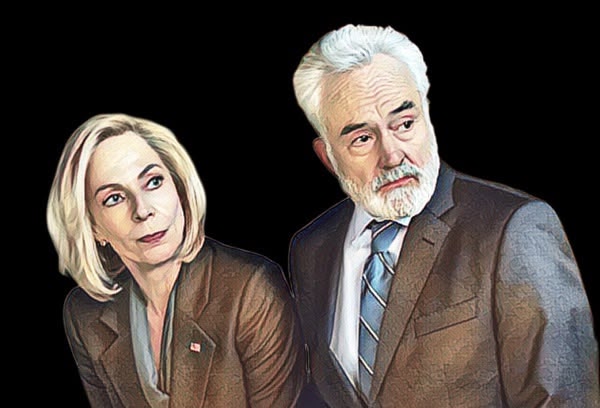
Todd is convinced that his wife has changed since the assassination attempt. Grace has become even more impatient, aggressive, and unwilling to accept questions. Her husband tries to confront her about her behavior, but she interprets every expression of concern as an attempt to undermine her.
It is interesting to observe how Bradley Whitford develops Todd. He is not merely an unhappy husband trying to find some institutional relevance. He is someone who realizes that the woman with whom he has shared his life is becoming a person he no longer entirely recognizes.
When Grace discovers that Kate met Vaughn without Todd present, she reacts angrily. The problem, apparently, is not simply the outcome of the negotiation. It is the fact that Kate made an independent decision.
The president seems increasingly unable to tolerate any display of autonomy from her advisers.
Meanwhile, Stuart confronts Billie Appiah about the information he has uncovered. He now knows that Grace was involved in the operation responsible for the attack on HMS Courageous and cannot understand how the chief of staff continues working for her.
Billie tries to explain that she attempted to prevent certain decisions, but Stuart is unconvinced. For him, the issue has moved beyond political disagreement. His conclusion is that Grace is no longer fit to remain president.
It is an extraordinarily serious accusation. But after everything that has happened this season, it hardly comes out of nowhere.
Billie, meanwhile, represents a familiar dilemma within any power structure. How long can someone remain inside an administration while trying to prevent disastrous decisions? And at what point does staying cease to be a form of resistance and become an act of complicity?
The same question Kate began asking in the previous episode now extends to other members of the administration. But the great confrontation takes place during a dinner with Grace, Todd, Kate, and Hal.
The evening begins with an appearance of civility, although the atmosphere is already charged with tension. Grace speaks privately with Kate about Todd’s involvement in the British negotiations. Kate attempts to defend the president’s husband, acknowledging that he might make a positive contribution, while also admitting her initial reservations.
The problem is that Grace has no intention of forgetting that Todd was excluded from the meeting with Vaughn. When all four sit down at the table, the conversation quickly turns into a reckoning.

Todd confronts his wife about her behavior. Grace reacts badly. Hal attempts to intervene, while Kate tries to explain the dangers of a naval blockade and introduce her alternative plan for recovering the Russian sailors’ bodies.
It is one of those moments when The Diplomat demonstrates its ability to turn dialogue into scenes of enormous tension. Characters interrupt one another, change the subject, attempt to control the narrative, and end up revealing far more than they intended.
Grace realizes that the discussion is not simply about a diplomatic disagreement. Everyone at the table seems to be questioning her judgment since she was shot.
Kate admits that this is indeed a concern. It is a delicate situation. Surviving an assassination attempt does not necessarily mean losing the ability to govern. But neither does it make a president immune from questions about decisions that could put millions of people at risk.
Grace agrees to discuss the matter, at least apparently. Kate revisits the events surrounding HMS Courageous and explains why she considered the threat against Vaughn unacceptable.
And then she admits the truth. She never delivered the ultimatum to the prime minister. The silence that follows is revealing. Even the chef’s presentation of the evening’s meal seems to arrive at the worst possible moment, interrupting a conversation that has already exceeded every conceivable limit of social discomfort.
Grace gets up, only to return later with a bottle of wine, determined to continue. Hal tries to manage the conflict. Kate defends her decision. Todd insists that something is profoundly wrong with the way Grace is exercising power. But the president refuses to back down. Instead, she decides that Todd will be responsible for personally delivering the threat to the British prime minister. If Kate refused to carry out the order, someone else will do it.
It is a decision that transforms her husband, until now a marginal figure in political discussions, into a direct instrument of presidential authority. Grace thanks Kate for her services and wishes her good night. The words, although formally polite, sound very much like a dismissal. Kate understands perfectly.
She leaves the table in silence, wearing a smile that combines disbelief and resignation. Billie takes her place, while Grace also orders Hal to leave. It is an excellent ending precisely because it does not depend on explosions, terrorist attacks, or another unexpected death. All it takes is a dinner table.

The episode makes it clear that the crisis is no longer confined to relations between the United States, the United Kingdom, and Russia. It is unfolding inside the White House itself, where the president seems to interpret disagreement as disloyalty. And it also reaches Kate, who finally attempts to establish a boundary, only to discover that doing so may mean losing everything she has built.
Keri Russell is particularly good in this confrontation. Her Kate remains impatient, impulsive, and frequently unable to control her own reactions. But this time, something is different: she knows exactly what she is risking.
Hal, meanwhile, remains torn between his love for his wife and his attraction to power. Todd attempts to regain some influence over Grace, while Billie struggles to justify her own continued presence in the administration.
They all seem trapped by the same question: is it possible to continue working for someone when you no longer believe in their decisions?
The seventh episode sets the stage for the season finale without needing another catastrophe. And perhaps that is precisely why it works so well. After so many threats, conspiracies, and clandestine operations, The Diplomat finally confronts its characters with something that cannot be resolved through another political maneuver. A moral choice. The only question is who will have the courage to make it.
Descubra mais sobre
Assine para receber nossas notícias mais recentes por e-mail.

