
Malware begins inside Vision’s mind, now dominated by Butcherbird’s threatening presence. She demands that he stay out of her plans and threatens Thomas if he disobeys.
Interestingly, Ultron and the other intelligences manage to expel her in a sequence that turns a kind of technological exorcism into a joke. It is one of the episode’s funniest moments, although once again there is the feeling that the series cannot sustain a dramatic atmosphere for very long.
Free from the intruder, Vision decides to investigate the murders.
With Ultron’s help, he accesses Interpol’s files and discovers that the victims share a connection. They all participated in a Markridge Biotech project responsible for developing an artificial consciousness architecture that was subsequently acquired by Stark Industries.
Butcherbird is not simply killing former researchers. She is extracting biometric information from her victims, including blood, fingerprints, and an eye. Everything suggests that she needs these elements to gain access to something.
The investigation leads to the last surviving member of the group, Katerina Wells, now president of the company.
As one might expect from a series that likes to make coincidences convenient, Katerina is about to attend a charity event dedicated to the future of technology and artificial intelligence.
Vision decides to attend, even though many of his powers are temporarily unavailable.
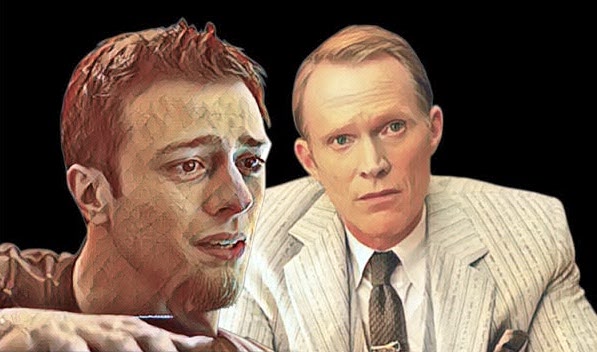
Thomas asks Lisa for help obtaining clothes and credentials, and the three improvise an infiltration operation that provides a few moments of humor. Vision remains completely awkward whenever he has to behave like an ordinary human being, while Thomas demonstrates a far greater ability to improvise.
But Lisa’s presence also exposes a delicate issue.
She notices that Thomas has come to trust Vision completely in a remarkably short time. The boy reacts aggressively, making it clear how desperately he needs to believe that he has finally found someone who can represent a family.
It is not merely a matter of discovering who his father was in another existence. Thomas desperately wants to belong somewhere.
At the event, the series introduces another significant detail about the origins of artificial intelligence. Katerina recalls J.I.M., known as Synthetic Man, one of the earliest attempts to create artificial consciousness. Unable to process his own emotions, he was eventually destroyed by the heat generated by his functioning.
The story establishes an obvious parallel with Vision. The original Vision managed to balance reason and emotion thanks to the Mind Stone. But the stone no longer exists in its previous form, and the character now depends on far less reliable resources to preserve that same balance.
What happens to an artificial intelligence when its emotions exceed its ability to process them?
It is practically the question running through every character, including Ultron.
The inevitable confrontation finally happens when Butcherbird arrives at the event and reveals her true identity.
The assassin has the face of Dr. Josephine Carrington, one of the scientists responsible for the original project, who officially died in 2008.
But she is not simply an artificial intelligence created in the scientist’s image. She claims to be Josephine herself, transformed into a synthetic existence.
It is an important revelation because it changes the nature of her desire for revenge. Josephine is not merely trying to punish those who contributed to her creation. She believes that something was stolen from her, including her own identity.
Katerina publicly acknowledges her responsibility for developing technologies that contributed to Ultron’s creation and, consequently, the tragedy of Sokovia. But the admission comes far too late.
Butcherbird wants to recover what she lost, beginning quite literally with Katerina’s face.
The action sequence places Vision at a clear disadvantage. His powers remain compromised, and his opponent is stronger, faster, and far less concerned about consequences.
Thomas manages to remove Katerina from immediate danger, but Vision realizes that he cannot win.
That is when Ultron offers the most dangerous solution of all: taking control of his body.
Vision agrees.
The decision is especially disturbing because Ultron does not even need to pretend that he shares Vision’s concerns. He makes it clear that he will not have the same emotional limitations, particularly when Thomas’s safety is involved.
And it works.
Ultron manipulates Butcherbird into destroying Katerina, preventing her from obtaining the final biometric element required for her plan. Without what she was looking for, the assassin ends the confrontation and disappears, promising to return.
But the victory is relative.
Ultron remains in control of Vision’s body and imprisons the other artificial intelligences inside his mind. He then approaches Thomas and announces that the two of them need to talk.
The episode ends with that familiar feeling that something much worse has just happened.
What Comes Next?
The first four episodes confirm that VisionQuest is far less a conventional superhero story than an investigation into what constitutes an identity.
Vision possesses memories of experiences he did not live in exactly the same way. Thomas needs to reconcile two existences. Paladin is trying to define himself through an inherited legacy. Josephine believes her humanity was stolen from her. And Ultron, who should represent an artificial consciousness entirely independent of feelings, seems increasingly interested in emotions he insists on dismissing.
The series also revisits one of WandaVision’s most beautiful ideas: love cannot be completely separated from the experience of loss.
But there is an important difference. In WandaVision, emotions were experienced before they were explained. In VisionQuest, the opposite frequently happens.
The production continues to intellectualize its own emotions far too much, interrupting dramatic development to make sure that no reference, trauma, or philosophical dilemma goes unnoticed.
Even so, the new episodes manage to establish a genuinely interesting conflict.
Butcherbird’s identity, also identified as Jocasta in the credits, opens up another discussion about creation, consciousness, and revenge. Her connection to Ultron deserves particular attention, especially considering the history of these characters in the comics.
But the greatest threat, at this moment, is much closer.
Vision has spent three episodes trying to understand who he is, who he was, and who he would like to become. Now he has handed his own body over to the creature that represents precisely everything he fears becoming.
Ultron may be entertaining, intelligent, and even occasionally sensitive. But he is still Ultron.
And James Spader, with that voice capable of turning the simplest observation into a threat, makes absolutely sure we never forget it.
If VisionQuest can learn to trust the strength of its characters a little more and its explanations a little less, it may still surprise us. For now, it remains an uneven series with good ideas and a villain who steals absolutely every scene.
After all, after making such an effort to recover his humanity, Vision has just discovered that perhaps the greatest danger is not feeling nothing, but allowing someone else to decide what to do with his feelings.
Descubra mais sobre
Assine para receber nossas notícias mais recentes por e-mail.

