
As published on CLAUDIA
In an age of wannabe TED Talk speakers, when influencers seem to be competing to discover the next formula for success, Elizabeth Holmes’s story should be required viewing. She had all the ingredients to become a phenomenon: a revolutionary idea, an apparently brilliant young mind, an inspiring story, and the promise of changing the world. There was just one detail missing: her invention actually working. And, astonishingly, that did not prevent her from convincing some of the richest and most influential men in the United States that she was a genius.
Four years after writing about the miniseries The Dropout for CLAUDIA, I find myself returning to the story of one of Silicon Valley’s most notorious fraudsters. Elizabeth Holmes is in prison, convicted of defrauding investors, but she seems to have lost none of her ability to dominate the conversation. The reason this time is You Can See Everything, a documentary directed by Nathan Fielder and Lance Oppenheim, which opened in American theaters on October 16 and is already sparking debates about its methods, revelations, and the very definition of truth.
Her story is worth revisiting. In 2003, at just 19, Holmes dropped out of Stanford University to found Theranos, a company that promised to revolutionize blood testing. Her invention would supposedly detect hundreds of diseases using only a few drops of blood, eliminating the need for expensive and unpleasant procedures. It was an almost irresistible proposition, particularly because it carried a humanitarian promise: making healthcare more accessible.

Dressed in her signature black turtlenecks, inspired by Steve Jobs, speaking in a deep voice that became one of her trademarks, Holmes carefully constructed the image of a visionary. Her company was eventually valued at $9 billion. She appeared on magazine covers, was celebrated as a symbol of female entrepreneurship, and earned the trust of experienced investors, politicians, and business leaders. Theranos even attracted interest in Brazil, with discussions about the possibility of bringing its technology to the public healthcare system.
The problem? The technology did not deliver what Elizabeth promised.
An investigation by journalist John Carreyrou, published in The Wall Street Journal in 2015, began dismantling the illusion. Employees reported irregularities, the accuracy of the blood tests came under scrutiny, and the company eventually shut down in 2018. Holmes was convicted in 2022 on four counts of fraud involving investors and sentenced to 11 years and three months in prison.
What has always struck me about the case is not simply her audacity, but how easily so many people accepted her narrative without demanding sufficient scientific evidence. We are not talking about naïve investors. We are talking about people accustomed to negotiating millions, influential board members, and professionals who should have understood the difference between a promise and a proven result.
Holmes knew how to sell a story before she could deliver a product. And the world bought that story.
In 2019, documentary filmmaker Alex Gibney had already exposed the machinery behind this illusion in HBO’s The Inventor: Out for Blood in Silicon Valley. Seen today, the film is even more frightening. Not merely because we know how everything ended, but because we can watch the scale of the spectacle built around a woman who seemed to have answers for everything except the questions that truly mattered.
In 2022, Amanda Seyfried portrayed Holmes in the excellent miniseries The Dropout, originally released on Hulu in the United States and on Star+ in Brazil before moving to Disney+. The actress reproduced the artificially deep voice, carefully controlled gestures, and rigid posture of the entrepreneur in a performance that earned her an Emmy. The series also explored Holmes’s relationship with Sunny Balwani, a Theranos executive and her partner during part of the company’s existence, who was also convicted of fraud.
At the time, I wrote here about how difficult it sometimes was to remember, while watching the series, that we were not seeing a documentary. Seyfried’s performance was so convincing that it almost replaced the real Elizabeth Holmes in our collective memory.
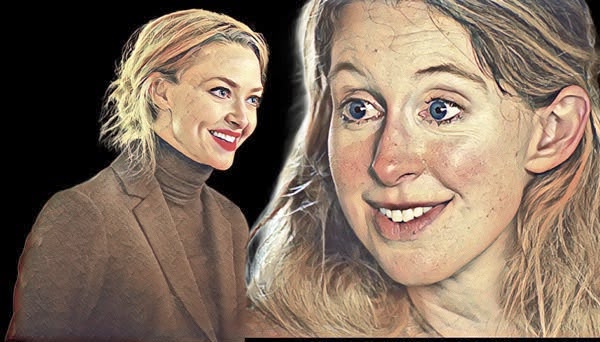
Well, the story has become even stranger. Amanda Seyfried has returned to play Holmes, this time inside a documentary about the real Elizabeth Holmes.
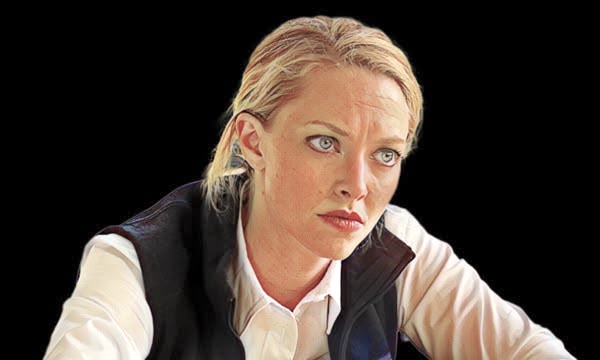
You Can See Everything begins 34 days before the entrepreneur was due to begin serving her prison sentence in May 2023. Holmes and her partner, Billy Evans, allow filmmakers to follow their family routine with their two young children. According to Evans, the idea was to offer the public an opportunity to meet the woman behind the headlines, rather than simply the criminal portrayed in the press.
It is interesting to note that, even after her conviction, Holmes continues to seek ways to regain control of her image. The entrepreneur who once sold the world the narrative of a medical revolutionary now wants to present another story: that of a misunderstood woman, a mother, who continues to insist on her innocence.
And once again, she finds an audience.
But the directors do not follow a conventional path. Nathan Fielder, known for The Rehearsal, works precisely with the manipulation of real situations, reenactments, and experiments that challenge the viewer’s perception. When Holmes goes to prison and is no longer available for filming, the documentary adopts an even bolder structure. Amanda Seyfried is invited to recreate events the cameras never captured, repeating scenes and conversations from real life.
It is undoubtedly an original cinematic proposition. If we are being generous, we might call it bold. If we are being more critical, it is questionable.
We are living in a moment when distinguishing facts from fabricated narratives has become increasingly difficult. AI-generated images, videos taken out of context, carefully edited stories, and conflicting versions of reality are already part of our everyday lives. When a documentary deliberately mixes authentic footage with staged scenes, to what extent is it investigating the truth, and to what extent is it contributing to the very confusion it claims to expose?
International critics have received the film enthusiastically. Some consider its structure revolutionary, while others see the experiment as a brilliant investigation into the limits of trust. But there are also questions about the filmmakers’ choices and what they leave out. Former Theranos employee Tyler Shultz, one of the whistleblowers who exposed the company’s practices, has criticized the film for failing to present information essential to understanding the fraud.
Amanda Seyfried also becomes involved in a confrontation with Billy Evans, who questions her portrayal of Holmes in The Dropout. The actress, in turn, must deal with an almost surreal situation: once again portraying a real woman while that same woman attempts to regain control over how she is represented.
The greatest irony is that the documentary seems to confirm what made Elizabeth Holmes so fascinating in the first place. Even after her defeat in court, she remains capable of bringing intelligent people, artists, filmmakers, and journalists into her orbit. She is no longer selling a revolutionary machine. Now, the product is herself.
That, too, is a form of reinvention.

The discussion goes far beyond the Theranos case. We live surrounded by inspirational speeches about entrepreneurship, overcoming adversity, leadership, and personal transformation. Motivational talks are shared as though they were lessons in wisdom, catchy phrases replace arguments, and millions of followers often seem enough to give someone authority. The ability to tell a compelling story has, at times, become more valuable than the ability to demonstrate that the story is true.
There is nothing wrong with inspiring stories. The problem begins when we confuse charisma with competence, confidence with knowledge, and conviction with evidence.
Elizabeth Holmes knew exactly how to exploit that collective willingness to believe. She did not invent our desire to believe in geniuses and miracles. She simply figured out how to turn it to her advantage.
You Can See Everything does not yet have a confirmed release date in Brazil, but it already deserves attention for the debate it is provoking. For those unfamiliar with the story, The Dropout and Alex Gibney’s documentary are excellent starting points. And for those who already know the case, perhaps it is time to revisit everything from a different perspective.
After all, the most frightening aspect of this story is not that Elizabeth Holmes managed to deceive so many people. It is realizing that, even knowing her history, we remain interested in the next version of the story she has to offer.
And perhaps that is precisely the question we should ask ourselves before believing another irresistible narrative: are we looking for the truth, or simply for a story we wish were true?
Descubra mais sobre
Assine para receber nossas notícias mais recentes por e-mail.

