
Are we the same person at home, at work, among friends, or in front of strangers? We probably like to believe we are, even though we know that the way we speak, behave, and even express our feelings changes depending on our surroundings and the people we interact with. There are behaviors we reserve for our private lives, opinions we avoid expressing professionally, and qualities we deliberately emphasize when we want to make a good impression. Does this mean we are pretending to be someone we are not, or is creating different versions of ourselves simply part of living in society?
The question leads us to an even more complicated one: is there a true version of ourselves hidden behind the different images we present to the world? And if there is, how would we recognize it?
Carl Gustav Jung’s analytical psychology offers one way of understanding this construction through the concept of the persona, the social mask through which we present ourselves to others. Jacques Lacan, meanwhile, takes the problem further by examining how the ego itself is formed through identifications and external images. Although their theories emerge from different foundations, both allow us to explore the relationship between what we believe ourselves to be, what we wish to represent, and our need to be recognized.
Jung: The Persona Is Not a Lie
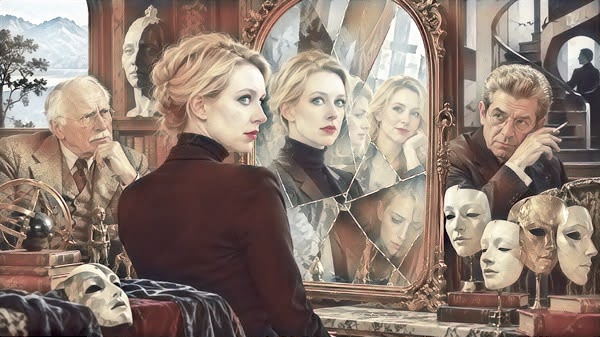
Jung borrowed the Latin word persona, associated with the masks worn by actors in ancient theater, to describe the face we present to the world. The comparison is particularly revealing because a mask does not merely conceal. It also allows us to perform a role, establish a recognizable identity, and participate in social relationships.
The persona serves a necessary adaptive function. We do not behave in exactly the same way with our children, our superiors, our friends, or strangers. Doctors, teachers, journalists, and executives develop ways of communicating and behaving that reflect the responsibilities of their professions. It would be virtually impossible to move between different social environments without adapting, to some degree, to the expectations of those around us.
This does not mean that every role is false. The persona is a legitimate construction, shaped by the relationship between our individual characteristics and collective demands. It allows us to be recognized in particular settings and facilitates our integration into society. The problem begins when we confuse this representation with the entirety of our identity.
Someone who has built an image around competence may find it difficult to admit insecurity. A person admired for being strong may struggle to show vulnerability, while someone who has always played the role of peacemaker may feel guilty when expressing anger. The more we depend on a particular image to gain recognition, the more threatening it may seem to behave in ways that contradict it.
Jung described the dangers of excessive identification with the persona, when individuals begin to confuse themselves with the social roles they perform. The mask stops functioning merely as a means of adaptation and begins to limit what a person can recognize within themselves. Aspects of the personality that conflict with the desired image may be rejected, denied, or kept outside conscious awareness.
This raises an important question: if we have spent so long learning to perform a particular role, how can we distinguish what we do to meet external expectations from what we genuinely recognize as part of ourselves?
How Do We Learn to Become What Others Expect?
The construction of this image begins long before our professional lives. From childhood, we notice which behaviors receive approval, attract attention, or provoke rejection. A child constantly praised for being responsible may learn to value that quality above others, while another, admired for being cheerful, may find it difficult to express sadness. These experiences do not mechanically determine personality, but they participate in the formation of our identifications and expectations.
As adults, we remain subject to this process. We change careers, take on responsibilities, enter relationships, and seek acceptance within different groups, adapting our presentation to the demands we perceive in each environment. Often, we believe we are making entirely personal choices when we are also responding to models of success, acceptance, and recognition that we have absorbed throughout our lives.
Adaptation is not necessarily problematic. It becomes an issue when we feel unable to depart from the image we have constructed without losing our place in the world. We continue to sustain a character not simply because we want to perform a certain role, but because we fear what might happen if we stop.
Jung connects this difficulty to the process of individuation, through which we seek to recognize and integrate different dimensions of our personality. Individuation does not mean eliminating the persona or discovering a perfect, definitive identity. It means understanding that we are more complex than the roles we perform.
Lacan: The Ego Is Also an Image
If Jung helps us understand the social mask, Jacques Lacan asks an earlier question: where does the image we have of ourselves come from?
In his formulation of the mirror stage, Lacan describes how a child identifies with an image of bodily unity that contrasts with their still-fragmented experience of their own body. This identification contributes to the formation of the ego, but it also involves a form of misrecognition, because the subject begins to recognize themselves in an external representation that does not encompass the entirety of their experience.
The concept is not limited to a child literally encountering a mirror. Its importance lies in the understanding that the ego is constituted through identifications and remains shaped by relationships with others. What we perceive as our identity does not develop in isolation, but through images and references encountered outside ourselves.
Jung’s persona and Lacan’s imaginary ego are not equivalent concepts. Jung is concerned with the social function of the mask and the risks of identifying too closely with it. Lacan investigates the very constitution of the ego, showing that our experience of identity already depends on external identifications.
There is another important dimension. We construct not only an image of who we believe ourselves to be, but also an image of who we would like to become. In On Narcissism, published in 1914, Freud explored the ideals against which individuals evaluate themselves. Lacan would later distinguish between the ideal ego, associated with the image of completeness with which we identify, and the ego ideal, associated with the symbolic position from which we seek recognition.
This helps explain why certain images can become so demanding. We do not simply want to be seen by others. We want to be recognized in a particular way, and we frequently begin to evaluate our own worth according to that expectation.
But what happens when an image that once brought us recognition stops working? Can we abandon it? And when we construct another, are we revealing who we really are, or merely finding a new way to be recognized?
Elizabeth Holmes: From One Character to Another
Few recent stories illustrate this discussion as vividly as that of Elizabeth Holmes, the founder of Theranos, the company that promised to revolutionize blood testing and eventually became one of Silicon Valley’s biggest scandals.
For years, Holmes cultivated a carefully recognizable image. Her artificially deep voice, black turtlenecks inspired by Steve Jobs, red lipstick, unusually wide eyes, fixed gaze, and the confidence with which she presented supposedly revolutionary technology all contributed to the image of a young visionary seemingly destined to transform medicine. She was not simply selling a technological innovation. Her own image was part of the promise.
When Theranos’s technological claims were exposed as false and Holmes was eventually convicted of defrauding investors, that character acquired an entirely different meaning. The woman once celebrated as an example of leadership and innovation came to represent, for many, the manipulative potential of a corporate culture fascinated by grand promises.
Now, the documentary You Can See Everything, directed by Nathan Fielder and Lance Oppenheim, presents an apparently different Elizabeth Holmes. Filmed during the weeks leading up to her imprisonment, the project was given access to the private lives of Holmes, her partner Billy Evans, and their family. The couple’s stated intention was to allow the public to finally meet the woman behind the headlines.
The executive in black turtlenecks, speaking with an authoritative voice, gives way to the mother of two young children, the affectionate partner, the woman anxious about being separated from her family and insistent on her own sincerity. Her voice is no longer the same, the setting has changed, and the narrative seeks to emphasize a human dimension that her previous public image seemed to exclude.
But here lies the most fascinating aspect: in trying to abandon one character, might Holmes be constructing another?
The question does not imply that her emotions are false or that her suffering is not real. Motherhood, the fear of imprisonment, and family life are genuine experiences that need not be questioned simply because they belong to someone convicted of fraud. The issue is understanding how certain characteristics come to occupy the center of a new public presentation, and how the desire to be recognized differently may shape that construction.
In the first version, Holmes needed to be seen as an extraordinary executive, someone capable of challenging the world. In the second, she appears to want the public to recognize an ordinary, sensitive, misunderstood woman behind the familiar image. Both involve a relationship between the image being presented and the gaze of the person receiving it.

Who Created Elizabeth Holmes?
One of the controversies raised by the documentary makes this question even more interesting. In 2023, just weeks before beginning her prison sentence, Holmes gave an interview to Amy Chozick of The New York Times. Discussing the actresses who had portrayed her or had been considered for projects about her life, including Amanda Seyfried, who played her in The Dropout, and Jennifer Lawrence, who had been attached to a film project, Holmes reportedly said that they were not portraying the real Elizabeth Holmes, but a character she herself had created.
In the documentary, however, Holmes and Billy Evans dispute the quotation. According to them, Holmes actually said that the actresses were portraying a character created by other people, not by her.
The New York Times reaffirmed the accuracy of its reporting on October 22, 2026. Chozick explained that she had written down the statement during a walk on the beach with Holmes, but had not recorded that particular conversation and no longer had the original notebook. The recording provided by the couple does not contain the disputed exchange either, leaving no conclusive public record that could settle the disagreement.
The most revealing detail, however, is that Holmes acknowledged having deliberately changed her appearance and manner of speaking to be taken seriously as an executive. According to her, the construction of this image had also been encouraged by her former romantic and business partner, Sunny Balwani, who pressured her to abandon characteristics he considered unsuitable for a powerful leader. In her account, he had used the expression “kill Elizabeth,” a version disputed by Balwani’s attorney.
The phrase is symbolically powerful because it suggests that assuming a particular social identity might require relinquishing aspects of oneself. But it also takes us back to Jung’s question: to what extent can we distinguish what we construct to satisfy other people’s expectations from what we genuinely recognize as part of our personality?
Holmes may have chosen the voice, the clothes, and the behavior, but she did not invent the executive model she sought to embody. Corporate culture already celebrated the visionary, tireless, seemingly unshakable leader. Likewise, the image now circulating through films, news reports, and documentaries does not depend exclusively on how she would like to be recognized.
The dispute over who created the character is therefore not merely a question of authorship. It leads us to the difficulty of separating the image we seek to construct from the one others construct of us.
Our Need to Discover Who Is Lying
This is where the documentary adds another dimension to the problem. Nathan Fielder does not merely observe Holmes. He repeatedly questions her, challenges her statements, and tries to determine whether he is dealing with someone who believes in her own innocence or a person capable of deliberately manipulating those who listen to her.
Holmes insists that she did not lie, despite having been convicted of fraud and even when confronted with questions that expose contradictions in her explanations. The viewer follows these conversations, searching for some clue that might reveal what is really going on. A glance, a hesitation, a smile, a change of expression, or an unexpected answer seems to acquire disproportionate significance, as though one of these details might unlock the mystery of her personality.
Who is the real Elizabeth Holmes? The ambitious executive who deceived investors? The woman who claims she sincerely believed in her technology? The mother who fears being separated from her children? Someone who is still deliberately lying, or someone who has constructed a narrative she herself believes?
These questions are fascinating, but they cannot be answered through observation from a distance, much less through an improvised diagnosis based on a documentary. Holmes’s conviction establishes responsibility for concrete actions, but it does not give us direct access to the workings of her unconscious. Similarly, genuine displays of emotion do not prove the truthfulness of everything she says.
There is a difference between deliberately lying, distorting memories, rationalizing behavior, and believing in a convenient interpretation of one’s own history. These are distinct processes that may overlap under certain circumstances but should not be confused. Psychoanalysis, particularly through Freud, invites us to consider that subjects do not possess complete knowledge of their own motivations, and that what we say about ourselves does not necessarily encompass the entirety of our psychic experience.
This does not mean that every lie is unconscious, or that the existence of the unconscious removes individual responsibility. It simply means that the relationship between what we say, what we believe, and what motivates us may be far less transparent than we would like.
And there is another question: why do we feel such a strong need to discover the truth about someone?
The Desire to Find the Real Person
The fascination of stories like Holmes’s does not depend solely on the seriousness of what happened. It is also connected to our difficulty accepting that a person may exhibit contradictory behaviors without any single characteristic explaining all the others.
We want to know whether the woman who shows affection for her children is the same person who deceived investors, as though one dimension necessarily canceled out the other. We search for signs of sincerity or manipulation because we want to organize what we see into a coherent, recognizable identity. When we cannot, uncertainty seems to demand a definitive answer.
This need resonates with the imaginary dimension described by Lacan. We seek to recognize in others a relatively stable image, one capable of giving some unity to what we observe. But the subject cannot be reduced to that image, just as our perception of another person is never independent of our own identifications, expectations, and fantasies.
We may idealize someone and later feel deceived when we discover characteristics incompatible with the image we constructed. We may also move in the opposite direction, reducing someone to their worst actions and struggling to acknowledge any other dimension of their existence. In both cases, the problem lies in the attempt to transform the complexity of a subject into a single representation.
Interestingly, the documentary itself participates in this process. By offering access to Holmes’s private life, it seems to promise a closer encounter with the truth, but it also produces a new representation of her. The selection of images, the editing, the questions, and the filmmakers’ perspective all contribute to the construction of the character presented to the audience. The camera does not eliminate the mediation between the person being filmed and the public.
The irony is that, while trying to discover who Holmes really is, we are also watching the construction of yet another image of Elizabeth Holmes. And the viewer, convinced that they are searching for the truth, participates in this construction by interpreting every gesture through what they already know, or believe they know, about her.

Is There Someone Behind All the Masks?
We tend to imagine that if we could remove our different social masks, we would find a completely authentic identity preserved somewhere within us. But Jung and Lacan, through very different theoretical approaches, make that idea much more complicated.
For Jung, recognizing the persona as one part of the personality, rather than its entirety, is essential to expanding awareness of aspects of ourselves that have been neglected during the process of social adaptation. Lacan, meanwhile, questions the existence of an ego that can be completely separated from the identifications through which it was constituted.
There is, therefore, no simple operation of removing the mask to discover an essence untouched by external influences. Our history, our relationships, and the images with which we identify all participate in the way we perceive ourselves. This does not mean that we are condemned to perform the same roles forever, but that understanding our identity also requires acknowledging the circumstances in which it was constructed.
Perhaps that is precisely why Elizabeth Holmes’s story generates such fascination. As we try to determine whether we are watching a remorseful woman, someone who believes in her own innocence, or someone who continues to manipulate others, we confront a difficulty that also belongs to our everyday relationships: we do not have complete access to anyone’s psychological truth, not even our own.
We are all, to some extent, characters in our social relationships. We construct images to be accepted, admired, respected, or loved, and those images may change according to our needs and circumstances. Yet as we search for the real Elizabeth Holmes behind the different versions presented to the public, perhaps we are repeating the same movement we make when looking at ourselves: believing that, at some point, we will discover a definitive image capable of explaining everything we are.
The larger question is not simply which character Holmes created, which character others constructed, or which one she wishes to present now. It is understanding why we so desperately need to believe that, behind all these representations, there is a single, entirely coherent, and ultimately true version of a person.
And what happens when we discover that perhaps we cannot answer that question even about ourselves?
Descubra mais sobre
Assine para receber nossas notícias mais recentes por e-mail.

