
Marian Brook seems to be one of the most emotionally balanced characters in The Gilded Age. She is generous, independent, modern for her time, and capable of seeing beyond the prejudices that shape nineteenth-century New York society. She stands up for her friends, helps those in need, questions social conventions, and insists on making her own decisions. Yet there is a contradiction that becomes increasingly apparent: the woman who understands other people’s feelings and needs so well seems to have enormous difficulty recognizing her own. And when she falls in love, she frequently finds herself in a position of vulnerability that should, by now, feel all too familiar.
The Season 4 premiere offers the perfect opportunity to put Marian on the psychoanalytic couch. After spending the night with Larry Russell, the man she loves and to whom she was once engaged, she wakes up distressed, ashamed, and desperate to return home. We do not see the moment she wakes up, or when the previous night’s happiness turns into panic. Instead, we encounter a woman who seems unable to recognize herself. Later, when she attempts to tell Peggy what happened, she admits that perhaps she is not the person she thought she was.
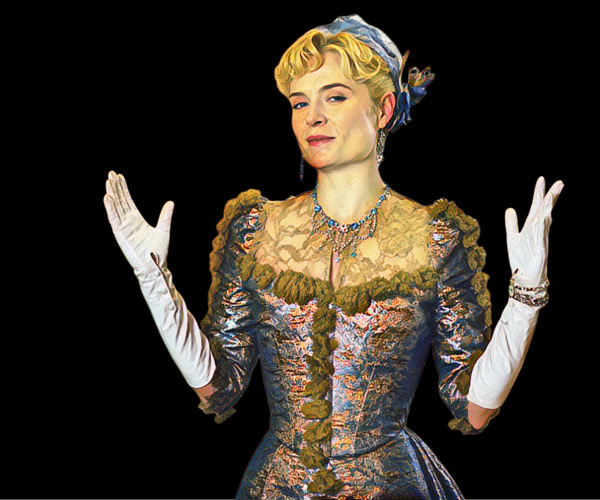
Her reaction may seem exaggerated to contemporary viewers, but it is entirely understandable in the context of the 1880s. An unmarried woman who engaged in sexual relations outside marriage risked losing her reputation and permanently compromising her prospects. Larry, as a man, would not face the same consequences.
But Marian’s anxiety did not begin in that hotel room. To understand it, we need to return to her childhood, her mother’s death, her relationship with her father, and a succession of experiences in which trusting someone often meant being left unprotected.
The Girl Who Learned to Take Care of Others
Marian lost her mother when she was very young. The series has revealed little about this woman, although some of Agnes’s remarks suggest that Marian’s family history contains conflicts we have yet to understand. We do not know how Marian experienced the loss, what memories she retained, or how her mother’s absence affected her childhood.
Her relationship with her father, Henry Brook, offers more concrete information. He drank, gambled, and squandered the family fortune. Marian remained by his side and cared for him until his death, apparently unaware of the full extent of their financial ruin. Only afterward did she discover that virtually nothing remained. Even the house in which she had lived did not belong to the family.
Her sense of abandonment was twofold. She lost her father and, at the same time, the image of security he represented. She discovered that the reality she believed in had never existed, and that she could no longer demand explanations from the man she had trusted.
There is a possible reversal of roles here. The daughter who should have been protected became responsible for caring for her father, without receiving equivalent protection in return. In psychology, this dynamic can be understood through the concept of parentification, which occurs when someone prematurely assumes emotional or practical responsibilities that should belong to adults.
We do not know when Marian began occupying this position. But we can ask what happens to someone who learns to associate love with responsibility for another person, particularly when her own needs remain secondary.
Did Marian learn that, to be loved, she first had to be needed?

The Woman Who Needs to Save Everyone
Since arriving in New York, Marian has demonstrated an almost constant willingness to help others. She befriends Peggy Scott, confronts prejudice, seeks solutions to other people’s difficulties, and frequently assumes the role of mediator in conflicts she did not create. Her dedication to work also reveals a desire to build an identity of her own, independent of a husband or her aunts’ approval.
None of this necessarily needs to be interpreted as a symptom. Generosity can simply be generosity, and the ability to recognize injustice is one of the character’s most appealing qualities. But psychoanalysis invites us to investigate the function certain behaviors serve in someone’s emotional life.
Melanie Klein developed the concept of reparation to understand, among other things, the need to care for and restore loved objects in the presence of feelings of guilt, aggression, and loss. Reparation can be a healthy expression of love, but it can also become excessive when someone feels compelled to constantly compensate for something.
In Marian’s case, we might consider whether caring for others provides a sense of control over experiences that, in her own history, were entirely beyond her control. She could not prevent her mother’s death, save her father from his destructive behavior, or preserve the family’s financial security. But she can help Peggy, protect her friends, and attempt to correct injustices.
The hypothesis is not that all her kindness conceals an unconscious motivation. Rather, there may be a connection between her ability to care for others and her difficulty accepting the position of someone who needs to receive care.
Marian seems to know exactly what to do when someone else is suffering. But what happens when she is the one who needs protection?

Repetition: Different Men, the Same Helplessness
In Beyond the Pleasure Principle, published in 1920, Freud explored a question that remains fundamental to psychoanalysis: why do some painful experiences seem to return throughout a person’s life, even when that person consciously wishes to avoid them?
The repetition compulsion does not simply mean making the same mistakes. What repeats may be an emotional position, an expectation, a way of forming relationships, or a particular response to the possibility of loss.
Marian’s romantic history offers especially interesting material for this investigation.
Tom Raikes arrived promising love and freedom. He knew about her financial vulnerability, declared his love, and encouraged her to challenge convention and defy her aunts’ disapproval. Marian trusted him, agreed to compromising meetings, and even planned to elope. But Raikes abandoned her when he found a woman whose fortune could further his ambitions.
Dashiell Montgomery represented a different possibility. He was respectable, financially secure, and offered a socially appropriate marriage. But Marian realized that accepting him would require surrendering important aspects of her identity. He did not want her to continue working, and he seemed to expect her to fill the place left by his deceased wife. Marian refused.
That refusal matters. It demonstrates that she is not incapable of recognizing her desires or establishing boundaries. On the contrary, she can walk away from a relationship when she realizes that the price would be losing herself.
Then comes Larry Russell. A constant friend, confidant, and apparently sensitive to her needs, he represents the possibility of reconciling what previously seemed irreconcilable: love, friendship, independence, and security.
But even with Larry, intimacy develops through discreet meetings, stolen kisses, and situations in which Marian must manage the risk of being discovered. His lie about the Haymarket shatters the trust she had placed in him. And when they finally reunite in Season 4, they spend the night together without renewing their engagement.

Once again, Marian trusts. Once again, she crosses boundaries for love. And once again, she realizes that her security also depends on a man’s willingness to act responsibly.
This does not mean Larry is the same as Raikes, or that he will abandon her. It means the emotional situation may feel familiar to Marian, even if the men themselves are different. Perhaps what repeats is not her choice of partner, but the experience of trusting, taking a risk, and discovering that love does not necessarily provide the protection she expected.
The Death Drive: Why Does Marian Put Herself at Risk?
The question becomes even more complicated when we consider that Marian knows perfectly well the rules she challenges.
With Raikes, she agrees to meetings that could compromise her reputation. With Larry, she allows clandestine encounters even while insisting that appearances must be maintained. She seems to take pleasure in challenging certain conventions, but tries to retain some control over the consequences.
On the night at the hotel, that balance collapses. Marian knows she should not share a room with Larry, but she wants to be with him. He comes to her door, she lets him in, and they surrender to their attraction. The following morning, pleasure gives way to anxiety and regret.
We might ask whether there is a self-destructive dimension to this behavior. Freud associated the death drive, among other theoretical manifestations, with the tendency to compulsively return to painful experiences, even when they offer no apparent pleasure.
However, it would be premature to conclude that Marian puts herself at risk because she unconsciously wishes to suffer. Challenging oppressive rules can also represent an affirmation of autonomy and vitality. Her desire for Larry is not, in itself, self-destructive.

Perhaps the more interesting hypothesis lies at the intersection of repetition compulsion and the attempt to master an earlier experience of helplessness. As a child, Marian had no control over her family’s losses. As an adult, she tries to establish her own conditions for love. She chooses when to meet, negotiates boundaries, and decides when to approach someone and when to withdraw.
But love also involves something that cannot be controlled: another person’s desires and choices. Could it be that, by returning to situations in which trust and danger become intertwined, Marian is unconsciously attempting to create a different ending from the one she experienced with her father, and later with Raikes?
We do not have enough evidence to answer definitively. But the question allows us to explore repetition without treating female desire as a pathology.
Leaving Before Being Left
Another recurring behavior deserves attention: the speed with which Marian ends a relationship or withdraws when she feels her security is threatened.
After the Haymarket lie, she breaks up with Larry. He even questions whether she will abandon him again. When they wake up at the hotel, the gesture seems to repeat itself. Marian dresses, insists on leaving immediately, and leaves Larry interpreting her behavior as another rejection. But there is a fundamental difference.
In the first situation, we can explore whether her reaction was intensified by previous experiences of disappointment. In the second, the danger is real. Marian needs to return home without being seen in compromising circumstances. This is not necessarily an escape from love, but an attempt to protect her social standing.
The same behavior can serve different psychological functions. It is possible that Marian has learned to withdraw quickly when she perceives a threat of abandonment, attempting to regain some control before being caught off guard again. But that does not mean every decision to leave is impulsive or irrational.

Her experience with Larry also reveals an important relational dynamic. He interprets her withdrawal as evidence that she does not love him enough, while Marian struggles with consequences he does not seem to fully understand. And once again, she finds herself in the position of having to explain, justify, and make the other person understand. The girl who cared for her father may have become a woman who assumes a disproportionate share of the emotional responsibility in her relationships.
The Superego: When Agnes Doesn’t Need to Be There
Marian presents herself as a modern woman, but her independence has limits she may not have fully recognized. She defends Peggy, challenges prejudice, and refuses to let her life be entirely dictated by social expectations. Yet when she breaks the rules in pursuit of her own desires, she proves far more conservative toward herself than toward others.
The morning after her night with Larry, Agnes is not at the hotel. Nobody has discovered what happened. At that moment, no external punishment exists. And yet Marian is already condemning herself.
In Freudian theory, the superego is a psychic agency associated with the internalization of prohibitions, demands, and ideals. We do not need the physical presence of an authority figure to experience guilt. The censor can continue operating within us.
It is tempting to imagine Agnes taking up residence in Marian’s psyche, policing even what her niece does when she is far beyond her watchful eyes. But it would be simplistic to blame the aunt alone. The demands of purity, respectability, and obedience belong to the entire social structure in which Marian was raised.
What makes Marian particularly interesting is that she seems capable of challenging those expectations when they affect other women, but unable to free herself from them when it comes to her own life. Marian can understand and forgive the desires of others. Her own desires, however, seem to require justification.

Desire and the Loss of Her Self-Image
After spending the night with Larry, Marian tries to speak to Peggy. Her difficulty describing what happened reveals more than shame. She seems unable to reconcile the woman she believed herself to be with the woman she discovered in that intimate encounter.
This brings us closer to Freud’s concept of the ego ideal, although it is important to distinguish it from the superego. The former concerns, among other things, the models and ideals with which a person seeks to identify; the latter involves demands, criticism, and punishment.
Marian has constructed an image of herself as rational, prudent, independent, and capable of resisting social pressure. But she discovers that she can also be impulsive, passionate, and willing to cross boundaries for pleasure.
The conflict is not necessarily that she did something she did not want to do. It is that she wanted something she cannot reconcile with the image she has constructed of herself. And there is an even deeper dimension to this experience.
For much of her life, Marian has occupied positions in which she needed to care for, help, understand, or respond to other people’s needs. With Larry, that night, she is not saving anyone, defending a friend, or fulfilling a family obligation. She simply wants something.
Perhaps that is precisely what makes the experience so destabilizing. For once, pleasure is not associated with a noble cause, a responsibility, or an act of care. It is something Marian wants for herself. And she seems not to know what to do with that discovery.

Trust as an Emotional Necessity
Despite her disappointments, Marian continues to trust people. She does not become cynical after Raikes, does not abandon her principles after her father’s financial ruin, and does not stop believing in the possibility of love. This capacity can be understood as an important expression of psychic vitality. Losing a loved object does not necessarily mean losing the ability to invest emotionally in others.
But there is a hypothesis worth exploring: perhaps Marian needs to continue believing in people’s reliability because acknowledging their limitations would force her to confront helplessness all over again. If her father could not protect her, Raikes failed to keep his promises, and Larry may also disappoint her, whom can she trust?
The point is not that Marian is naive. She recognizes contradictions, perceives injustice, and knows how to set boundaries. But there may be a distance between intellectually understanding that someone can fail her and emotionally accepting that this failure could leave her unprotected.
In that sense, trust can be both a strength and a defense. It allows Marian to keep loving, but it may also lead her to invest too much hope in people who have yet to demonstrate that they can fulfill their promises.
Does Marian Need to Learn How to Be Loved?
Perhaps this is the most important question in her story.
Marian demonstrates an extraordinary capacity to love. She cares, welcomes, understands, helps, and remains emotionally available even when life disappoints her. But when she needs to acknowledge her own needs, she seems to experience anxiety, guilt, or fear of losing the relationship.
The point is not to turn her generosity into a symptom or suggest that her suffering stems exclusively from unconscious conflicts. Marian lives in a society that objectively restricts women’s freedom. Her fears are legitimate, and her choices take place within profoundly unequal conditions.
Even so, psychoanalysis allows us to ask whether she reproduces, in her adult relationships, a position learned very early in life: that of someone who must care for others without being able to fully depend on them.
Her father needed her. Raikes demanded trust and sacrifice. Dashiell expected her to fulfill a predetermined role. Larry asks her to believe in his love, but does not always demonstrate an understanding of the risks she assumes.
Each relationship is different. But in every one of them, the tension between what Marian gives and what she receives emerges in some form. Perhaps her challenge is not merely to find a man who chooses her, but to discover whether she can establish a relationship in which she does not have to continually earn the right to be loved.
Her story with Larry is far from over. He may surprise her, acknowledge his mistakes, and demonstrate that he is different from Raikes. But not even marriage would automatically resolve the conflict that has accompanied her since childhood.
Marian’s real problem does not seem to be an inability to trust. On the contrary, she trusts repeatedly, even when doing so makes her vulnerable. Perhaps her greatest difficulty lies in recognizing that she, too, deserves care, protection, and reciprocity without having to offer something in return.
Marian Brook has spent her life trying to save the people she loves. But who will be willing to care for her when she finally stops being the person who saves everyone else?
Descubra mais sobre
Assine para receber nossas notícias mais recentes por e-mail.


1 comentário Adicione o seu