
The first season of All’s Fair ended with one of its most important characters arrested for murder, a decades-long friendship in jeopardy, and a woman determined to destroy everyone around her. Nothing particularly surprising in Ryan Murphy’s universe, which turned a legal drama about attorneys specializing in multimillion-dollar divorces into a lavish soap opera of rivalries, betrayals, and revenge. And despite the scathing reviews it received upon its premiere, the series attracted enough viewers to secure a second season, arriving on Disney+ on November 4.
What is curious is that, after nine episodes following women capable of dismantling marriages, exposing lies, and protecting fortunes, we discovered that none of them is particularly good at recognizing manipulation within her own firm. Especially when it comes from someone they have known for years.
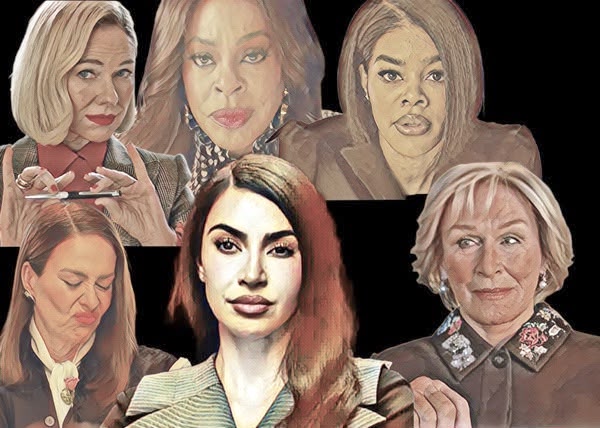
Starring Kim Kardashian, Naomi Watts, Niecy Nash-Betts, Glenn Close, and Sarah Paulson, All’s Fair left several questions unanswered. Some involve murder, others romantic relationships, but perhaps the most important concerns these women’s ability to continue trusting one another.
How Did Season 1 End?
Allura Grant (Kim Kardashian), Liberty Ronson (Naomi Watts), and Emerald Greene (Niecy Nash-Betts) built a powerful law firm specializing in high-stakes divorces. With the guidance of Dina Standish (Glenn Close), the three achieved professional independence after leaving a male-dominated practice.
The problem was that the greatest threat to their business did not come from a billionaire ex-husband, a disgruntled client, or a competing law firm. It came from Carrington Lane (Sarah Paulson), Allura’s longtime rival, whose obsession with the women at the firm developed into an elaborate revenge scheme.
Carr spent much of the season trying to find a way into the partnership. Dina, who believed she knew her former protégée, even suggested bringing her aboard as a gesture of reconciliation. It was a mistake that would prove costly.
After realizing that Carr had not changed, Dina began opposing her admission. The response was devastating. Carr started manipulating Liberty, exploiting her insecurity about never feeling entirely accepted by the group, before turning her attention to Allura and presenting fabricated evidence suggesting that Dina was experiencing some form of cognitive decline.
The result was a humiliating intervention in which the women confronted their own mentor, placing more faith in Carr’s insinuations than in the friendship they had shared for decades. As if that were not enough, the police arrived during the confrontation to arrest Dina for the murder of Lloyd Walton, the man who had sexually assaulted Emerald.
The final scene showed Carr crossing Dina’s name off her revenge list. An important victory, but hardly the end of her campaign. After all, the other women are still on that list.
Did Dina Really Kill Lloyd Walton?
This is the first major question Season 2 needs to answer. Lloyd was murdered after assaulting Emerald, and the police investigation uncovered reasons to suspect someone connected to the firm. Dina was arrested, but the series never established whether she actually committed the crime.
Could Carr have manipulated evidence to frame her? It is certainly possible, particularly considering how successfully she fabricated a narrative about Dina’s supposed mental deterioration. But there is another possibility: Dina may have been protecting Emerald and decided to take matters into her own hands.
That would be an interesting twist for a character who spent the season exercising an almost maternal authority over the other women. Dina understands the mechanisms of power and knows that justice does not always work as it should. Still, the possibility that she committed murder must remain a suspicion rather than a conclusion.
There is also her grief following Doug’s death. Carr exploited that vulnerability, turning expressions of mourning into supposed evidence of incompetence. It is one of the cruelest aspects of her strategy: persuading the other women that Dina’s suffering was sufficient reason to discredit her.
And here is a question just as important as the identity of the murderer: once the truth emerges, how will Allura, Liberty, and Emerald repair the betrayal of the woman who has always protected them?

Carrington Lane: The Revenge of a Woman Who Wants to Be Allura
Sarah Paulson was one of the highlights of the first season. Carr could easily have been nothing more than a cartoonish villain, but the actress transformed her into someone simultaneously pathetic, terrifying, and fascinating.
Her rivalry with Allura went far beyond professional competition. After becoming sexually involved with Chase Munroe (Matthew Noszka), Allura’s ex-husband, Carr began reproducing her rival’s appearance in one of the season’s most bizarre sequences.
The essential detail is that Chase actually called her Allura’s name during an intimate encounter. The humiliation helps explain Carr’s physical transformation, although it hardly justifies her obsession.
Carr does not simply want to defeat Allura. She seems to want to take her place, earn her recognition, and simultaneously destroy everything she admires about her.
When a woman needs to transform herself into her rival in order to feel desired, the competition is no longer merely professional or romantic. Something much deeper is at work in her inability to distinguish admiration, envy, and identity.
Her therapy session in the final episode made it clear that revenge has become the organizing principle of her existence. Carr cannot relinquish the need to punish the women she holds responsible for her failures, even when her decisions threaten to destroy her own life.
But how far is she prepared to go? There are still names on her revenge list, and the second season could transform an external enemy into someone with direct influence over the firm’s decisions.
Allura and Chase: Love, Ego, or the Need to Win?
Allura’s marriage to Chase was destroyed by infidelity. The football player became involved with Milan (Teyana Taylor), an employee at the firm, before seeking reconciliation with his ex-wife. Later, he ended up in Carr’s arms, becoming part of a rivalry over which he seems to have increasingly little control.
Allura, meanwhile, never appeared entirely free of the relationship. Reconciliation briefly seemed possible, but her feelings remain entangled with wounded pride and an inability to accept defeat.
Does Allura genuinely love Chase, or can she simply not tolerate the idea of being replaced? And does Chase want his marriage back, or is he trying to reconstruct an image of himself that disappeared when he stopped being the husband of a powerful woman?
These are questions the series has yet to explore with the depth they deserve. There is an interesting paradox at the heart of Allura’s character: a lawyer capable of recognizing the weaknesses in other people’s marriages, yet seemingly unable to identify her own patterns of repetition.
The arrival of a new man in her life, played by Brazilian actor Cauã Reymond, promises another romantic possibility and, judging by the first images, a considerable dose of sensuality. Promotional material introduces his character as a bodyguard, but the nature of his relationship with Allura remains to be seen.

Liberty: The Woman Who Almost Married a Lie
Liberty spent the first season trying to believe she had finally found a trustworthy man. Reggie (O-T Fagbenle) seemed to represent the possibility of emotional stability, particularly in a professional environment where she witnesses the collapse of relationships every day.
Until Emerald discovered that he was concealing serious financial problems.
The revelation prompted Liberty to call off the wedding. It was not necessarily Reggie’s financial situation that ended the relationship, but the fact that he had concealed information that could have jeopardized his future wife’s assets.
It is a perfect irony for a divorce attorney who specializes in protecting women from the financial consequences of failed marriages.
More troubling, however, was how readily Liberty accepted Carr’s insinuations about her friends. Her need to feel included made her vulnerable to a woman who knew exactly how to offer the recognition she craved.
In Season 2, Liberty will have to confront not only the consequences of her broken engagement but also the role she played in Dina’s downfall.
Emerald and the Murder That Could Destroy the Firm
Emerald has always been one of the group’s most practical and determined women. A former police officer and investigator, she knows how to uncover information that others would prefer to keep hidden. But she was also the character subjected to one of the season’s most violent experiences when she was sexually assaulted by Lloyd Walton.
Her attacker’s murder placed the firm under investigation and eventually led to Dina’s arrest. Although Emerald has obvious reasons to want justice, that does not mean she is responsible for the crime.
Her background in law enforcement could prove decisive in discovering what really happened. At the same time, the possibility that someone acted to protect her introduces a moral conflict the series has yet to explore.
How far can an action taken on someone else’s behalf be justified? And who bears responsibility when protection crosses the boundaries of the law?

What Can We Expect From Season 2?
The trailer and official information suggest that the partnership will face a new crisis involving unexpected alliances, friendships pushed to their limits, and a revelation capable of threatening the very existence of the firm.
The new season will consist of eight episodes, beginning with three released simultaneously on November 4. Cauã Reymond joins the cast, which will also feature appearances by Denise Richards, Margo Martindale, Jaime Pressly, and other guest stars.
But the central question is not about the new characters or the extravagant divorce cases that will undoubtedly remain part of the narrative. It concerns the future of Grant, Ronson & Greene.
Carr managed to turn trust between the partners into suspicion, persuading women accustomed to investigating lies to accept hers without question. Dina, the one person who recognized the manipulation, ended up behind bars. And Allura, who should have been capable of recognizing her greatest rival’s intentions, became one of her easiest victims.
All’s Fair never intended to be a particularly realistic legal drama. It is a fantasy about powerful women who wear extraordinarily expensive clothes, win multimillion-dollar battles, and frequently make disastrous personal decisions. Its excesses are part of its premise and, occasionally, part of its charm.
Now Ryan Murphy has an interesting opportunity: to give the spectacle of luxury and revenge more substantial emotional consequences. Because after everything that has happened, it will not be enough to discover who killed Lloyd or who will become Allura’s next lover.
The question that should truly shape the second season is something else entirely: what remains of a friendship when trust has been destroyed by the very people who were supposed to protect it?
Descubra mais sobre
Assine para receber nossas notícias mais recentes por e-mail.

