
William Shakespeare died on April 23, 1616, at the age of 52. Four hundred and ten years later, he remains one of the most important and influential writers of all time. His plays continue to be performed around the world; his stories are constantly adapted for film and television, and his characters remain so familiar that we often fail to recognize when we are watching a Shakespearean narrative. Even his identity and the authorship of his works continue to be questioned, investigated, and reimagined in books and films, a controversy that says a great deal about how difficult it is to comprehend the magnitude of his talent.
Shakespeare was a genius, and not merely because of the beauty of his language or his ability to construct unforgettable stories. His understanding of human nature was so extraordinary that his characters have crossed centuries without losing their relevance. Love, jealousy, envy, ambition, resentment, guilt, and the need for recognition remain as present in our lives as they were in sixteenth- and seventeenth-century England. Our customs, relationships, and even the ways we tell stories have changed, but we remain trapped in the same conflicts.
Perhaps that is why it is virtually impossible to discuss drama without returning to Shakespeare. He did not invent every emotion, situation, or conflict he portrayed, nor were all the stories he told his. But he knew how to transform them into something so universal that his characters continue to serve as reference points for almost any discussion of the human condition.

Did Shakespeare Understand the Human Mind Before Freud?
The connection between Shakespeare and psychoanalysis is particularly fascinating. Sigmund Freud was born in 1856, more than two centuries after the playwright’s death, yet he found in Shakespeare’s works an extraordinary repertoire through which to investigate the unconscious.
Hamlet became a fundamental reference in Freud’s reflections on desire, repression, and the Oedipus complex. Lady Macbeth was also examined by Freud, particularly in relation to the contradiction between her seemingly limitless ambition and the guilt that ultimately consumes her.
Jacques Lacan returned to Hamlet to explore desire and the subject’s relationship with the Other. The Danish prince’s hesitation, his relationship with his mother, his dead father, and his inability to act acquired new interpretations, demonstrating how a character created centuries earlier could still offer material for investigating subjectivity.
This does not mean Shakespeare anticipated psychoanalytic theories or that his characters should be treated as patients. What is remarkable is precisely the opposite: he was able to portray conflicts that psychoanalysis would attempt to understand and formulate theoretically much later.
Macbeth desires power but is destroyed by guilt and fear. Othello loves Desdemona but allows jealousy and manipulation to turn that love into violence. King Lear confuses love with submission and only recognizes his blindness after losing almost everything. Hamlet wants to avenge his father but remains trapped between duty, desire, and doubt.
These are characters who do not merely face external conflicts. Their greatest enemies are often within themselves.
And perhaps that is Shakespeare’s most important achievement: nobody is entirely good, evil, courageous, or cowardly. His characters are contradictory, vulnerable, and frequently incapable of understanding their own motivations. Just like us.
The Playwright Who Never Left the Movies
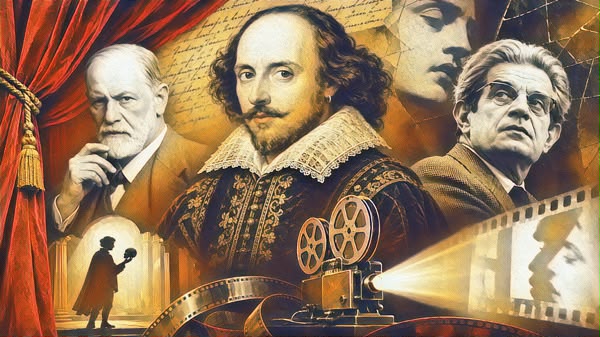
Shakespeare’s influence on cinema is virtually inexhaustible. There are traditional adaptations of his plays, transpositions into different periods and cultures, contemporary reinterpretations, and films that borrow his narrative structures without necessarily acknowledging their origins.
Romeo and Juliet can be recognized in West Side Story, which transforms a rivalry between families into a confrontation between New York street gangs. The Taming of the Shrew reappears as a teenage comedy in 10 Things I Hate About You. Hamlet found an unexpected interpretation in the world of The Lion King, while King Lear inspired Akira Kurosawa’s Ran.
Kurosawa himself had already transported Macbeth to feudal Japan in Throne of Blood, demonstrating that a tragedy written in England could find the same dramatic power in an entirely different culture.
And then, of course, there are the films that directly celebrate the original texts, such as Baz Luhrmann’s Romeo + Juliet, starring Leonardo DiCaprio and Claire Danes, or Kenneth Branagh’s monumental Hamlet.
These examples help explain why Shakespeare continues to be adapted. His stories do not depend exclusively on the settings in which they were written. We can replace kings with businessmen, noble families with criminal organizations, castles with skyscrapers, and dynastic disputes with corporate warfare. The conflicts remain recognizable.
From Macbeth to MobLand: The Difference Between Tragedy and Plot Twists
I often think about Shakespeare when watching contemporary television series, particularly those built around powerful families, betrayals, struggles for control, and an endless succession of murders.
Succession, for example, owes a great deal to the tradition of King Lear, with children competing for the recognition and power of a patriarch who cannot separate family affection from his authority. Shakespearean structures can also be recognized in countless stories about criminal organizations, family feuds, and characters consumed by their own ambition.
It was something that came to mind again while watching MobLand. The series brings together classic elements of tragedy: rival families, fragile alliances, compromised loyalties, power struggles, and characters who seem inevitably headed toward destruction.
But there is a difference between assembling the ingredients of a Shakespearean tragedy and constructing one with Shakespeare’s depth.
The Bard did not need to rely solely on surprising his audience. His dramatic reversals emerged, to a considerable extent, from the choices and contradictions of his characters. In Macbeth, we know early on that ambition and violence will lead to ruin. In Othello, we watch Iago’s manipulation unfold while remaining almost constantly aware of the trap being set. The tension does not depend exclusively on surprise, but on the anguish of seeing what the characters themselves cannot yet understand.
Contemporary television often confuses complexity with the sheer number of unexpected developments. Deaths, betrayals, and revelations accumulate, but they are not always supported by the psychological construction necessary to give them the intended impact.
Shakespeare understood that a tragedy does not become great simply because many people die. It becomes great because we understand what brought each character to that fate.

The Mystery of William Shakespeare
There is another curious aspect to Shakespeare’s enduring presence: the playwright himself continues to be a character in other people’s stories.
We know relatively little about his personal life. We know he was born in Stratford-upon-Avon and worked as an actor, playwright, and businessman, but significant gaps remain in his biography. The absence of certain historical records has helped fuel theories suggesting that his works were written by someone else, including Francis Bacon or Edward de Vere, the Earl of Oxford.
These hypotheses are rejected by the overwhelming majority of Shakespeare scholars, yet they continue to inspire curiosity and fiction.
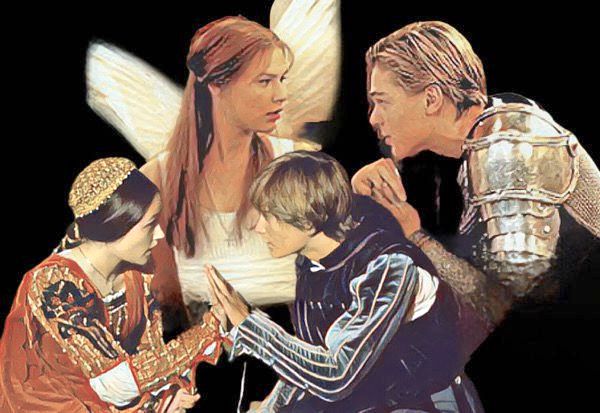
Films such as Anonymous, directed by Roland Emmerich, directly explored the authorship controversy. Shakespeare in Love, meanwhile, imagined the playwright’s romantic life and the creative process behind Romeo and Juliet. In Hamnet, fiction inspired by Shakespeare’s family life connects the loss of his son to the creation of one of his most celebrated tragedies.
It is almost as though his body of work had become so extraordinary that the man himself no longer seemed sufficient to explain it.
And perhaps there is an irony in that. Shakespeare wrote so many stories about characters who were incapable of fully understanding themselves that, four centuries later, we are still trying to discover who he really was.
Why Does Shakespeare Remain Unmatched?
We tend to associate Shakespeare’s genius with his great monologues, the lines that have survived centuries, and the tragedies that continue to be performed in theaters around the world. But his greatest achievement may have been understanding that no story can sustain itself through events alone. What matters is what those events reveal about the characters.
Hamlet is not fascinating simply because he must avenge his father’s murder. Macbeth is not memorable merely because he wants to become king. Juliet does not remain alive in our imagination simply because she falls in love with the wrong man. And Lady Macbeth does not disturb us solely because she encourages a murder.
We keep returning to them because we recognize their doubts, desires, contradictions, and inability to deal with what they feel.
Shakespeare wrote approximately 38 plays, along with sonnets and poems, and helped establish a dramatic language that continues to be used, transformed, and reinvented. His influence has crossed theater, literature, opera, ballet, cinema, and television. It reached psychoanalysis and remains present in discussions about politics, family relationships, power, and human behavior.
In 2024, we celebrated the 460th anniversary of his birth. In 2026, we marked 410 years since his death. These are important dates, but almost secondary when compared with a body of work that seems to exist beyond time.
After all, Shakespeare died four centuries ago, but his characters continue to live, love, betray, desire, suffer, and repeat the same mistakes.
And perhaps that is the greatest proof of his genius: the Bard did not need to know the future to understand how we would continue to behave. He only needed to understand human nature.
Descubra mais sobre
Assine para receber nossas notícias mais recentes por e-mail.

