
As we wait for the return of The Gilded Age, it is worth revisiting the farewell of Downton Abbey and tracing the themes the two worlds share, especially divorce. Julian Fellowes has never treated marriage as a simple romance. Across all of his work, particularly in Downton Abbey and now The Gilded Age, marriage operates as a social contract, an economic mechanism, and a tool for survival inside rigidly hierarchical systems. But when it comes to divorce, his real interest rarely lies in the end of a relationship itself. What fascinates him is what happens afterward: who loses status, who loses money, who manages to rebuild a public image, and who discovers that, in that society, marriage had been the only form of minimally protected social existence.
That helps explain why the subject has started gaining so much weight within The Gilded Age, especially after Downton Abbey: The Grand Finale. Fellowes seems increasingly interested in observing the moment when traditional structures begin to fail without having completely disappeared yet. And few experiences expose that as brutally as divorce among aristocratic and millionaire elites.
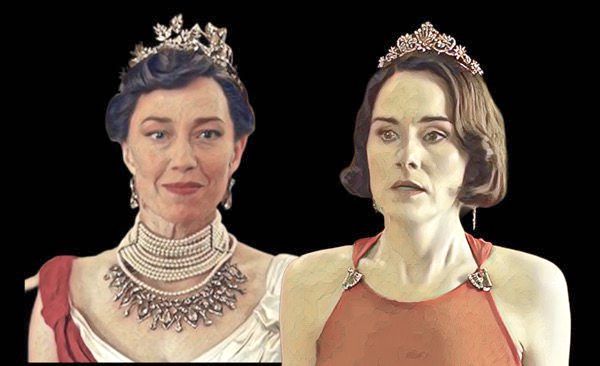
In Downton Abbey, the subject appeared indirectly for years, almost always surrounded by shame, scandal, and fear of social exclusion. Lady Edith lived through the stigma of motherhood outside marriage. Rose faced resistance because of her interracial marriage. But it was Mary Crawley who spent entire seasons trying to balance personal desire with aristocratic obligation. The world of the series still operated inside a deeply conservative English model in which divorce was legally possible but socially devastating.
In The Grand Finale, Fellowes finally pushes that discussion further by showing characters realizing that certain structures can no longer survive on appearances alone. The British aristocracy of the postwar period no longer possesses the same financial or moral authority. The entire film is haunted by symbolic farewells, family reorganizations, and the feeling that the old order has lost absolute control over the future. Lady Mary’s position becomes threatened after her husband, already largely absent from the previous films, asks for a divorce. Socially excluded, we spend the final chapter of the Crawley saga watching the maneuvers required to navigate prejudice and taboo inside a hierarchical and conservative society.
The shadow of divorce has been looming over The Gilded Age since the third season, but it promises to become central in the next one. Fellowes enters far more explosive territory because the late 19th-century New York millionaire society was obsessed with appearances, even if it was less bound by English aristocratic formalities. Or at least that is the narrative we hear in Downton Abbey about Americans. It is not exactly what The Gilded Age has shown so far. Yes, new money constantly changed the rules and created an environment where marriages were simultaneously vehicles for social ascent and public traps, but we also saw how Aurora Fane, much like Lady Mary, was the one forced to pay the price when her husband chose another woman. In other words, social exile.
Bertha Russell defended divorced women and perhaps more than any other Fellowes character in recent years understands that money is the only real way around hypocrisy. Her marriage to George Russell is not built simply as a love story but as a strategic partnership of power. The two operate almost like a family corporation. There is genuine affection between them, something rare among the elites portrayed by the series, but there is also complete awareness that they function as a political unit within that society.
That is precisely why many viewers have started speculating that Fellowes may eventually push Bertha toward trajectories inspired by real figures from America’s elite, especially the Vanderbilts. The family’s history was marked by arranged unions, financial disputes, public infidelities and divorces capable of destroying reputations entirely.
Gladys’ marriage inevitably echoes that of Consuelo Vanderbilt. Like her real-life counterpart, she was pressured into marrying a duke in one of the most famous social arrangements of that transatlantic elite. The marriage united American money with a British aristocratic title, exactly what so many families of the era desired. But while Consuelo’s relationship was deeply unhappy, a carefully staged form of emotional imprisonment for public consumption, Gladys’ marriage has so far been portrayed as respectful and affectionate.
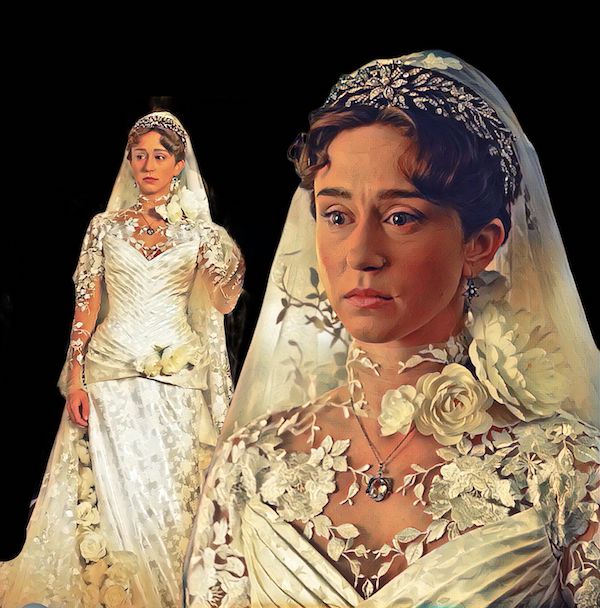
The crucial detail is that Alva Vanderbilt, the very mother who forced her daughter into that marriage, eventually divorced her husband, William Kissam Vanderbilt, in 1895. That divorce became a social earthquake. Not because infidelity was rare among those elites, but because women were still judged infinitely more harshly when they publicly ended a marriage. Fans of Bertha are terrified that her relationship with George may ultimately be doomed.
Alva survived socially because she possessed money, strategic intelligence, and an extraordinary ability to rebuild her public image. After the divorce, she reinvented herself as a figure associated with the suffragist movement and women’s activism. Fellowes clearly knows this historical material deeply. And The Gilded Age increasingly feels as though it is moving toward that exact point: the moment when women begin realizing that marriage and social survival no longer need to be the same thing.
The difference between Downton Abbey and The Gilded Age lies precisely in how each universe confronts modernity. Chronologically, Downton comes after The Gilded Age, and in the film, we hear Americans boast about “caring less” about divorce, but that was never entirely true.
The reality is that, in Downton Abbey, the aristocracy is trying to preserve a declining system. In the Gilded Age, nobody knew what the new rules would be. Everything is being negotiated at once: money, surnames, political power, cultural influence, and female freedom.
That is why divorce carries such dramatic potential in the American series. Not merely as a romantic scandal, but as a mechanism capable of altering entire economic alliances. A divorced woman could lose invitations, social standing, and financial security. But she could also discover an unprecedented form of autonomy. Fellowes understands that ambiguity perfectly.
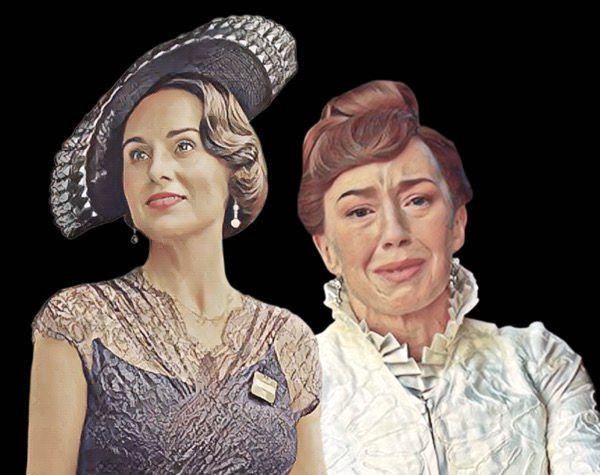
It even appears in the way he writes about socially intelligent women. In Downton Abbey, Cora frequently acted as a mediator between tradition and change. Bertha Russell does something entirely different. She does not try to soften the system. She wants to defeat it. And that places her much closer to the real women of America’s Gilded Age elite.
Most interestingly, Fellowes rarely writes complete revolutions. His characters move slowly, negotiating space inside existing structures. Rather than destroying the system, they try to learn how to survive within it without disappearing. That is exactly what makes divorce such fertile ground in his narratives. It represents the moment when the social veneer stops hiding the fragility of relationships underneath.
But there is something that always softens part of those fears: Julian Fellowes remains deeply devoted to happy endings. Even when his characters experience public humiliation, financial loss, or social exclusion, there is almost always an attempt to emotionally reorganize that universe. And perhaps that is ultimately his favorite subject of all: people trying to maintain elegance, control, and relevance while social rules change too quickly around them.
Descubra mais sobre
Assine para receber nossas notícias mais recentes por e-mail.


1 comentário Adicione o seu