
The jewel that survived more as an image than as an object
On May 19, 1536, Anne Boleyn was executed at the Tower of London after being accused of adultery, incest, and treason against Henry VIII. Nearly five centuries later, much of her life remains surrounded by historical disputes, political reconstruction, and cultural fascination. Yet few images have survived as powerfully as the necklace with the letter “B” suspended beneath pearls, which to this day visually defines the queen.
Curiously, perhaps no other jewel in English history is both so famous and so mysterious.
There are no documents proving who created the necklace, when it was made, or what happened to it after Anne’s death. No known financial records, detailed inventories, or physical evidence of its survival exist. And yet the necklace endured across the centuries as one of the great symbols of the Tudor era, becoming almost an extension of Anne Boleyn herself.
Anne Boleyn was one of the first women in the English monarchy to deeply understand the power of her own image.
Tudor fashion as political language
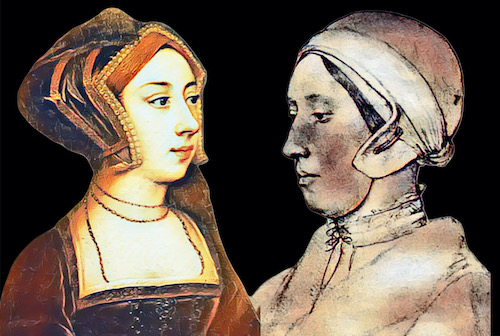
In Tudor England, appearance was never simply appearance. Nobles were raised from childhood to understand that clothing, fabrics, jewels, and adornments directly reflected social status, family honor, and political legitimacy. Jewelry did not function merely as decoration. It functioned as language. As a public declaration of belonging, lineage, and authority.
The most accepted theory among historians is that the necklace belonged to the personal collection of the Boleyn family. The letter “B” represented not simply “Boleyn,” but the political strength of a lineage attempting to consolidate its place within the English court. Contrary to the later image of Anne merely as Henry VIII’s ambitious mistress, the Boleyns were sophisticated, politically strategic, and deeply connected to the broader European world.
Her father, Thomas Boleyn, was an influential diplomat. Her mother came from the powerful Howard family. Anne spent formative years in France, serving within the French court during her youth.
The French influence and the creation of a visual identity
It is precisely there that many historians believe the inspiration for the jewel emerged.
In early sixteenth-century France, personalized jewelry with initials, medallions, and family symbols was fashionable among aristocratic women. Anne absorbed that continental aesthetic profoundly and returned to England carrying not only new references in fashion but a much more modern understanding of social performance, public image, and female identity. Contemporary portraits of figures such as Anne de Pisseleu, mistress of Francis I, already depicted women wearing initial pendants as an important part of their public presentation.
The necklace bearing the letter “B,” therefore, did not seem to function merely as ornamentation. It functioned almost as a visual signature.

Why “B” instead of “A”?
And that helps answer one of the most intriguing questions surrounding the piece: why the letter “B” and not “A,” for Anne?
Because surnames carried political importance.
More than representing Anne herself, the necklace represented the House of Boleyn. It represented lineage, ambition, power, and belonging. It was a way of asserting her aristocratic origins and her position at court. In a monarchy built on bloodlines, alliances, and inheritance, the “B” carried far greater political weight than a simple personal monogram.
This was not uncommon among noblewomen of the period. Margaret of York, for example, appeared wearing a “B” referring to her title as Duchess of Burgundy, while other aristocratic women used letters associated with their families or titles.
Anne Boleyn’s other jewels
At the same time, Anne also owned other jewels linked to her initials. Historical records mention pieces bearing “A,” “AB,” “AR,” and heraldic combinations associated both with the Boleyns and the Tudors. This reinforces the idea that she consciously built a visual identity for herself long before royal women began doing so systematically.
Drawings attributed to Hans Holbein the Younger also show that Henry VIII’s court used personalized jewelry as an important part of the visual language of power. Records exist of “HA” monograms representing Henry and Anne, reinforcing how carefully the couple’s iconography was constructed during Anne’s rise within the English court.
There is an especially fascinating detail hidden within some of these monograms: in certain versions of the “HA” symbol, the letters conceal a visual message. The design subtly forms the phrase “H AMAT A,” Latin for “Henry loves Anne.” The couple used the emblem on walls, palaces, ceilings, and personal objects as a kind of shared identity for the reign they hoped to build together.
Few queens understood the symbolic power of appearance as deeply as Anne Boleyn did.

The symbolism of pearls
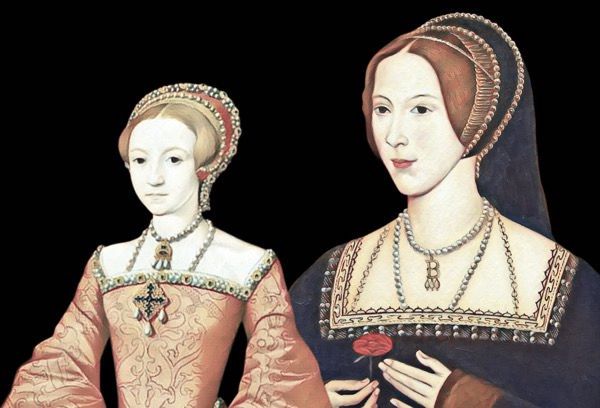
The pearls featured in the necklace were not accidental either. The necklace is traditionally described as a short pearl choker with a solid gold “B” pendant from which three large drop-shaped pearls hung. In Tudor iconography, pearls symbolized purity, chastity, and feminine virtue. The detail becomes almost cruel when we remember that Anne was executed under accusations of promiscuity and adultery that many historians today consider politically fabricated.
In portraits, she appears elegant, controlled, refined, and surrounded by symbols of legitimacy.
It is almost as though the image itself resists the accusations.
The mystery of the portraits
And there is another fascinating detail in all of this: there are no confirmed portraits of Anne Boleyn wearing the necklace that were painted while she was alive.
The queen’s most famous images, including the version immortalized by the National Portrait Gallery, were produced years after her execution, likely based on descriptions, copies, or a now-lost original portrait. At least three known versions of the portrait exist, all created later. Historians believe the original image was probably painted before Anne became queen, around 1530, when she was still simply an aristocratic lady at court. Even the clothing depicted suggests this.
This has led some historians to suggest a particularly fascinating theory: that the “B” necklace may have been visually emphasized or even amplified in later portraits as a means of making Anne instantly identifiable.
In other words, the pendant may also have functioned as an artistic device.
Henry VIII spent years attempting to erase Anne Boleyn from English memory after her death. Portraits were destroyed, coats of arms removed, and public references to his second wife virtually disappeared from court. In that context, later artists may have used the necklace as a visual code to ensure Anne remained recognizable even after her political erasure.
That makes the jewel even more symbolic.
Because it survived not only as an object, but as an image.
What happened to the necklace after the execution?
After her execution in 1536, Anne’s jewels were confiscated by the Crown and were likely dismantled, repurposed, or melted down, something extremely common within the Tudor monarchy. As a convicted traitor, all of her property automatically reverted to the king.
The exact fate of the necklace remains unknown.
Over the centuries, countless theories emerged. One of the most famous claims is that loyal supporters secretly hid some of Anne’s jewels and later passed them to her daughter, Elizabeth I.
Did Elizabeth I inherit her mother’s jewels?
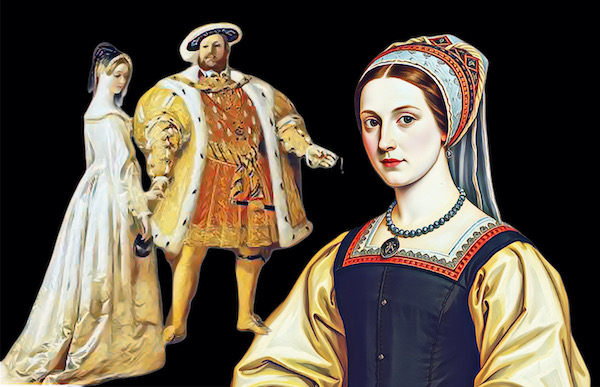
That theory gained strength largely because of a portrait known as The Family of Henry VIII, painted around 1545. In the work, Henry VIII appears beside Jane Seymour and his children Edward, Mary, and Elizabeth. One detail has fascinated historians and Tudor enthusiasts for decades: Elizabeth appears wearing a delicate necklace bearing the letter “A.”
Many believe the jewel may have belonged to Anne Boleyn herself.
And that opens up a series of fascinating questions.
Did Henry VIII notice the detail? Did he consciously allow his daughter to wear a jewel connected to her executed mother? Or did the symbol pass unnoticed at a time when the king was already old, ill, and emotionally distant from the conflicts of his past?
Another theory involves Catherine Parr, Henry VIII’s final wife, who maintained a close relationship with Elizabeth. Some historians speculate that Parr may have discreetly helped preserve or recover jewels connected to Anne’s memory for the young princess.
Hever Castle curator Owen Emmerson believes the pendant truly belonged to Anne Boleyn and notes that Mary Tudor also appears in the portrait wearing jewelry associated with her own mother, suggesting both princesses may have been wearing maternally inherited pieces.
Another fascinating theory involves Elizabeth I herself. Historian Eric Ives believed that, in a teenage portrait of the future queen, Elizabeth may be wearing a remodeled version of her mother’s famous “B” necklace. His main argument lies in the three dangling pearls, strikingly similar to those associated with Anne Boleyn’s necklace in traditional portraits.
None of this has definitive proof.
But the mere fact that these theories have survived for centuries reveals how singular Anne Boleyn’s place remains within the English historical imagination.
The legend of the pearls in the British Crown
Another enduring legend claims that the pearls from Anne’s necklace were preserved and later incorporated into the Imperial State Crown used in official royal ceremonies. Once again, no concrete documentation supports the theory, but it continues resurfacing precisely because it symbolically connects Anne Boleyn to the continuity of the British Crown itself.
The necklace as a contemporary cultural phenomenon
Today, the necklace lives a second cultural life.
It constantly appears in films, television series, and reinterpretations of the Tudors, from The Tudors to Becoming Elizabeth, while also fueling a vast contemporary market for historical replicas. A pearl choker and a gold “B” are enough for people to immediately think of Anne Boleyn.
Henry VIII’s greatest irony
And perhaps that is the greatest irony of all.
Henry VIII tried to destroy Anne’s political legitimacy, her reputation, and even her visual memory after May 19, 1536.
Yet 490 years later, Anne Boleyn remains recognizable through the outline of a single necklace.
Descubra mais sobre
Assine para receber nossas notícias mais recentes por e-mail.

