
This article contains spoilers for the first two episodes of The Shards.
Perhaps no series could feel more like Ryan Murphy than The Shards. There are extremely wealthy teenagers, spectacular houses, early-1980s Los Angeles, sex, drugs, closeted homosexuality, dangerously beautiful people, graphic violence, a serial killer, and meticulous period reconstruction set to an irresistible soundtrack. To complete the package, there are nepo babies in the cast, including a pairing so unlikely it almost sounds as if Murphy invented it himself: Cindy Crawford’s daughter and the son of Richard Gere, Crawford’s ex-husband, are in the same series.
The surprise is realizing that Murphy did not need to impose his obsessions on Bret Easton Ellis’s novel. Almost all of them were already there waiting for him.
Published in 2023, The Shards is autofiction in which Ellis returns to Los Angeles in 1981 and makes a teenage version of himself the protagonist. Bret is 17, attends the exclusive Buckley School, belongs to a group of rich, beautiful teenagers largely left to their own devices by their parents, and begins writing what will eventually become his first novel, Less Than Zero. At the same time, he is hiding his sexuality, moving between a girlfriend and secret male lovers, while becoming increasingly obsessed with Robert Mallory, the mysterious new student who inspires desire, jealousy, fear, and suspicion in almost equal measure.
All of this takes place while Los Angeles is being terrorized by a killer known as the Trawler, who abducts young people, enters their homes, calls his victims, and returns their brutally mutilated bodies. Bret quickly becomes convinced that Robert is somehow connected to the crimes.
The problem is that Robert reaches us largely through Bret.

Is Robert Mallory the Killer or Bret’s Creation?
The series sets that trap from the beginning. Bret, played by Igby Rigney, first sees Robert before he arrives at Buckley during a screening of The Shining. When they finally meet at school, Robert insists he was never at that theater. Bret immediately treats the lie as evidence that something is wrong. But evidence of what?
The choice of The Shining hardly feels accidental. Bret is a future writer watching a story about a writer whose perception of reality deteriorates into violence. Before we have enough information to suspect Robert of anything, Bret has already started constructing a narrative around him.
That is where The Shards becomes much more interesting than a conventional serial-killer mystery. Bret is not simply trying to uncover a story. He is learning how to create one.
In the novel, this subjectivity is even more radical. Robert is a slippery presence because it is difficult to separate who he actually is from what Bret imagines him to be. Even details of his appearance shift, while Bret becomes increasingly skilled at turning fragments, suspicions, and desires into a coherent theory. Eventually, the reader starts doing the same thing. Murphy, however, is not a filmmaker naturally inclined toward empty spaces. Ellis can leave us in uncertainty. Murphy wants something to happen.
For now, that difference works surprisingly well.
In The Shards, Privilege Also Means Abandonment
These teenagers smoke in white-tablecloth restaurants, cross Los Angeles without curfews, use drugs, have secret sex, and live in enormous homes where parents barely seem to exist.
At first, their freedom looks enviable. Then it becomes unsettling. Bret is virtually alone while his parents travel around Europe. Other teenagers can disappear without their families noticing immediately. They live like adults, not because they are mature, but because almost no one around them is actually behaving like one. And the adults who do appear hardly provide safety.
Terry Schaffer, Debbie’s father and a powerful Hollywood producer played by Wes Bentley, becomes increasingly interested in both the novel Bret is writing and his sex life. Liz, played by Evan Rachel Wood, seems to numb her unhappiness with drugs, alcohol, and emotional outbursts. Steven, Terry’s assistant, played by Jordan Roth, completes a household in which the teenagers may actually be the least alarming people. Then Robert arrives.
Homer Gere only needs to enter a scene for us to understand why Bret cannot stop looking at him. Robert is beautiful, self-assured, and impossible to read. He also seems to recognize very quickly what Bret is trying to hide. When he starts moving closer to Bret’s friends and, more importantly, to men Bret has secretly slept with, attraction turns into paranoia. At one point, Robert suggests that when Bret speaks to him, perhaps he is really speaking to himself. It may be a provocation. It may also be the key to the entire story.
Is Robert the monster or the mirror?
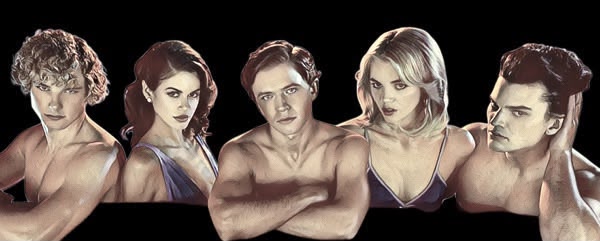
The Trawler Enters Bret’s Secret Life
The mystery becomes personal through Matt. Someone calls him, enters his space, terrorizes him, and leaves signs that seem connected to the Trawler. Matt suspects Bret and reveals that Robert has been asking questions about their relationship. Then Matt disappears.
When Bret receives a recording containing the sounds of his torture, the nature of the threat changes completely. Whoever sent it does not simply know Matt. They know Bret, and they know what Bret is hiding. The serial killer has crossed the line between a distant horror reported in the news and Bret’s secret sexual life.
Robert becomes the obvious suspect — perhaps too obvious. He lies, asks questions, appears close to the right people, and seems almost entertained by Bret’s suspicion. But there are also the Riders of the Afterlife, break-ins, symbols, and hints that more than one threat may be operating at once.
Robert could be the killer. He could know the killer. He could be involved without being the Trawler. Or Bret could be forcing separate events into one narrative because connecting fragments is already becoming part of the way he sees the world.
That uncertainty is far more compelling than simply asking who committed the murders.
Ryan Murphy Turns 1981 Into a Spectacle
While the horror grows, Murphy builds an almost obscenely beautiful version of 1981. Importantly, these are not the neon caricature of the 1980s that television so often recreates. The decade has barely begun. The 1970s are still visible in the interiors, clothes, cars, and movies, while a different cultural landscape is beginning to take shape.

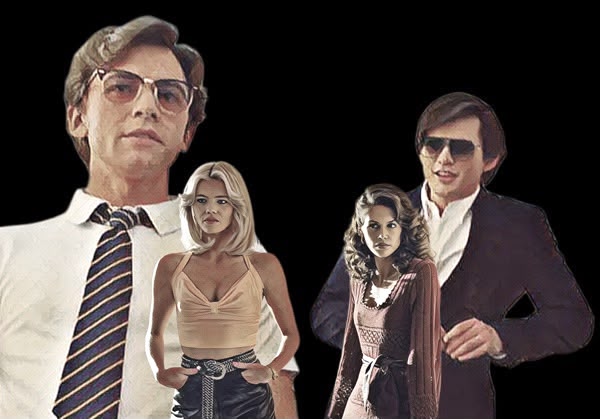
New Hollywood is fading. Heaven’s Gate has become the symbol of its collapse. MTV is arriving. Music videos are beginning to reshape pop culture. Bret, meanwhile, is moving from adolescence toward adulthood and beginning to imagine the writer he will become.
There is also something else coming that he cannot see. Bret is a gay teenager discovering sex and desire in 1981, as the first AIDS cases are beginning to be identified in the United States. This makes his description of Robert as a “virus” entering the group particularly difficult to hear innocently.
The characters are experiencing sex, drugs, and freedom as discovery without knowing how brutally the decade will transform all three. That historical knowledge gives the series its most effective layer of nostalgia. The swimming pools, cars, music, parties, and immaculate clothes are seductive, but there is melancholy underneath them.
The beauty matters because we know the world they inhabit is about to change.
Kaia Gerber and Homer Gere Make Nepo-Baby Casting Meta
And then there is the casting, where Ryan Murphy may have out-Ryan-Murphyed himself.
Kaia Gerber, who plays Susan, is the daughter of Cindy Crawford and Rande Gerber. Homer Gere, who plays Robert, is the son of Richard Gere and Carey Lowell. Cindy Crawford was married to Richard Gere from 1991 to 1995.
So Murphy has cast Cindy Crawford’s daughter and the son of her ex-husband as two beautiful, privileged young people in a story about the elite of Los Angeles — and their characters are attracted to each other. They are obviously not related, but the pop-cultural connection is too good to ignore.
It becomes even more layered because Richard Gere’s American Gigolo, released in 1980, belongs to precisely the world of sex, beauty, money, and Los Angeles that The Shards is recreating. Homer enters that fictional universe carrying one of its cultural references on his own face.
And somehow the family tree goes even further: Carey Lowell was once married to Griffin Dunne, nephew of Joan Didion, whose writing is an important reference for Ellis and for the young Bret depicted here. Calling Gerber and Gere simply nepo babies almost misses the joke. This is celebrity archaeology: descendants of the Hollywood mythology playing the privileged children of a fictionalized Hollywood mythology.
Artificial? Of course.
Perfect for Ryan Murphy? Absolutely.

There Are Two Versions of The Shards
That casting also helps explain why The Shards seems to operate on two different levels. On the surface, it can be watched as an expensive teen thriller: school politics, sex, romance, secrets, beautiful people, and murder. Something like a more polished cousin of Riverdale or Pretty Little Liars.
But another series is hiding underneath. There is The Shining, Chinatown, Heaven’s Gate, American Gigolo, Joan Didion, the end of New Hollywood, MTV, Reagan-era America, and AIDS approaching on the horizon. All of those references matter because Bret is not simply surviving his senior year. He is witnessing one cultural world disappear while becoming the person who will later write about it.
The question is whether Murphy can keep those two series together.
In its first two episodes, the series turns Bret Easton Ellis into a thriller about desire, privilege, and paranoia
Descubra mais sobre
Assine para receber nossas notícias mais recentes por e-mail.

