
I saw Stand by Me when it was released in 1986, so there is an inevitable emotional trap in writing about the 40th anniversary of a film that, from the beginning, was about the passing of time. Or perhaps that is precisely why it still works so beautifully.
On August 8, Stand by Me marked four decades since its American release, and remains one of the most moving films ever made about childhood, even though its premise, reduced to a few words, sounds considerably less inviting: four boys walk across the Oregon countryside to find the body of another boy. Death is there at the beginning, in the middle, and at the end of Stand by Me. But the film was never really about death.

It originated from “The Body,” the novella Stephen King published in the 1982 collection “Different Seasons.” For readers who associated King almost exclusively with horror, it was something different. There were no haunted hotels, telekinetic teenagers, or supernatural monsters. Instead, there was something perhaps even more frightening: children discovering that the adult world is flawed, unfair, and mortal.
The story is deeply connected to King’s memories and feelings about childhood, although it should not be read as a literal autobiography. Decades later, when remembering Rob Reiner, King would again describe The Body as an unusually personal story, one that exposed something of the vulnerable boy he had once been.
Interestingly, Reiner was not the person who first discovered the novella and decided it should become a film. Screenwriters Bruce A. Evans and Raynold Gideon came first. They fell in love with the story, approached King’s representatives, and began the difficult process of securing the rights.
The project was not an obvious commercial proposition. There were no major stars, the protagonists were 12-year-old boys, and the entire story revolved around a group of children looking for a corpse. Adrian Lyne was originally attached to direct, but eventually left the project. That was when the screenplay reached Rob Reiner. And Reiner saw what was missing.
Stand by Me was not his directorial debut. He had already made This Is Spinal Tap and The Sure Thing. But it was his first drama, and arguably the film in which he discovered a different kind of voice as a filmmaker. Reiner understood that the four boys should not carry exactly the same dramatic weight. He made Gordie LaChance, played by Wil Wheaton, the emotional center of the story.
Gordie has lost his older brother Denny, played by John Cusack, and with him has essentially lost the attention of his parents, particularly his father. The journey to find a dead boy, therefore, becomes the journey of another boy trying to understand his own symbolic disappearance inside his family. Gordie needs to discover whether he deserves to take up space, whether his stories matter, and whether he can continue existing beyond grief.
Reiner recognized something of himself in that relationship with an imposing father. He had grown up in the shadow of Carl Reiner, one of the great figures of American comedy. Perhaps that is the true secret of Stand by Me: the plot promises us an adventure and delivers a memory.
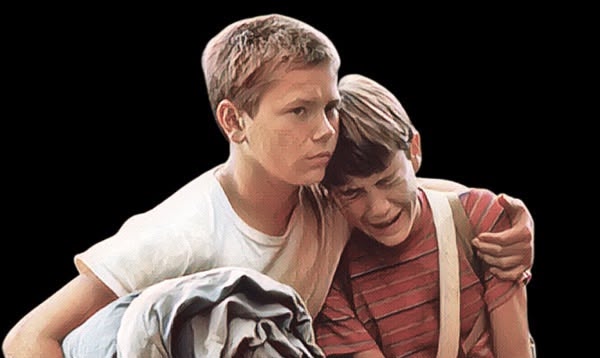
Gordie, Chris, Teddy, and Vern set out to see a dead body because they are 12 years old, and at 12, death still feels like something that happens to other people. Along the way, they joke, fight, tell stories, run from a train, confront bullies, and reveal things to one another that they cannot say to the adults in their lives.
By the time they finally reach the body they had been so eager to find, nothing is exciting about it anymore. Death stops being an abstraction and becomes real. They return home changed because they have crossed a boundary nobody could have prepared them for.
And then there were those four actors.
River Phoenix was only 15 when the film was released, and as Chris Chambers, he has an intensity that remains almost startling to watch. Chris is judged by adults as someone already condemned by his family name, his background, and his social class, but Gordie sees in him what nobody else seems willing to see.
Phoenix would build an extraordinary career in only a few years. He earned an Oscar nomination for Running on Empty, made My Own Private Idaho, and died in 1993 at just 23. From that moment on, watching Stand by Me carried an additional sadness. The boy who seemed to understand more than everyone around him never had the chance to grow old.
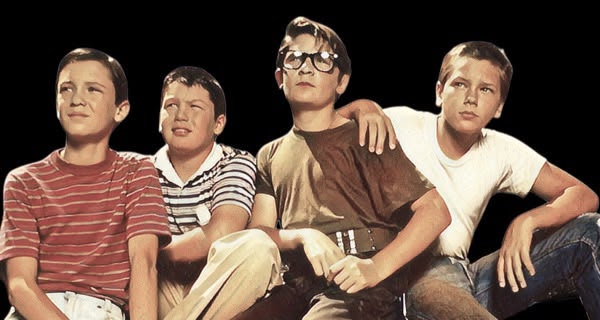
Wil Wheaton would go on to Star Trek: The Next Generation. Jerry O’Connell, who was essentially beginning his screen career, would build a long career in film and television. Corey Feldman became one of the most recognizable child actors of his generation, while Kiefer Sutherland, terrifying as Ace Merrill, would become one of the most enduring stars in the cast.
Seen today, Stand by Me also feels like a photograph of a generation of young actors seconds before their lives headed in radically different directions.
The film did not exactly begin as a cult movie. It began small and became the kind of success Hollywood had not expected. Made for roughly $8 million, it earned more than $50 million worldwide, received an Academy Award nomination for adapted screenplay, and firmly established Reiner as one of the most interesting directors of his generation.
The cult status came with time, as new generations recognized it as something close to the emotional blueprint for stories about groups of children confronting something bigger than themselves. Much of the nostalgia that would later fuel productions such as Stranger Things inevitably leads back to those railroad tracks.
For Stephen King, the result had particular significance. His relationship with film adaptations has always been more complicated than the caricature of an author who simply hates filmmakers changing his books. King admired Brian De Palma’s Carrie. The adaptation that famously troubled him was Stanley Kubrick’s The Shining, which dramatically altered his novel and its emotional logic. With Stand by Me, the opposite happened.
When King first watched Reiner’s film, he was so moved that he reportedly needed a few minutes before he could speak about it. Over the years, he would repeatedly place it among the finest adaptations of his work. And that relationship did not end there.
Reiner returned to King with Misery in 1990, another extraordinary adaptation. His connection to King’s universe became so important that when Reiner created his production company, he called it Castle Rock Entertainment, after the fictional Maine town where King set The Body and many of his other stories. Castle Rock would later also be involved with The Shawshank Redemption, another film now regarded as one of the greatest King adaptations.
So Stand by Me did more than bring Reiner and King together. It helped create one of the most important bridges between the author’s literature and the cinema.

Forty Years Later, the Empty Chairs
It is impossible, however, to celebrate the 40th anniversary of Stand by Me in 2026 the way we celebrated its 20th or 30th. For years, the unavoidable absence was River Phoenix. Whenever members of the cast reunited, there was always the awareness that one of the four boys had never grown older alongside the others. At an anniversary celebration years ago, Reiner himself spoke of the feeling that there should have been another chair there for River. Now there is another empty chair.
Rob Reiner and his wife, Michele Singer Reiner, were killed in their Los Angeles home in December 2025. Their son Nick Reiner has been charged with two counts of first-degree murder and has pleaded not guilty.
We know that Rob and Michele died from multiple sharp-force injuries and that investigators have said they were stabbed. But the complete autopsy reports remain under court restriction. More importantly, there is still no public answer to the question that may be the hardest one of all:
Why?
The criminal case remains unresolved as prosecutors and defense attorneys continue to examine evidence and documentation. There is something brutally ironic about all of this.


At 39, Rob Reiner made a film about four boys walking for miles because they wanted to understand a death. Forty years later, we are celebrating the survival of that film while still trying to understand the death of its director.
Perhaps that is also why Stand by Me feels even sadder now. It was never really the story of finding Ray Brower’s body. It is the memory of an adult man trying to find again the boys who once walked beside him when he was 12, and realizing that some people can only exist again when we tell their stories. River Phoenix did not live to see the film turn 40. Rob Reiner did not either. But Gordie, Chris, Teddy, and Vern are still walking along those tracks.
And perhaps that is why, forty years later, we are still walking with them.
Descubra mais sobre
Assine para receber nossas notícias mais recentes por e-mail.
 miscelana.com