
Anyone watching The Shards without knowing Bret Easton Ellis’s novel has every reason to wonder how much of it actually happened. The protagonist, Bret Easton Ellis, attends the same school the author attended, lives in the Los Angeles of Ellis’s adolescence, and is beginning to explore his sexuality while dreaming of becoming a writer. At the same time, his friends appear to be targeted by a serial killer known as the Trawler, while a cult called the Riders of the Afterlife terrorizes the city. Is this autobiography, true crime, or fiction? The most accurate answer may be that Bret Easton Ellis would very much prefer that we never know exactly where one ends and the other begins.
The Shards, published as a novel in 2023 after Ellis originally told the story in installments on his podcast, is usually described as autofiction, and for good reason. When he first began releasing it, Ellis even presented the story as almost entirely autobiographical, claiming that the people and events were real. Later, however, he became far more playful about that assertion. When a former school friend contacted him after the book was published, for instance, Ellis referred to what he had written as his fictional version of their senior year.
That contradiction is precisely where the game begins.
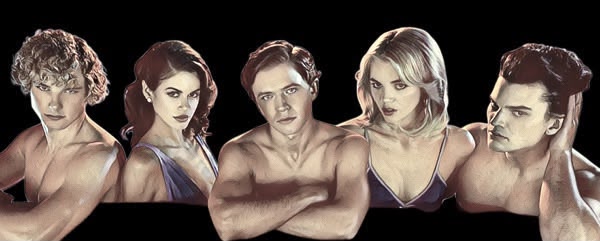
What in The Shards is actually true?
Bret Easton Ellis did, in fact, grow up in Los Angeles and attend the exclusive Buckley School, inhabiting the privileged world that appears in both the novel and the series. The teenager surrounded by money, cars, drugs, parties, absent parents, and a peculiar kind of emotional numbness also clearly anticipates the universe Ellis would turn into Less Than Zero only a few years later. His debut novel was written during college and published when he was just 21, but the raw material of that affluent, detached Los Angeles adolescence was already there.
There is also something deeply autobiographical in Bret’s discovery of his sexuality and his sense that he is living two lives at once. In the series, Igby Rigney plays a teenager who has a girlfriend and performs the social role expected of him while hiding his relationships and desires involving other boys. Whether every encounter or character existed exactly as depicted is beside the point. That sense of doubleness belongs to the version of his youth Ellis chose to reconstruct.
The cleverest part is that an older Bret also exists within the narrative. We are not simply watching the author’s adolescence. We are watching the version a writer chose to create decades later about his own adolescence. Memory, desire, guilt, fantasy, and fiction arrive already intertwined.
And that is where the Trawler and the cult come in.
Did the Trawler really exist?
No. The serial killer known as the Trawler is fictional. There is no real-life murderer by that name hidden somewhere in Bret Easton Ellis’s biography.
That does not mean the fear surrounding the character is completely disconnected from reality. Ellis is recreating a Los Angeles still haunted by the cultural memory of the Manson Family and by decades of stories about serial killers in California. The Trawler fits perfectly into that landscape precisely because he feels like someone who could have existed. But his crimes, methods, and connection to the characters belong to the thriller.
And perhaps that is exactly why the device works so well. Ellis inserts an invented threat into an extraordinarily specific and recognizable recreation of his own life, then asks us to decide which part we should trust.
What about the Riders of the Afterlife? Was the cult real?
Again, the answer is no. The Riders of the Afterlife are part of the fictional construction of The Shards. They are deliberately presented as a kind of post-Manson cult, surrounded by satanic imagery, break-ins, violence, and animal sacrifice. The cultural reference is real. The organization itself is not.
Ryan Murphy, however, seems to have immediately recognized how much television potential there was in this element of the story.
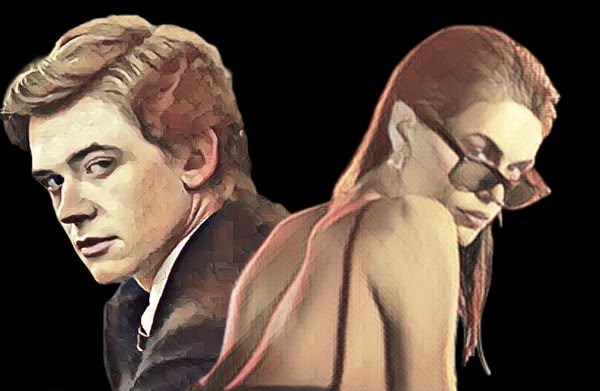
In the first episodes of the adaptation, the Riders have a stronger presence and receive more concrete development than they do at the same stage of the novel. The series expands the organization, its rituals, and its leadership more quickly, while also drawing its crimes closer to those associated with the Trawler. It is a significant change because something that also functioned in the book as background noise feeding Bret’s paranoia becomes a much more conventional television mystery.
And this is where The Shards becomes such an oddly perfect combination of Ellis and Murphy. Ellis built a story in which we cannot completely trust the narrator, memory, or even the boundary between autobiography and invention. Murphy takes that ambiguity and turns part of it into spectacle: more sex, more horror, more cult mythology, more suspects, and, naturally, more visual excess.
So, is The Shards based on a true story?
Yes and no, which is exactly the answer Bret Easton Ellis seems to prefer.
The school is real. Los Angeles is real. The teenage writer is real. Some of the friendships, experiences, desires, and memories were probably inspired by real people and events, although it is impossible to safely match every character with someone from Ellis’s life. The Trawler is not real. Neither are the Riders of the Afterlife. Robert Mallory belongs precisely to the territory where the novel stops owing us anything resembling verifiable memoir and fully embraces the thriller.
Which makes it especially funny that the series opens with the traditional disclaimer stating that any resemblance to actual persons is coincidental. The protagonist has the author’s name, attends the school he attended, and is living a version of his adolescence.
Coincidence, of course.
Bret Easton Ellis could hardly have chosen a better way to begin.
Descubra mais sobre
Assine para receber nossas notícias mais recentes por e-mail.

