
Some productions enchant us because of what happens onstage. Others acquire an even greater dimension because of what they reveal about a company. The Theatro Municipal do Rio de Janeiro’s Don Quijote does both: it is a beautiful, vibrant, and technically demanding production, and it also confirms that the Municipal Ballet is enjoying a truly remarkable artistic moment.
The technical standard is impressive among both the soloists and the corps de ballet. The women are beautiful, precise and assured, but it is always important to highlight the strength of the male dancers as well. For many years, men in ballet had less space, fewer opportunities and even less encouragement to pursue classical dance. Today, seeing an entire generation of male dancers take over the Municipal’s stage with presence, technique, and personality is one of the most exciting aspects of every production the company presents.

In fact, the opening night of Don Quijote offered an unexpected demonstration of the strength of this ensemble. Principal dancer Márcia Jaqueline was injured and had to be replaced during the first act. Marcela Borges stepped in at the last minute to take over the role of Kitri, without having previously rehearsed with Cícero Gomes, her partner that evening.
It is difficult to convey the magnitude of this challenge to anyone unfamiliar with Don Quijote. Kitri is not a role in which a ballerina can simply “step in and dance.” The ballet is long, physically exhausting, and demands an almost merciless combination of jumps, turns, extremely precise small steps, classical lines, stamina, and acting. On top of everything else, the ballerina must establish complete trust with Basílio throughout their pas de deux. Marcela Borges did not merely step in: she swept the audience away.
I have followed her career with great curiosity and affection, and I almost always leave her performances enchanted. Marcela is a rising star, but what happened on opening night was greater than one exceptional individual performance. Having a ballerina capable of unexpectedly assuming the leading role, carrying the evening and winning over the audience proves that this is a genuinely prepared company. A ballet company cannot be measured solely by the stars announced in the programme, but also by the quality of those who are ready to step in when the stage demands it.
I watched Juliana Valadão’s Kitri opposite guest dancer Gabriel Lopes as Basílio, and the two were simply beautiful. Not merely attractive onstage — although they certainly are — but artistically beautiful, assured, moving and completely in sync. There are partnerships in which we can see the technical effort behind every movement. With Juliana and Gabriel, even knowing the almost absurd difficulty of the choreography, what reached the audience was confidence, pleasure and an apparent sense of freedom.

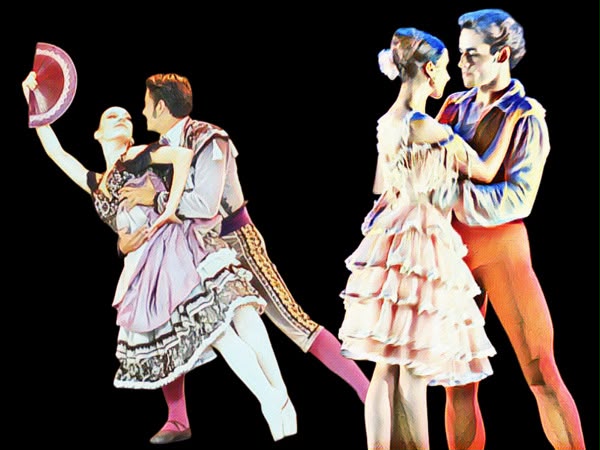
Juliana was extraordinarily precise, but her Kitri was never limited to precision. There was energy, humour, flirtatiousness, authority and an infectious joy in the way she occupied the stage. Kitri must appear free even while performing some of the most difficult steps in the classical repertoire, and Juliana achieved exactly that. She danced with confidence, personality and a radiance that made it impossible to look away.
Gabriel Lopes confirmed everything his career had already suggested. A 2016 graduate of the Bolshoi Theatre School in Brazil, he built his career in Russia, where he now performs as a principal dancer. He recently danced Albrecht opposite Natalia Osipova in Giselle during the gala held at the Theatro Municipal itself. As Basílio, he displayed confident technique, excellent jumps, elegant presence, beautiful lines and a stage masculinity that never needed to rely on excessive force.
He truly is a beautiful dancer to watch, in every possible sense. His dancing has amplitude, elegance and naturalness, but he is also generous with his partner. Gabriel was not there merely to complete his variations or display his virtuosity: he built a relationship with Juliana. He looked at her, reacted to her and made it appear as though the two were genuinely telling the same story.
That made all the difference. The romance, complicity and humour between Kitri and Basílio are essential if Don Quijote is not to become merely a sequence of technical feats. Juliana and Gabriel delivered the virtuosity, naturally, but they also delivered emotion. They were beautiful, assured and genuinely thrilling. At several moments, there was that rare sensation of watching two dancers who were completely happy to be together onstage — and that happiness reached the audience intact.
Marcela Borges also returned to the stage in another solo during that performance and once again brought the audience to its feet. It was another of those moments that reinforced the perception that we were not watching a company built around one name or a single star, but one filled with possibilities.
I would love to mention every dancer by name because there are standouts in every section, but that would practically require reproducing the entire programme. What matters most is precisely the ensemble: the impression that everyone is committed to the same production, from the leading dancers to the corps de ballet. There is energy, character, humour and genuine pleasure in dancing.


The production conceived by Hélio Bejani and Jorge Texeira preserves the classic and instantly recognisable moments of Marius Petipa’s choreography while still managing to introduce a sense of freshness. It is a delightful, colourful, vivid and wonderfully humorous production that never sacrifices the rigour Don Quixote demands. The Theatro Municipal Symphony Orchestra, conducted by Tobias Volkmann, completes the experience with Ludwig Minkus’s irresistible score.
The second week features different pairings in the leading roles, including Manuela Roçado and Rodrigo Hermesmeyer, as well as Marcela Borges and Mateus Imperial. Márcia Jaqueline and Cícero Gomes also remained on the announced schedule, although the principal ballerina’s participation naturally depends on her recovery.
Whatever the pairing, however, audiences can expect an evening of beauty, refined technique and enormous pleasure. Don Quixote concluded its first week by confirming something that has already become evident in the Municipal’s recent productions: the company is renewed, confident and artistically inspired.
There are stars, principal dancers and emerging young talents. Above all, however, there is a company. And few things in ballet are more moving than realising that an entire company is ready to shine. Don Quixote is unmissable.
Descubra mais sobre
Assine para receber nossas notícias mais recentes por e-mail.


1 comentário Adicione o seu