
With Florence Pugh about to take on Cathy Ames in the new adaptation of East of Eden, it is only natural that all the attention should be focused on her. Cathy is one of the most terrifying characters in American literature, a woman whom John Steinbeck presents as someone possibly incapable of recognizing good and evil as human experiences. After three character analyses, I think we have sufficiently established why she fascinates us. What we may have left in the background is that East of Eden also contains extraordinary male characters and one of the most painful conflicts between fathers, sons, and brothers ever brought to the screen.
That was precisely the part of the story Elia Kazan chose in 1955. Steinbeck’s novel spans three generations, follows the Trask and Hamilton families from the Civil War to World War I, and repeats the biblical story of Cain and Abel twice. Kazan and screenwriter Paul Osborn eliminated almost everything that preceded Cal and Aron. They did not create a complete adaptation, but a radical concentration of the novel around a son desperate to be loved by his father. It was also how cinema found James Dean.
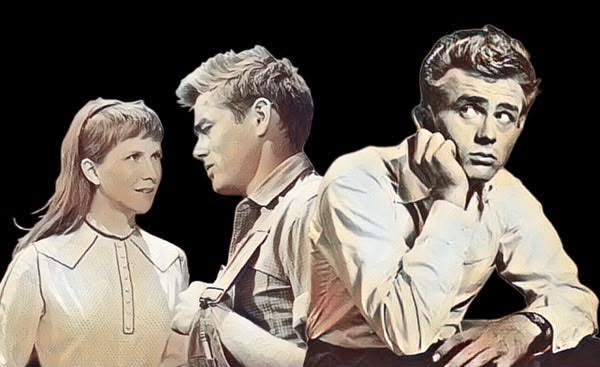
Cain and Abel Across Two Generations
In Steinbeck, the biblical reference is not limited to the twins Cal and Aron. It begins one generation earlier, with Adam Trask and his half-brother Charles. Adam is the sensitive and apparently virtuous son; Charles is strong, violent, and consumed by the perception that their father prefers his brother. When the two offer their father gifts, Cyrus enthusiastically accepts Adam’s simple present and virtually dismisses the expensive, carefully chosen gift from Charles.
The scene reproduces the central conflict in the story of Cain and Abel. God accepts Abel’s offering and rejects Cain’s, without providing a justification that might ease the wound. Cain cannot endure the preference and kills his brother. Charles does not actually kill Adam, but he attacks him so violently that he nearly does. The jealousy does not arise simply from a desire to possess what belongs to the other. It comes from the conviction that the other has received a love that was denied to him.
Years later, the conflict returns through Adam’s sons. Cal, short for Caleb, once again occupies the position of Cain; Aron, whose name deliberately resembles Abel’s, is the idealized son. Aron is religious, obedient, and seemingly pure. Cal is restless, impulsive, suspicious, and painfully aware of his own aggression. When he discovers that the mother he believed dead is alive and running a brothel, he begins to fear that he has inherited from her some kind of essential evil.
The problem is that Steinbeck is not merely reproducing the Bible. He is asking whether we are condemned to repeat it.
Cal loves Aron, but he also envies him. He wants to protect his brother from the truth about Cathy, yet at the moment of his greatest pain, he uses that very truth to destroy him. Aron is not physically murdered by Cal as Abel was by Cain, but he is pushed into an experience he cannot endure. The violence is no longer merely physical; it becomes psychological. Cal knows where his brother is most vulnerable and, when he feels rejected once again, strikes precisely at that point.
The Rejected Gift
Kazan’s adaptation preserves the scene that makes the biblical reference impossible to ignore. After Adam’s business venture fails, Cal invests in bean farming and profits from the United States entering World War I. He intends to give his father the money he lost and finally receive some sign of pride from him.
Adam refuses the gift because he considers wartime profit morally reprehensible. He then compares Cal’s offering with Aron’s “good” and “honest” gift. For the father, it is an ethical lesson. For the son, it is a repetition of the divine sentence: his brother’s offering is accepted; his own is rejected.
It is impossible to understand Cal’s reaction if we see only envy or cruelty. He does not simply want to surpass Aron. He wants his father to recognize that something good exists in him as well. The more Adam insists on treating him as the troubled son, the more Cal identifies with Cathy and with the fantasy that he was born evil. The rejection does not merely confirm that his gift is unsuitable. It confirms his fear that he himself is unsuitable.
Steinbeck therefore constructs a family system in which parents participate in the very behavior they later condemn in their children. Cyrus establishes the rivalry between Adam and Charles; Adam repeats the preference with Cal and Aron. Each generation believes it is merely responding to the children’s character, without realizing that it is also helping to produce it.
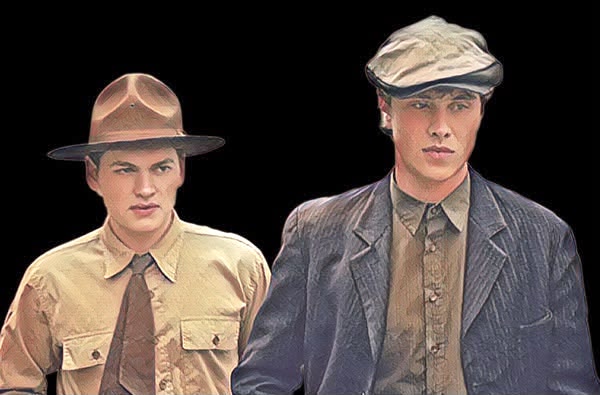
What Elia Kazan Removed From the Novel
When he adapted East of Eden, Kazan knew it would be impossible to fit everything into a single film. In a letter to Steinbeck, he admitted that even using only the final quarter of the novel left him with too much material. Cyrus, Adam’s youth, his violent relationship with Charles, almost all of Cathy’s story, and much of the Hamilton family were removed. Lee, the Chinese American servant who raises the boys and becomes the novel’s moral and philosophical center, disappeared entirely.
The loss is enormous. Lee participates in the discussion of timshel, the Hebrew word Steinbeck interprets as “thou mayest.” A human being is neither required to conquer sin nor condemned to surrender to it. He may choose. This possibility is the novel’s answer to the determinism that torments Cal: being Cathy’s son does not mean he is destined to become Cathy.
The film preserves the question but changes the path toward it. Rather than developing the transmission of violence across generations at length, Kazan makes Cal the emotional center of everything. His East of Eden does not fully explain the Trask family; it shows what it feels like to be the son who feels inexplicably rejected within it.
Kazan considered this one of his most personal films. In the relationship between Cal and Adam, he recognized something of his own experience with a father who constantly disapproved of him. Perhaps that is why he understood that the character did not merely require an actor capable of portraying anger. He needed someone who could make anger look like the final defense against humiliation.
How Elia Kazan Found James Dean
James Dean had already made small film appearances and worked in television and theater, but East of Eden was his first major role and his debut as a leading man. He was not yet the icon we know. Rebel Without a Cause and Giant had not even been filmed when Kazan chose him to play Cal.
Paul Newman was also considered, and footage of the screen tests conducted during that period still survives. Kazan, however, found something in Dean that did not seem entirely performed. He described his face as lonely, strange, and desolate and, years later, called selecting him as Cal “the most apt piece of casting” he had ever done.
There is an almost uncomfortable identification between actor and character. Dean does not play Cal as a confident or seductive rebel. His body bends, retreats, and advances, never seeming to find a comfortable position in his father’s presence. He wants to touch him and attack him, please him and punish him. In the scene in which Adam refuses the money, Cal does not react like someone who has lost an argument. He collapses like a child who has just received confirmation that he does not deserve love.
The tension became even more convincing because Raymond Massey, who plays Adam, neither understood nor approved of Dean’s unpredictable method. Kazan recognized the usefulness of that conflict and exploited it. Onscreen, the distance between the classical, rigid and controlled actor and the physically disorganized young man became the very distance between a father who demands restraint and a son who can no longer contain anything.
East of Eden premiered in March 1955. James Dean died on September 30, before Rebel Without a Cause and Giant reached theaters. It was therefore the only one of the three major films he lived to see released. The role that revealed Dean also preserved something that his posthumous transformation into a symbol of rebellion often obscured: his extraordinary ability to portray emotional deprivation.
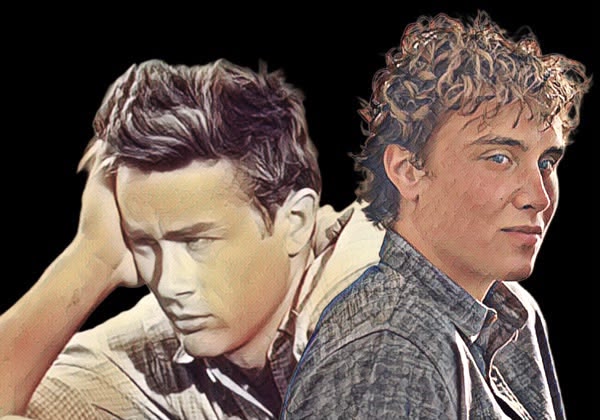
The New Cal Did Not Try to Be James Dean
The new miniseries written by Zoe Kazan, Elia’s granddaughter, promises to restore the breadth that the film deliberately sacrificed. It returns to both generations of brothers, gives the Hamiltons and Lee their place back, and once again puts Cathy at the center, now played by Florence Pugh. Christopher Abbott will play Adam, Mike Faist will be Charles, and Joe Anders will portray Aron.
The role of Cal, which introduced James Dean to cinema, has gone to Joseph Zada. The 21-year-old Australian actor previously appeared in the political drama Total Control and gained greater recognition in Invisible Boys and We Were Liars. His career is now moving quickly: in addition to inheriting from Dean one of Steinbeck’s most complex male characters, Zada was chosen to play the young Haymitch Abernathy in The Hunger Games: Sunrise on the Reaping, a role associated with Woody Harrelson in the franchise.
Zoe Kazan revealed that she asked the candidates for Cal and Aron to read for both roles. She wanted to preserve one of Steinbeck’s central ideas: neither brother is born permanently destined to occupy the place of good or evil. Either one could have followed the other’s path. In Zada, she found the combination of sharpness, tenderness, cunning, and self-loathing she was looking for. The most important detail is that he did not try to imitate James Dean.
The comparison will, of course, be inevitable. James Dean was not a star when Elia Kazan chose him; Zada arrives in the series as a promising actor whom Hollywood is already preparing for another major franchise. Still, both were asked to solve the same problem: to make Cal dangerous without erasing his vulnerability, and to show that his violence does not arise from an absence of love, but from the desperate need to receive it.
Perhaps the Bad Son Was Never Bad
The new adaptation premieres October 1 on Netflix. It will be impossible not to look first at Florence Pugh. Cathy enters other people’s stories as a force of destruction and seems to defy every attempt at psychological explanation. But the men of East of Eden do not exist merely as victims or counterpoints to her monstrosity. They carry a question that may be even more disturbing: how much of what we call individual character was produced by the place we were given within our family?
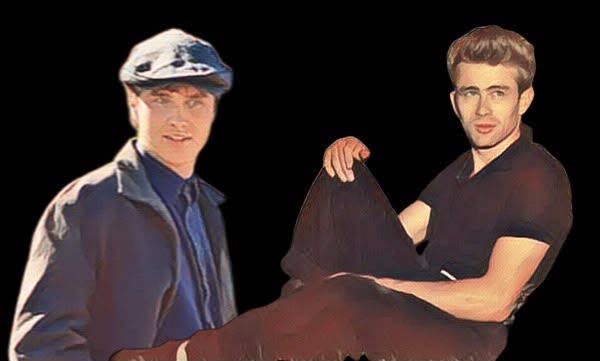
Charles and Cal are the rejected sons who respond with violence. Adam and Aron are the favored ones, but their supposed goodness also imprisons them. Adam becomes incapable of recognizing anything in his son that does not correspond to his moral ideal; Aron collapses when he discovers that his real mother cannot fit inside the pure image he created. None of them remains simply Cain or Abel. It is precisely this rigidity of roles that Steinbeck attempts to break.
Elia Kazan removed much of this architecture from the novel, but preserved its central wound. By choosing James Dean, he gave an unforgettable body to the son who believes he was born wrong. Before becoming Hollywood’s eternal rebel, Dean was Cal Trask, a Cain who did not want to kill Abel. He only wanted his father to accept his offering.
Descubra mais sobre
Assine para receber nossas notícias mais recentes por e-mail.


1 comentário Adicione o seu