
The second season of The Gentlemen has been widely praised, and with good reason. It is entertaining, violent, elegant, surprising, and perfectly controlled by Guy Ritchie. Theo James is excellent, Kaya Scodelario remains magnetic, and even its excesses are part of the pleasure of watching it. The problem is that, underneath this irresistible packaging, there is a story we already know very well.
More than a continuation or spin-off of the 2019 film, The Gentlemen has become an English revisitation of The Godfather, particularly The Godfather Part II. This is not simply a matter of influence, archetype, or discreet homage. The parallels are so numerous, specific, and literal that the question becomes something else entirely: how much of the season’s merit truly belongs to Guy Ritchie?
Eddie Horniman is Michael Corleone transplanted into the British aristocracy. Both are younger sons, disciplined military men initially removed from their families’ criminal businesses. Michael returns from World War II and tells Kay that the Corleones are his family, but that he is not like them. Eddie likewise believes he can solve the problems left behind by his father, protect the estate, and eventually return to his previous life, although neither man ever truly manages to go back.
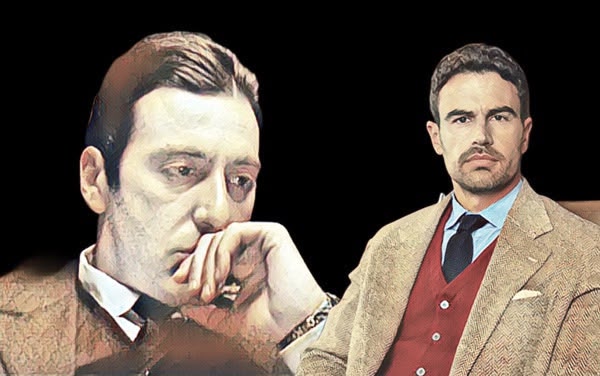
Circumstances gradually seem to force Eddie into crime. First, he wants to save his family. Then he needs to preserve the estate, protect the business, achieve independence, eliminate threats, and avenge the people he has lost. Every cruel decision is presented as an unavoidable exception, but the exceptions eventually become his method of ruling.
That is precisely Michael Corleone’s journey. He also begins by telling himself that he is acting for his family. Every murder is presented as necessary, every betrayal demands an answer, and every answer takes him further away from the decent man he once believed himself to be. The great lie shared by both characters is that they had no choice. In reality, they did have choices; they simply discovered that they were extraordinarily good at what they claimed to be doing out of obligation.
The comparison is not merely interpretive. Theo James openly mentions The Godfather Part II as a reference for understanding Eddie’s transformation: the story of a man who becomes increasingly capable of defeating his enemies while losing parts of himself along the way. Netflix itself used that reading in its official material about the season finale. Michael Corleone is not someone we are merely imagining inside Eddie Horniman, because he was consciously placed there.
Freddy, Fredo, and a betrayal within the family
The most obvious reference may be Eddie’s brother. Freddy does not merely occupy Fredo’s dramatic position; he practically carries the same name.
Freddy is the older brother who is unstable, resentful, and humiliated by his father’s decision to leave the inheritance to the younger son. Fredo also believes he has been diminished and passed over in favor of Michael. Both men crave recognition, want a share of the power, and are manipulated precisely because they cannot bear to remain in their brothers’ shadows.
In The Godfather Part II, Fredo provides information that makes the assassination attempt against Michael possible. In The Gentlemen, Freddy becomes involved in Gospel John’s conspiracy, driven by resentment over losing Halstead to Eddie. That alliance leads to Bella’s death and an attack on Freddy’s own family.
When Eddie discovers the betrayal, the confrontation recreates the same emotional dynamic between Michael and Fredo. Eddie beats his brother and points a gun at him, but does not kill him. Instead, he forces Freddy into a van with Gospel John and a chainsaw. Freddy emerges covered in blood, carrying the head of the man who manipulated him, while Eddie lights a cigar and tells him, “Good boy, Freddy.”
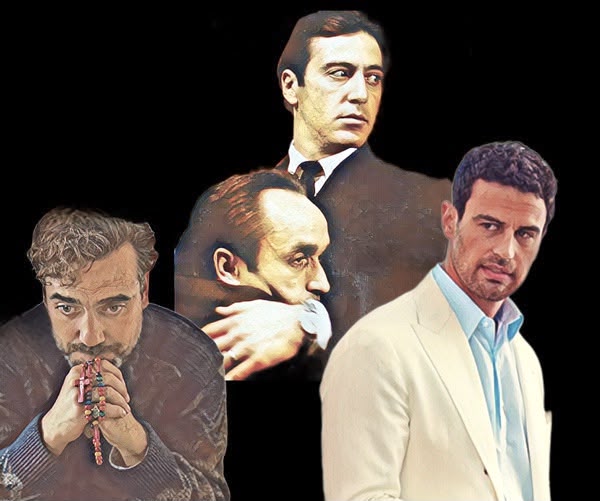
The outcome may appear different from Michael’s decision to have Fredo killed, but it grows out of the same logic. The younger brother assumes the right to judge, punish, and redefine the older brother’s place within the family. Eddie does not forgive Freddy; he breaks him psychologically and turns him into an instrument of his own version of justice.
Screenwriter Matthew Read described the scene as a ruthless form of “therapy and justice,” although there is a simpler word for it: power. Eddie decides who must die, who is allowed to live, and what price should be paid for each betrayal. He is no longer merely participating in the criminal world, because he has become the head of the family.
Bella is Apollonia and also Tracy Bond
The Italian section makes the debt even more explicit. Eddie travels to Italy, becomes involved with Bella, an Italian countess connected to organized crime, marries her, and is widowed only hours later. She is killed in an explosion arranged by his enemies.
Bella is clearly a version of Apollonia, the young Sicilian woman Michael marries during his exile. Apollonia dies when the car intended to carry Michael explodes in front of him. The loss helps complete his transformation and reinforces the idea that any possibility of a life outside crime has been taken away from him.
In The Gentlemen, Bella also represents the possibility of a different emotional life. The marriage begins as a strategic arrangement between two aristocrats capable of moving between old money and organized crime, but Eddie gradually falls genuinely in love with her. Only hours after the ceremony, as they begin their honeymoon journey, the plane she is piloting explodes before his eyes.
Bella, however, is not only Apollonia Corleone. She is also Tracy Bond.
In On Her Majesty’s Secret Service, James Bond marries Teresa “Tracy” di Vicenzo, the daughter of Marc-Ange Draco, the leader of a European criminal organization. Shortly after the wedding, as they leave on their honeymoon, Tracy is murdered by Bond’s enemies.

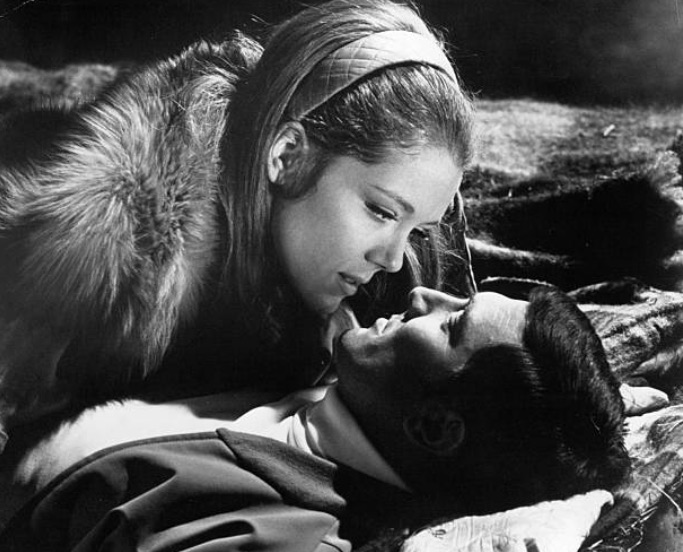
The parallel is almost perfect. Eddie, played by an actor repeatedly mentioned as a possible James Bond, looks impeccable in a tuxedo, marries a European aristocrat connected to organized crime, and becomes a widower immediately after the ceremony. Like Tracy, Bella is killed by her husband’s enemies at the precise moment when the story appears ready to grant its protagonist a rare chance at happiness.
Guy Ritchie merges Apollonia and Tracy into a single character. Bella begins inside The Godfather and dies inside James Bond. Eddie, meanwhile, combines Michael Corleone’s military background, criminal ascent, and moral degradation with 007’s elegance, tuxedo, and romantic tragedy. The result is extremely effective, but it is not original.
A confession without repentance
Even Eddie’s confession to a priest has been seen before. In The Godfather Part III, Michael confesses to Cardinal Lamberto that he ordered the murder of his own brother. It is one of the rare moments in which he relinquishes control, weeps, and fully acknowledges the horror of his decision.
His suffering does not absolve him. On the contrary, it confirms that Michael understands his own damnation. The entire third film is haunted by his attempt to obtain a redemption that cannot be bought, negotiated, or imposed. He achieved power but lost the family in whose name he always claimed to act.
Eddie recreates the ritual without experiencing the same contrition. His confession contains humor, attitude, and Guy Ritchie’s characteristic irreverence. He lists his sins, but does not appear crushed by them. The scene borrows the imagery of Michael’s Catholic guilt without forcing Eddie to carry the same moral weight.
Michael pays psychologically for becoming Michael Corleone, while Eddie, at least for now, is rewarded for becoming Eddie Corleone.
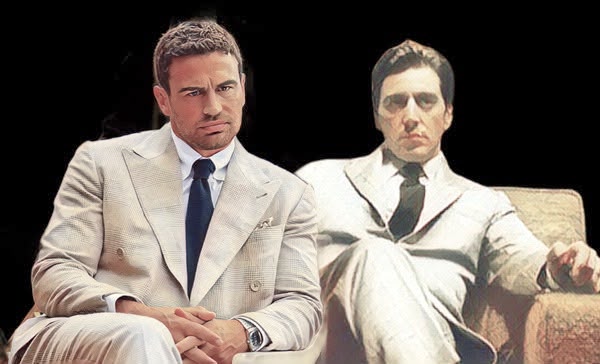
This may be the most important difference between the two works. Coppola transformed Michael’s ascent into a tragedy, while Guy Ritchie still presents Eddie’s ascent as an extraordinarily seductive fantasy. We may question what has happened to his soul, but the series continues to make his cruelty appear elegant, intelligent, and even desirable.
Is it a failure of memory or a lack of culture?
It would be easy to conclude that audiences praise The Gentlemen so enthusiastically. They have forgotten The Godfather, or, worse, because they lack the cinematic knowledge required to recognize its references. I do not think the explanation is either that simple or that fair.
No viewer should be required to recognize films released in 1969, 1972, 1974, and 1990 in order to enjoy a Netflix series in 2026. Cultural memory is not an entrance exam. Besides, even people who have never watched Coppola’s trilogy know Michael and Fredo indirectly. Those characters have been copied, quoted, parodied, and recycled so often that they have become part of our collective imagination.
Perhaps The Gentlemen works precisely because we recognize that architecture without necessarily identifying its source. The decent son who enters the criminal world to protect his family, the resentful older brother, the betrayal from within, the sacrificed wife, the revenge, and the gradual loss of the soul form an emotional structure that cinema tested and consecrated more than half a century ago.
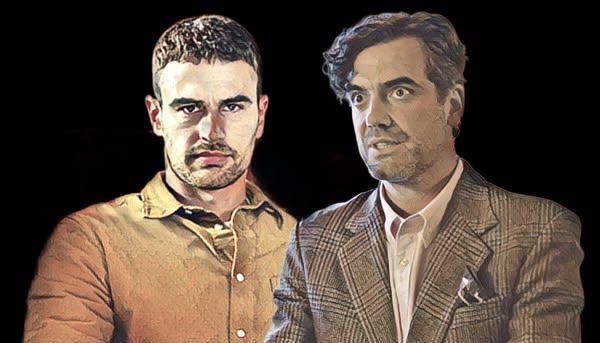
We know that this story works because it has worked before, and it once worked extraordinarily well.
The problem is not that viewers enjoy seeing it again. The problem is that part of the critical reception treats Eddie’s journey as an astonishingly original evolution when it is, to a considerable extent, an evolution that has already been written, filmed, and transformed into a cultural reference.
What, then, is Guy Ritchie’s achievement?
Guy Ritchie’s achievement is real, but it must be placed in the correct category. He is an instantly recognizable visual author, and the series bears all his signatures: the editing rhythms, music, black humor, choreographed violence, colors, tailoring, eccentric criminals, and almost fetishistic pleasure in masculine codes of power.
He also performs an intelligent cultural translation. The Italian American Mafia is replaced by the British aristocracy, bringing together two systems sustained by inheritance, territory, surnames, obedience, and silence. Eddie does not merely inherit an estate or a title. He inherits a power structure in which legal privilege and organized crime coexist perfectly.
There is also Susie Glass, the character who prevents Eddie from occupying the center of the story alone. She is not Kay, Apollonia, or Connie. She has her own project of power, understands the game better than almost every man around her, and begins building an operation independent of both her father and Eddie. Perhaps Susie is where The Gentlemen finds something less dependent on Coppola.
Ritchie’s merit therefore lies in appropriation, synthesis, and execution. It lies in combining Michael Corleone, James Bond, and the British aristocracy inside an irresistible contemporary package. He knows exactly which masculine myths still work and how to introduce them to a new generation, but he cannot claim originality for the journey itself.
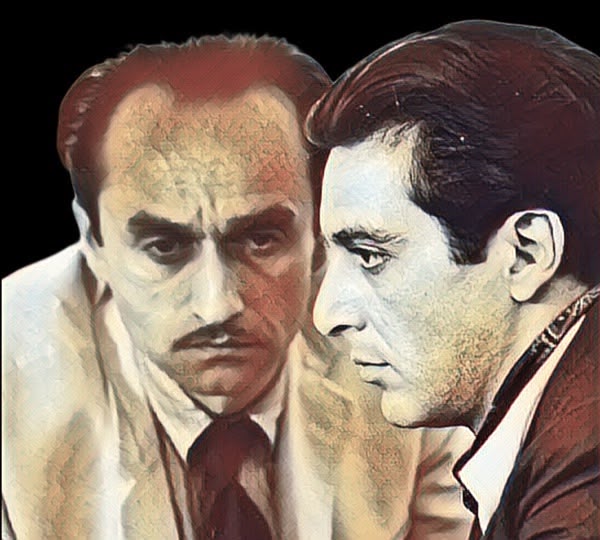
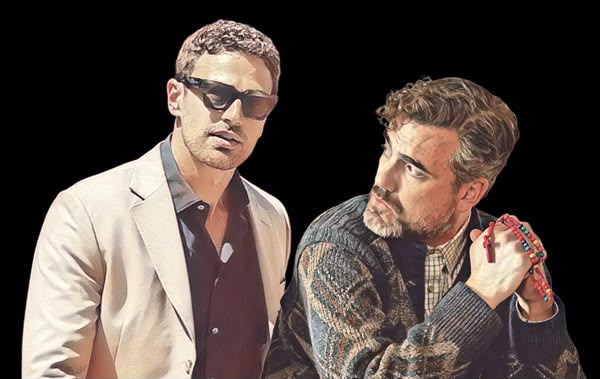
The second season of The Gentlemen is very good, and it may even be the best thing Guy Ritchie has made in some time. A considerable part of its power, however, still belongs to Francis Ford Coppola, Mario Puzo, Ian Fleming, and Peter Hunt.
Guy Ritchie took everything cinema has already taught us to desire — Michael Corleone, James Bond, the tuxedo, power, family, revenge, crime, and romantic tragedy — and placed it inside a new box. The result is elegant, entertaining, and exceptionally well executed.
Perhaps his greatest achievement is that he repackaged it all with such confidence that many people have called it new when, in reality, it is simply wearing a new suit.
Descubra mais sobre
Assine para receber nossas notícias mais recentes por e-mail.


I’m afraid this is missing the point entirely. Who is claiming Ritchie invented anything here…?
Ritchie himself certainly isn’t claiming that. He makes the parallels crystal clear through episode titles and actual scenes, dialogues and frames taken directly from The Godfather:
Do you renounce Satan?
Sicilians refusing gifts on the day of their daughters’ weddings.
Lady Sabrina pleading in favour of Freddy and kissing Eddie’s hand just like Connie does to Michael when she pleads for Fredo.
Eddie filmed thinking alone at his desk with his hand in front of his mouth in the same position as Michael…
And the list goes on.
Ritchie is in no way trying to pretend he invented this narrative: all the parallels pointed out in this article are a clear tribute to Coppola.
CurtirCurtido por 1 pessoa
Thank you, Reca. Those are excellent additional examples, and I agree that Ritchie is not attempting to conceal the references or claim that he invented this narrative. In fact, the article explicitly mentions that Theo James himself cites The Godfather Part II as a key to Eddie’s transformation and argues that Michael Corleone was consciously placed inside the character.
Where we differ is on what follows from that acknowledgment. Calling something an open tribute establishes intention, but it does not automatically settle the question of artistic merit. When a work borrows not only an archetype but also character names, narrative arcs, dialogue, framing, betrayals, confessions, and specific scenes, it is still valid to ask what the new work transforms, challenges, or adds to the original.
The examples you mention — Lady Sabrina repeating Connie’s gesture, the wedding customs, the episode title, and Eddie framed like Michael — reinforce how deliberate and extensive the homage is. They do not contradict the article’s argument; they make its central question even more relevant. At what point does a tribute become a highly accomplished restaging?
I also make clear that the season is very good and that Ritchie’s merit lies in its execution, cultural translation, style, and elements such as Susie’s independent trajectory. My point was never that he was trying to deceive the audience. It was that openly acknowledging a masterpiece does not mean all the power of its recycled narrative suddenly belongs to the person revisiting it.
CurtirCurtir