
There is an apparently semantic debate surrounding Harry and Meghan that, to me, goes far beyond the Royal Family. When a letter authorized by Charles III once again described the couple as private citizens, making it clear that they no longer perform official duties on behalf of the Crown, people close to the Sussexes were quick to point out that Harry and Meghan remain public figures, which at first might sound contradictory, but it is not. Both things can be true at the same time, because one expression refers to notoriety while the other refers to institutional status, and perhaps it is precisely this distinction, so simple in theory, that has become increasingly difficult to understand in practice.
Harry and Meghan are public figures, obviously, because they are internationally recognized, attract press attention wherever they go, generate news, contracts, projects, brands and debate, but they are also private citizens in the institutional sense, because they no longer represent the Crown, do not carry out official engagements on behalf of the king and do not hold a public role within the monarchy. One condition should not cancel out the other, yet in the digital age we have begun to confuse fame with function, visibility with authority and influence with representation, as if simply being heard by millions somehow created a form of legitimacy equivalent to that which comes from holding office, being elected or performing an institutional role.

This confusion, of course, did not begin with Harry and Meghan, because artists have used their notoriety to defend political and social causes for decades, some occasionally, others making activism a central part of their public identity. Sean Penn is an obvious example, as are Mark Ruffalo, Madonna and Roger Waters, all of them artists who, at different times, have used their stage, their fame and their audience to speak about politics, wars, civil rights, the environment, elections and international conflicts. One can agree or disagree with any of them; one can consider certain statements brave, exaggerated, misguided or even irritating, but that has never really been the point, because they have always had the right to speak.
What is newer, and far more curious, is that society has started to expect famous people not only to have the right to express an opinion, but almost to have an obligation to do so, as if an audience came with a permanent moral duty attached. When there is a war, people ask what a certain actor thinks; when there is an election, singers are expected to take a stand; when a humanitarian crisis emerges, celebrities who continue posting travel photos, advertisements, or everyday content without commenting on it can be attacked for remaining “silent,” and silence, which once could simply be silence, has come to be interpreted as a political position, moral failure, or complicity.
I have always found that strange, because someone can become an extraordinary actress without having any obligation to understand geopolitics, a musician can sell millions of records without possessing a particularly sophisticated analysis of a historic conflict, and an athlete can reach the top of a profession and still have no idea how to answer a question about a social issue that divides experts, governments, and entire societies. What leads us to demand answers from these people is, essentially, the fact that they have an audience, and audience, in today’s world, has become a form of power, but the power to influence and actual authority are not the same thing, even if they are increasingly treated as though they were.
I certainly do not believe artists should stay silent; quite the opposite, because the visibility of a celebrity can often draw attention to important causes, raise money, expand debates, and mobilize people in ways traditional campaigns might not, and there is also a long history of serious, consistent, and sincere activism among artists. The problem begins when we confuse the right to use a megaphone with the idea that owning that megaphone automatically turns the person speaking into an authority on everything they choose to discuss, because Mark Ruffalo can talk about politics, Sean Penn can talk about wars, Roger Waters can turn his shows into political statements, and Madonna can support candidates, while I still retain the right to listen to them, disagree with them, and remember that fame does not automatically make an opinion more qualified.
The fact that someone is known by millions of people does not mean that person represents those millions, just as having a huge number of followers does not turn followers into voters, engagement into legitimacy, or popularity into a mandate. Fame grants an audience, and that is no small thing, but it still does not grant public office or institutional authority, and perhaps this distinction has become harder to see because the very idea of celebrity has changed so radically over the last few decades.
For much of the last century, fame usually emerged as a consequence of some other activity, because Elizabeth Taylor was famous for being an actress, Frank Sinatra for singing and acting, Muhammad Ali for boxing, and even when their personalities became larger than their professions, there was still a body of work, a career or a talent that had initially brought them into public view. Today, in many cases, exposure itself is the profession, because influencers work with their own visibility, turning routine, marriage, children, travel, personal crises, opinions, consumption and intimacy into content, while followers become currency, engagement becomes commercial value and reach becomes bargaining power.
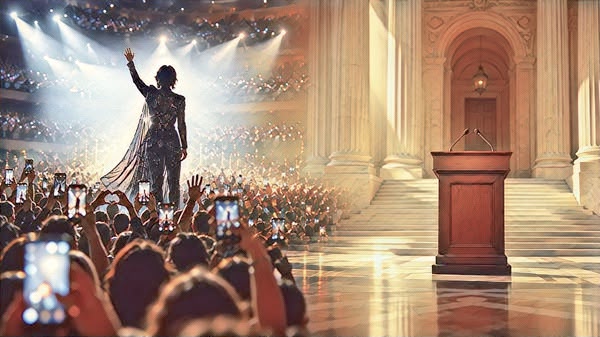
As a result, a category has emerged with a force that perhaps never existed before: someone who can be legally private, professionally public, and socially extremely influential, and it is easy to understand why we have started to become confused by this. Followers begin to look like voters, engagement begins to look like legitimacy, a trending topic starts to resemble a plebiscite, while influence is treated as authority, even though none of these things are actually the same.
And then we arrive at the Royal Family, which may be one of the best examples of this confusion, especially for those watching from outside the United Kingdom. The British monarchy occupies a space that is difficult to classify, because it is a family but also an institution; it is celebrity but also state, it involves glamour, gossip, weddings, clothes and scandals, but also diplomacy, protocol, official duties and institutional representation. In the United Kingdom, this distinction is more natural, because the king, the Prince of Wales and the members of the family who officially work for the monarchy occupy a category of their own within British public life, while outside the country, and especially in the United States, that boundary becomes far more blurred.
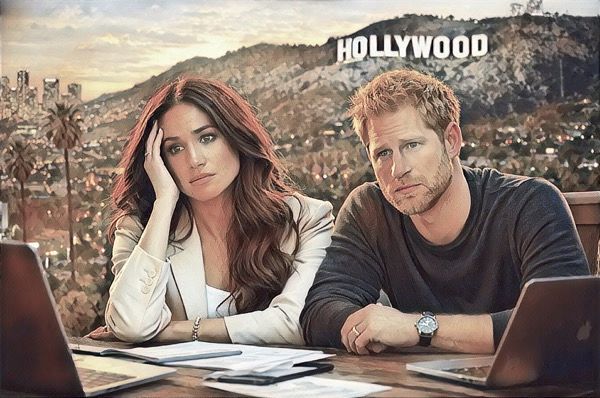
In the United States, the Royal Family often appears in entertainment, celebrity and pop culture coverage, which makes sense in a country with no monarchical tradition of its own and which tends to view kings, princes and dukes through the lens of fame, glamour and scandal. Harry and Meghan make that confusion even greater because they have crossed exactly those two worlds, since Harry was born a prince, grew up inside the institution and performed official duties for years, while Meghan was an actress, then became part of the Royal Family after their marriage and later left those duties with him, moved to California, signed deals with entertainment companies, produced content for platforms, gave interviews, launched projects and began operating in an ecosystem much closer to Hollywood than to Buckingham.
They did not stop being famous, obviously, but they did stop performing that function, and this difference, which seems so simple, may be exactly the part that has become hardest to understand in today’s world. No one should try to deny that Harry and Meghan remain internationally known, continue to be photographed, followed, discussed, and associated with the monarchy through family, history, and title, but notoriety does not recreate an institutional role; just as calling them private citizens does not mean pretending they are anonymous, it simply means they do not represent the Crown.
Perhaps the biggest problem lies precisely in the fact that today the word “private” has come to be confused with “unknown,” when in reality someone can show their home, family, routine, and thoughts to millions of people every day and still be a private citizen in relation to the state, while someone else can carefully protect their personal life, have almost no followers, and hold a public position of enormous responsibility. The digital world has scrambled these boundaries because it has turned intimacy into a product, exposure into a profession, and opinion into content, changing not only the way we communicate, but also the meaning of very old words.
A “friend” no longer has to be someone we know personally, “following” no longer means simply walking behind someone, and “influence” has ceased to be only an abstract quality and has become a profession, so it is not unreasonable to ask whether “public” and “private” have also changed meaning for a generation raised on social media, apps, short videos, livestreams and permanent communication. Perhaps that language change has also altered our perception of power, because today there seems to be a growing expectation that anyone with an audience must take a position on every issue, as if reach were synonymous with institutional responsibility.
Sometimes this may indeed be social responsibility, but at other times it may simply be the result of a system that has turned opinion into content, because platforms reward positioning, outrage, certainty, conflict, and constant participation. Saying “I do not know enough about this to comment” may be one of the most honest answers available, but it is also one of the least valued in an environment where silence means lost engagement and a lack of positioning quickly becomes suspicious.
The problem, then, was never that celebrities speak, because they can speak, should speak whenever they want to, and can use their visibility however they choose, but it is important not to confuse that with representation. A member of parliament owes answers on certain issues because that person was elected; a minister must account for decisions because they hold office; a head of state has institutional duties, while an actor, a musician, an influencer, or a celebrity does not automatically acquire any of those obligations simply because millions of people follow what they do.
We can listen to them, admire them, criticize them, agree with them, or change our minds after hearing them, but that still does not create a mandate. Social media may have changed our language, our relationships, our perception of intimacy, and even our definition of fame, and it may have created new forms of power that we are still learning how to understand, but I hope one distinction continues to survive, because being heard by millions does not mean speaking for millions, and fame, influence, and public office remain very different things.
Descubra mais sobre
Assine para receber nossas notícias mais recentes por e-mail.

